
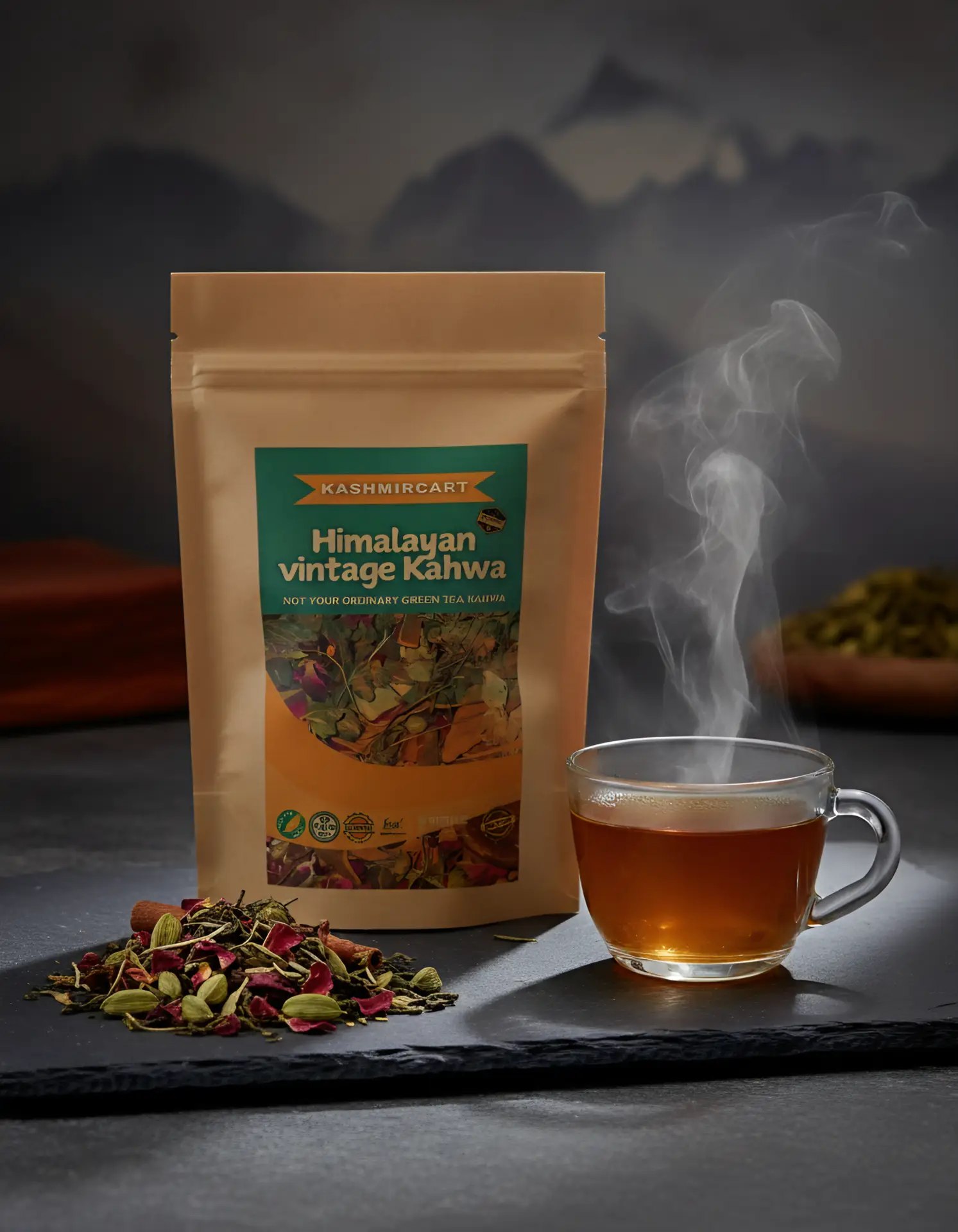
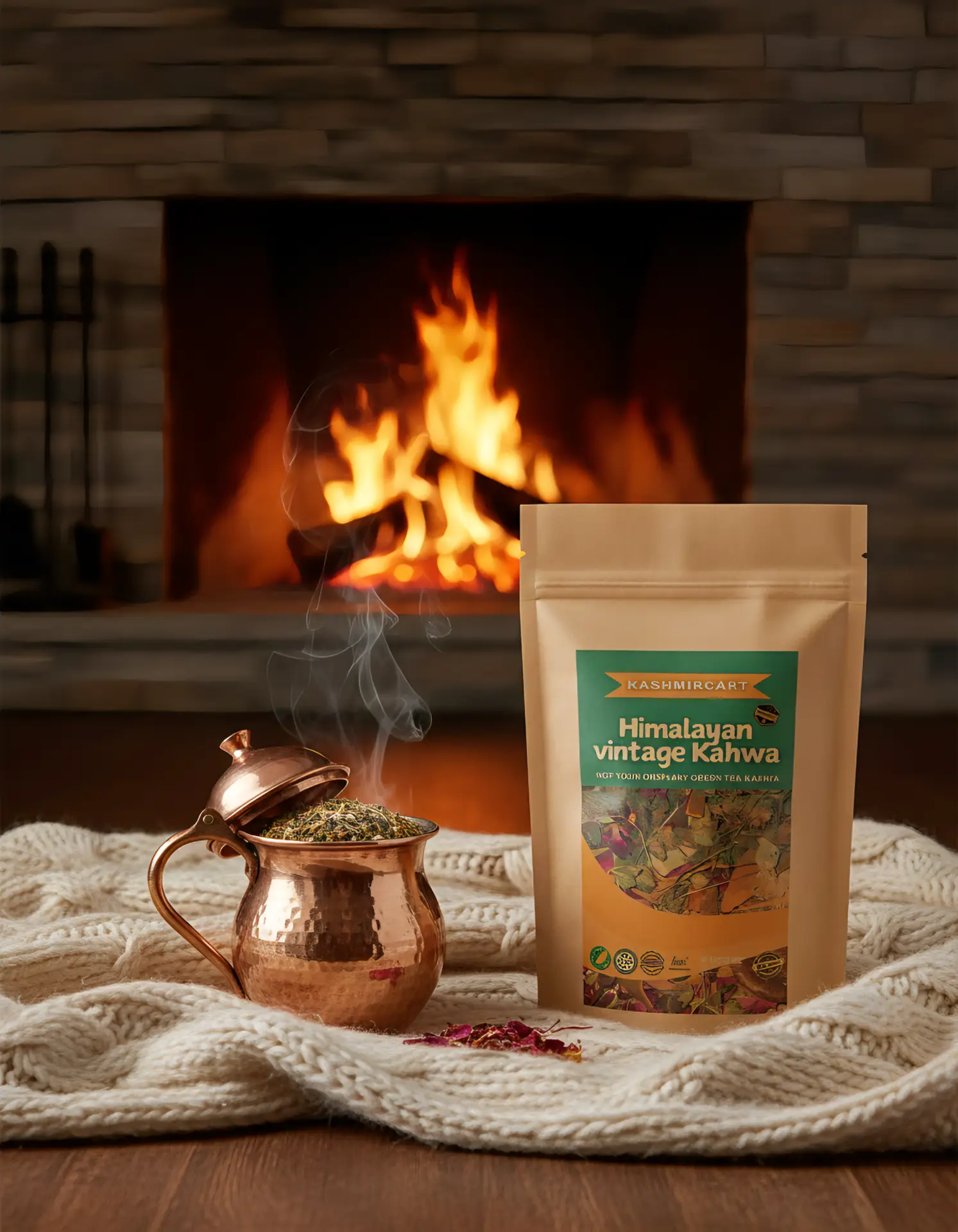
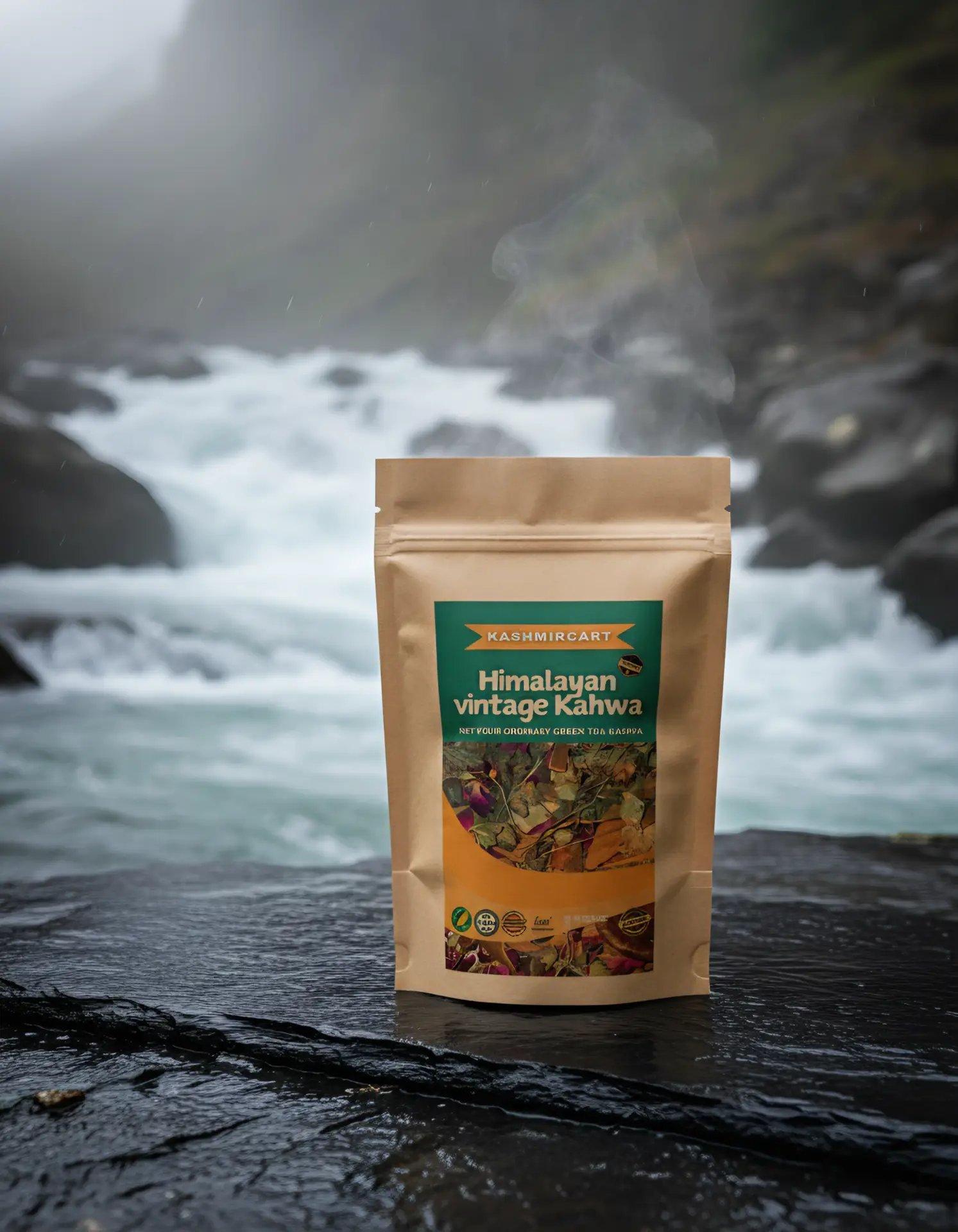
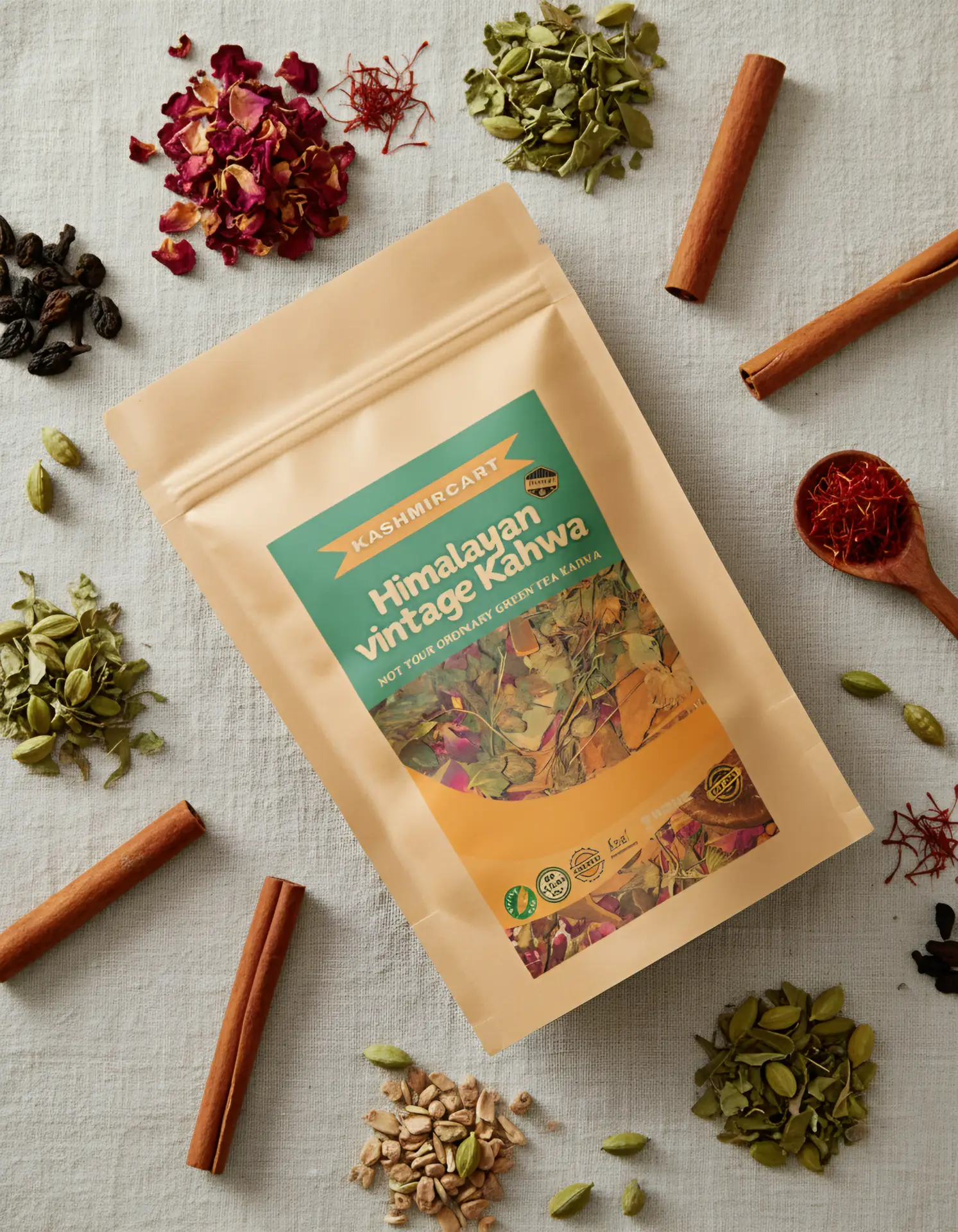
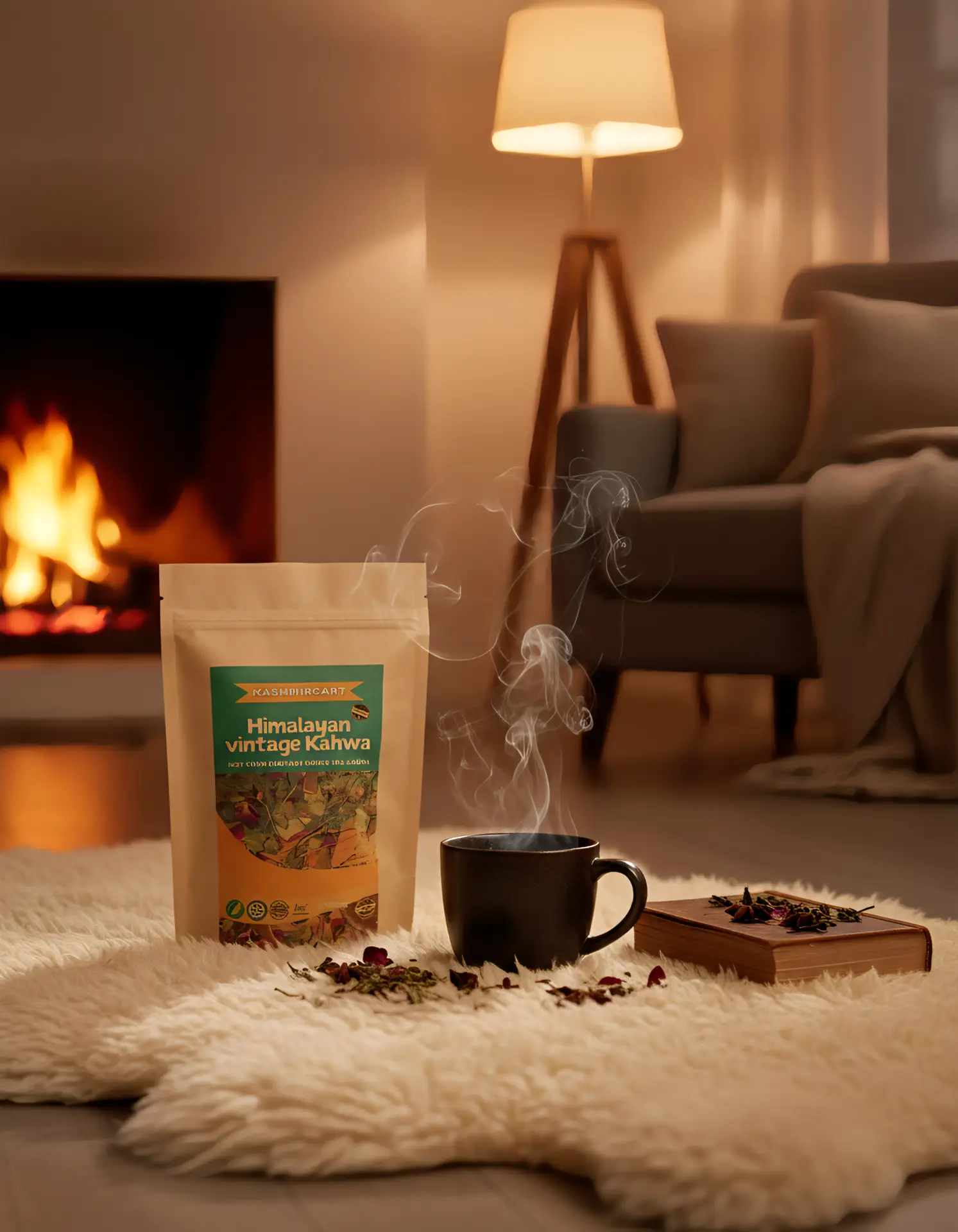
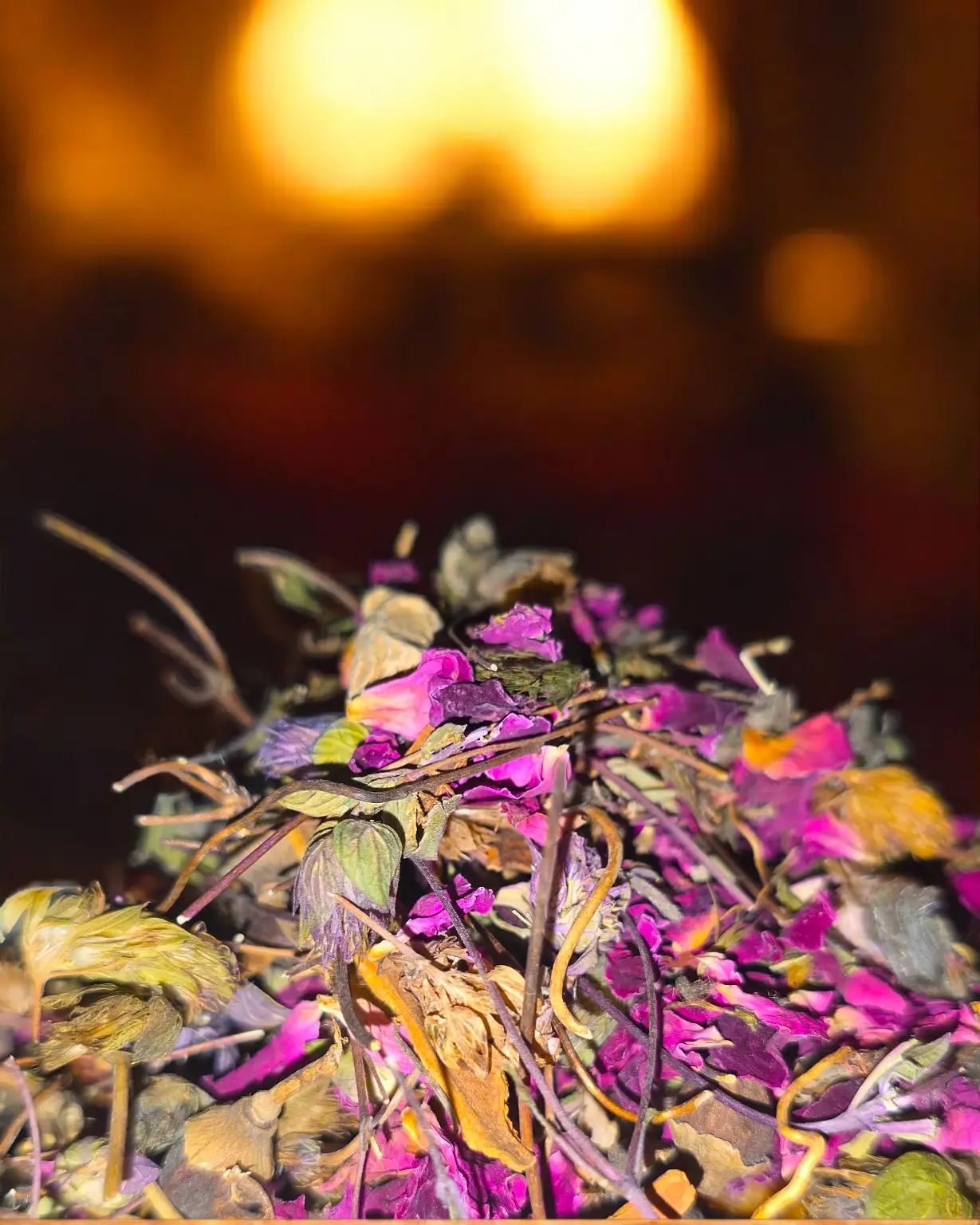
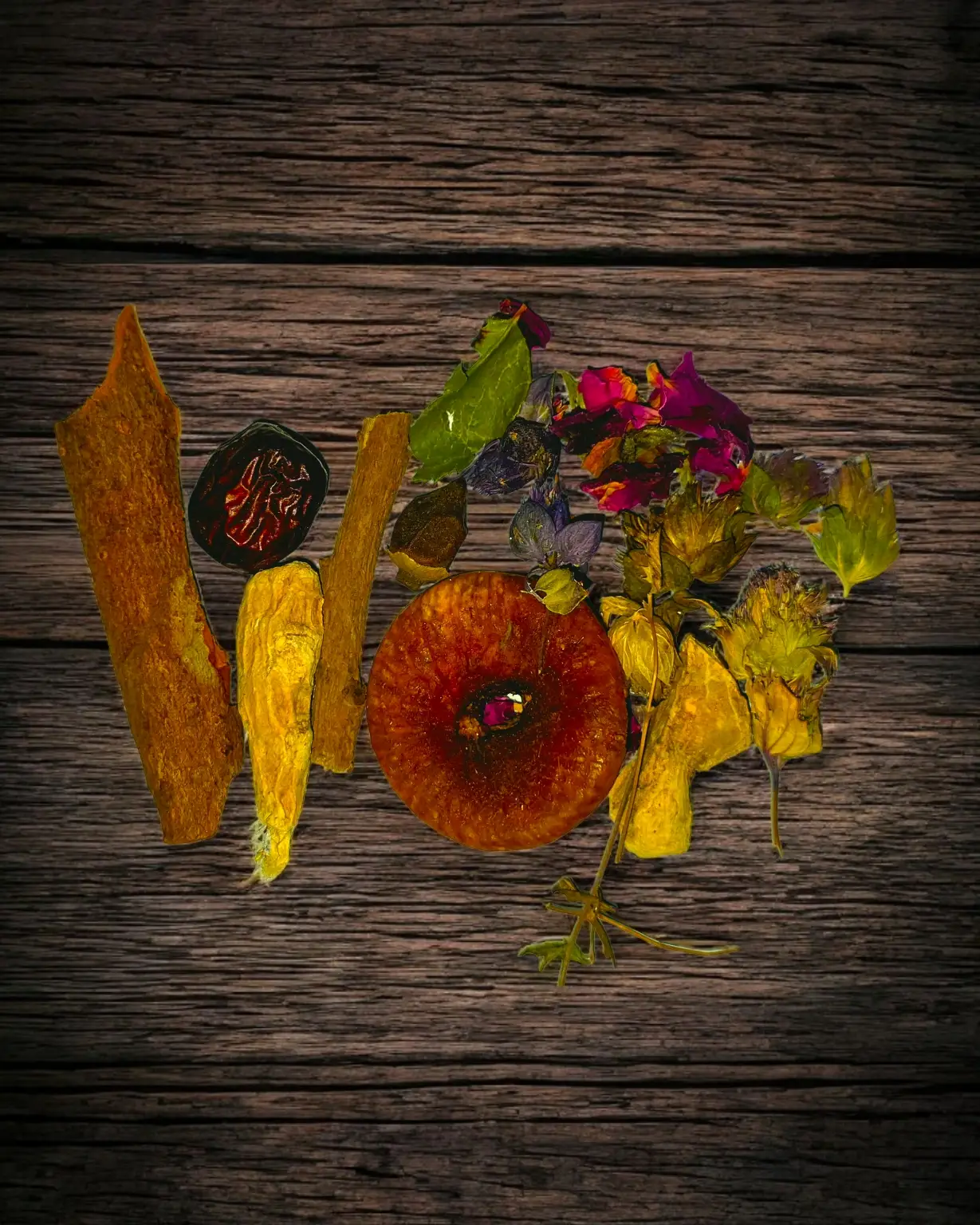
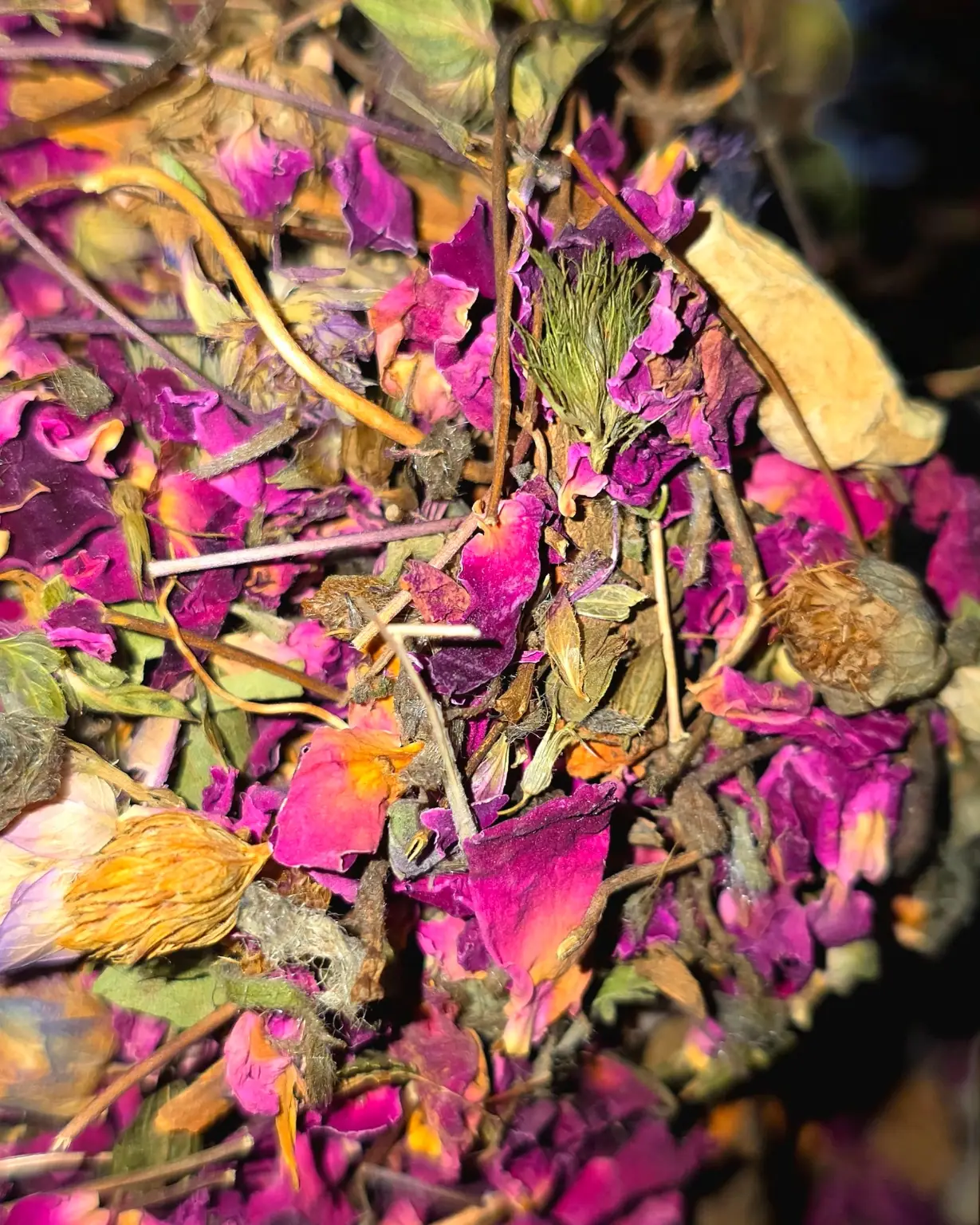
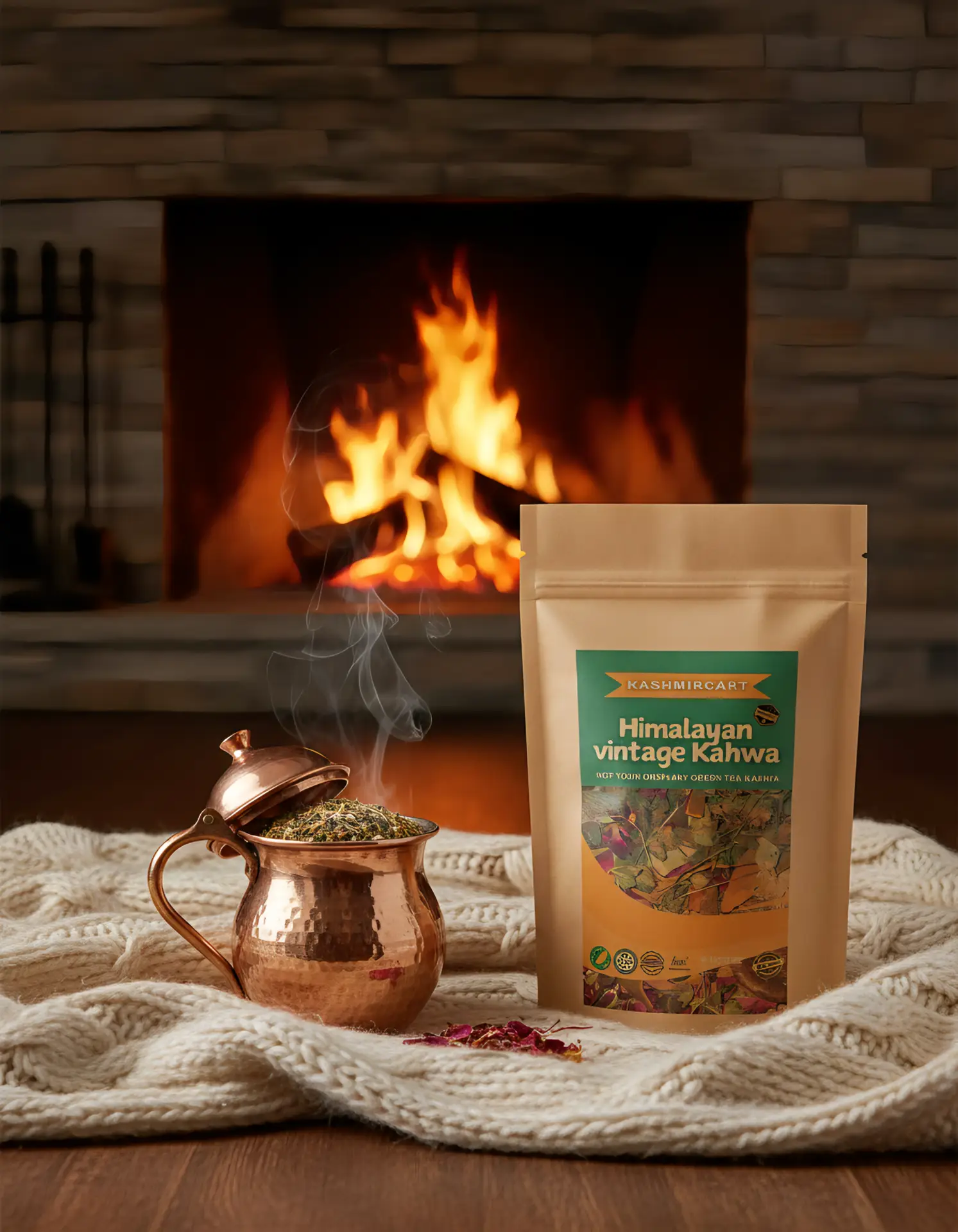


Himalayan Vintage Kahwa Heritage botanical blend
A heritage of botanicals. A cup from the Himalayas.
A 260 g botanical blend of twelve listed herbs, spices and fruits from KASHMIRCART. It keeps the warmth and ritual of a Kashmiri kahwa cup, yet its published formula contains no green tea and no Camellia sinensis leaf.
- 260 g pack
- No green tea listed
- Brew, simmer, strain
- Kashmir
What it is: the product listing describes a caffeine-free botanical infusion made without green tea. The blend's caffeine content and the identity of every botanical have not been independently verified for this editorial guide, so we qualify the relevant details below. The physical pack remains authoritative.
notes
Kashmir
- Net quantity
- 260 g As listed on the product page
- Ingredients named
- Twelve Botanical names as published
- Green tea
- None listed No Camellia sinensis in the published formula
- Published method
- 1 tsp : 2 cups Preparation ratio, not a dosage
01 · Understanding the cup
Not a green-tea kahwa. Still a deeply Kashmiri ritual.
The word kahwa usually brings green tea to mind. Himalayan Vintage Kahwa asks a different question: what happens when the cup is built from a wider botanical palette, and the tea leaf is left out? The answer is not a imitation of green-tea kahwa. It is its own aromatic infusion.
The direct answer
Himalayan Vintage Kahwa is a 260 g packaged blend of twelve listed botanicals, herbs, spices and dried fruits, sold by KASHMIRCART as a botanical infusion. The published formula contains no green tea. It is prepared by simmering approximately one teaspoon of the blend in two cups of water for around five minutes, then straining and serving warm.
Conventional Kashmiri kahwa
In Kashmir, kahwa is commonly a green-tea preparation built with warming aromatics. Recipes differ from one household to another, and there is no single “standard” family recipe.
- A base of green tea leaves from Camellia sinensis.
- Commonly cardamom, cinnamon and saffron, with slivered nuts served in the cup.
- A tea-based drink, so it naturally contains caffeine from the tea leaf.
- Brewed, simmered or assembled according to household custom and the samovar at hand.
Himalayan Vintage Kahwa
A twelve-ingredient botanical composition, described by the listing as caffeine-free and made without green tea or artificial flavouring. Its character comes from spices, flowers, fruit, roots and herbs rather than a tea leaf.
- No green tea in the currently published ingredient statement.
- Herbal, floral, warm and spiced in direction, according to the listing.
- Prepared as a simmered infusion: measure, simmer, strain, serve warm.
- A contemporary formulation inspired by the culture of kahwa — not presented here as an ancient, unchanged recipe.
A word about “vintage”
“Vintage” is the product name. The published listing does not state that these botanicals are aged, fermented or matured, and this guide makes no such claim. The word should be read as part of the formulation's identity, not as a verified ageing process.
Why we call it an infusion
India's food regulator, FSSAI, has clarified that only products from the tea plant, Camellia sinensis, may be described as tea; plant-based infusions fall under a different framework. We therefore use “botanical infusion” and avoid positioning this product as a herbal tea.
02 · The botanical collection
Twelve listed botanicals. One field sheet.
The current product page names twelve ingredients. Some are closely familiar; one is published only by a traditional name. This explorer separates what the listing tells us from what still needs confirmation, without inventing flavour notes or botanical identities.
Showing all 12 listed ingredients. The listing does not publish their proportions.
Arnebia
Arnebia benthamii (Wall. ex G.Don) I.M.Johnst.
A high-altitude western Himalayan species in the borage family, associated with red shikonin pigments in its roots. The genus includes several other species, and related root material can be traded under broad names such as ratanjot; this listing specifies A. benthamii, not a related Arnebia. It appears in ethnobotanical and Unani literature. The listing does not state the plant part used.
- In the cup
- No verified tasting note is available for this blend. Plant part and quantity are not published.
- Listing note
- The name is specific, but identity and composition have not been independently authenticated here.
Licorice
Glycyrrhiza glabra L.
The sweet root of a legume, containing glycyrrhizin. That compound explains both licorice's characteristic sweetness and the important cautions that accompany it. Its concentration in this blend is not published.
- In the cup
- Sweet and anise-like, with a woody, lingering sweetness typical of licorice root.
- Traditional note
- A long-used flavouring and botanical. Traditional use is not evidence that this product treats any condition.
Contains licorice. Read the licorice and medication cautions before deciding.
Cordia
Cordia dichotoma G.Forst.
A South Asian tree also known as lasoda, Indian cherry or glue berry. Its fruit and gum have food and traditional-use histories in the region. The listing does not identify which plant part is in this blend.
- In the cup
- The listing does not publish a tasting note for this ingredient, so none is asserted here.
- Listing note
- Part, grade and proportion are not stated. The card illustration is botanical, not a depiction of the packed ingredient.
Ginger
Zingiber officinale Roscoe
The knobby, aromatic rhizome of a reed-like tropical plant. Ginger is a familiar culinary spice in Kashmiri and wider South Asian kitchens and is used fresh, dried or ground.
- In the cup
- Warm and pungent, with a bright, lingering heat. Quantity in the blend is not published.
- Listing note
- Dried or fresh material is not specified on the listing; dried ginger is typical in blends.
Damask rose
Rosa damascena Mill.
Grown for its fragrant petals and used in floral waters, sweets and aromatic preparations across South Asia, West Asia and beyond. The listing does not state the form or grade of rose used.
- In the cup
- Softly floral and sometimes honeyed. Petals can naturally vary in aroma from one harvest to another.
- Listing note
- Dried petals are indicated by the name, but the listing does not specify plant part or quantity.
Fig
Ficus carica L.
The edible fruit of the fig tree. Dried figs are sweet, chewy and full of fine seeds, and are eaten as a pantry fruit or used in sweet and savoury cooking. The listing does not say how the fig is prepared.
- In the cup
- Dried-fruit sweetness is expected; the listing does not publish a formal tasting note.
- Listing note
- Whole, chopped or another preparation is not stated. Nor is the proportion used.
Raisins
Vitis vinifera L.
Grapes preserved by drying. Raisins are a common pantry ingredient in South Asian sweet and savoury dishes, contributing concentrated fruit sugar and texture of their own.
- In the cup
- Concentrated, dark-fruit sweetness is typical. The listing does not quantify how much is used.
- Listing note
- “Raisins” is given as the common name alongside the grape species; variety and origin are not listed.
Badgan-e-Khafaye
No binomial published
Botanical identity to be confirmedThe listing publishes this traditional name without a botanical binomial. Similar-sounding regional plant names can refer to different species, and KASHMIRCART's own journal has described a “Khafaye blend” as a multi-herbal composite. We have therefore not substituted a species or invented a plant description.
- In the cup
- Not described, because the ingredient's botanical identity is unconfirmed.
- Please note
- Do not identify or brew a plant from this name alone. Use the pack declaration and ask the manufacturer for the verified botanical identity.
Hyssop
Hyssopus officinalis L.
A small aromatic plant with narrow leaves and spikes of violet-blue flowers. Hyssop has a culinary and traditional-use history around the Mediterranean, West Asia and Europe, typically in modest amounts.
- In the cup
- A pointed, herbal, somewhat bitter aroma with a mint-adjacent character. Exact proportion is unpublished.
- Listing note
- Name given as Hyssop; leaf, flower and quantity are not specified.
Ceylon cinnamon
Cinnamomum zeylanicum Blume
Accepted name: Cinnamomum verum J.Presl
The dried inner bark of the Ceylon cinnamon tree. The listing uses the older synonym C. zeylanicum. True Ceylon cinnamon is distinct from cassia, a different Cinnamomum species sold as cinnamon in many markets.
- In the cup
- Warm, sweet and finely woody, generally gentler than cassia. Quantity is not published.
- Listing note
- Ceylon cinnamon is named; whether bark, quill or powder is used is not stated.
Tulsi
Ocimum tenuiflorum L.
An aromatic herb in the mint family, also called holy basil. Tulsi is culturally significant across India and has a long place in Ayurvedic tradition. The listing does not identify a particular variety or plant part.
- In the cup
- Clove-like, aromatic and sometimes peppery, with a herbaceous finish.
- Traditional note
- Traditional use is part of tulsi's cultural story; it does not establish a clinical effect for this blend.
Jujube
Ziziphus jujuba Mill.
The fruit of a small tree, eaten fresh in season and commonly dried. Dried jujubes are sweet and chewy, with a flavour often described as lying between date and apple. They are used in sweet and savoury preparations in parts of Asia.
- In the cup
- Dried-fruit sweetness with a faint tartness. Variety, cut and quantity are not published.
- Listing note
- The species is named; the listing does not specify whether the fruit is whole, sliced or dried before blending.
How to read this collection. Plant names reproduce the current published ingredient list and accepted-name notes. Listing an ingredient does not imply that it dominates the flavour, that all twelve are present in equal quantities, that KASHMIRCART grew all of them, or that the blend has any therapeutic effect. Proportions and plant parts are not published.
03 · The art of botanical infusion
A slow cup, in four quiet steps.
This is the method published on the current product page: roughly one teaspoon of the blend for two cups of water, a gentle boil of around five minutes, then straining. It is a culinary preparation, not a dosage schedule.
-
01
Measure into fresh water
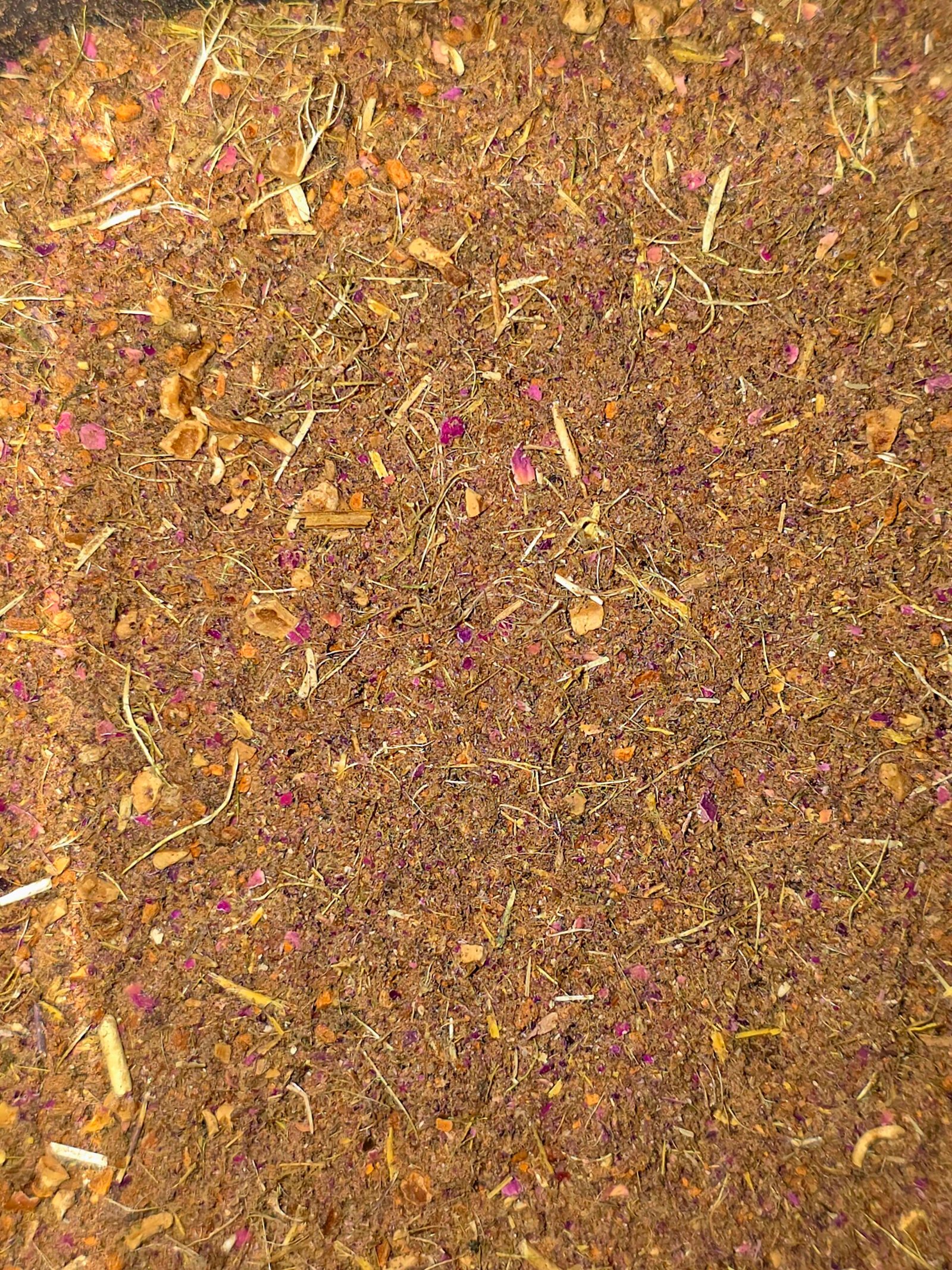
Use approximately one teaspoon of the coarse botanical blend for two cups of fresh water. Use a clean, dry spoon and keep steam and moisture out of the pack while it is open.
-
02
Bring to a gentle boil
Place the blend and water together in a saucepan and bring to a boil, then continue gently. The listing suggests around five minutes; it does not state a thermometer reading or extraction target.
-
03
Strain carefully
Switch off the heat and strain the hot infusion to remove the botanical pieces. A fine sieve is useful. Keep hands and faces away from the steam and pour slowly into a stable cup.
-
04
Serve warm
Pour and serve warm. The listing suggests honey may be added after preparation if you prefer sweetness. Taste unsweetened first if you want to meet the botanicals before adding anything.
- StartMeasure the blend
- HeatBring to a boil
- Around 5 minGentle simmer
- To serveStrain & pour
Label first. This guide follows the current online listing. The listing does not publish a roasting or grinding step, and we have not made either mandatory. If the physical pack gives different quantities, timings or preparation instructions, follow the pack.
Prepare a batch and serve warm. No verified daily serving frequency is published.
The listing does not specify water temperature beyond bringing the blend and water to a boil, nor a number of cups supplied per 260 g pack. This guide does not invent either.
04 · Aroma, flavour and the cup
Warm spice. Floral lift. A herbaceous depth.
No independent tasting panel was available for this guide. What follows is a sensory direction drawn from the current listing's own description and the known character of the listed ingredients — an expectation to discuss, not a promise that every batch will taste the same.
- Aroma
- Warm spice, dried fruit and a floral lift are the expected threads. Hot water can carry rose and cinnamon aromas quickly; ginger's brightness tends to sit underneath.
- Flavour direction
- The current listing describes a herbal, floral, warm and spiced profile. Tulsi and hyssop may supply the herbal register; rose the floral; ginger and cinnamon the warmth. Relative quantities are unpublished, so balance is genuinely unknown.
- Sweetness
- Licorice, figs, raisins and jujube can contribute natural sweetness. The listing does not state added sugar. Taste before sweetening; if you use honey, add it after preparation and according to your own diet.
- Colour
- No measured colour is published. Rose, dried fruit and cinnamon might suggest a warm amber-to-rosy cup, but steeping time, grind and plant proportions can shift that considerably. Judge your own prepared cup.
- Finish
- Expect a lingering spice note and a herbal finish. Hyssop can read slightly bitter; tulsi can feel clove-like. These are general ingredient characteristics, not a verified description of this exact blend.
- Batch variation
- Dried plant material is an agricultural ingredient. Colour, aroma and the visible ratio of pieces can vary naturally between batches; the product listing itself acknowledges this.
- Herbal depth
- Warm spice
- Rose petal
- Dried fruit
- Sweet root
- Dry finish
Sensory words are expectations, not laboratory descriptors. The only flavour direction attributed to the maker in this guide is the phrase “herbal, floral, warm and spiced” from the current listing. Individual experience and batch expression may differ.
05 · The Kashmiri connection
A warm cup is a way of making room for someone.
In Kashmir, the ritual of serving a warm drink is woven into hospitality, winter gatherings and the pleasure of receiving guests. A samovar — with its hot water, small cups and unhurried pouring — belongs to that familiar culture of welcome. The details differ from home to home; the gesture does not.
Traditional kahwa is closely associated with green tea, often layered with saffron, cardamom and cinnamon and finished with slivers of nuts. Its exact origins are debated, and household recipes vary. What is clear is that the drink has become one expression of a wider Kashmiri culture of warmth and generosity.
This twelve-botanical blend does not replicate that green-tea recipe. It borrows the ritual — a warm cup, an aromatic steam, the pause of offering it to someone — and takes it in a botanical direction. That distinction matters both culturally and in the cup.
Keep the welcome. Change the leaf. KASHMIRCART editorial field note
06 · A clear comparison
Two warm cups, two different foundations.
This is not a ranking. It is a practical guide to the difference between the green-tea preparation most people mean by Kashmiri kahwa and the botanical blend published here.
| Feature | Conventional Kashmiri kahwa | Himalayan Vintage Kahwa |
|---|---|---|
| Base | Green tea from Camellia sinensis is typical. | Twelve listed botanicals; the published formula lists no green tea. |
| Caffeine | Naturally present from the tea leaf; amount depends on leaf, quantity and brewing. | The listing describes it as caffeine-free. This has not been independently tested for this guide; confirm on the final pack. |
| Composition | Green tea with aromatics such as cardamom and cinnamon; saffron and nuts are common but not universal. | Arnebia, licorice, Cordia, ginger, rose, fig, raisins, Badgan-e-Khafaye, hyssop, Ceylon cinnamon, tulsi and jujube. Proportions are unpublished. |
| Preparation | Varies by household; typically brewed or simmered, then sweetened and served with nuts. | Published method: approximately 1 teaspoon per 2 cups of water, boil for around 5 minutes, strain and serve warm. |
| Cup character | Tea-based, aromatic and often golden from saffron. | Botanical and aromatic; the listing describes a herbal, floral, warm and spiced direction. No measured colour or flavour standard is published. |
| Identity | A long-associated Kashmiri green-tea preparation with many household interpretations. | A contemporary botanical formulation inspired by the culture of kahwa. It is not presented as an ancient, unchanged twelve-ingredient recipe. |
We make no claim that this product is superior, more powerful or more authentic than conventional kahwa. “Vintage” is a product name; no ageing process is published. FSSAI's recent clarification also means we do not call this green-tea-free infusion a “tea”.
07 · Botanical knowledge and science
A botanical name is not a health promise.
Ingredients can be described factually without turning a cup into a treatment. Here is the distinction this guide uses: what plants contain and how they have been used are not the same as proving what drinking this finished blend will do.
What we are — and are not — saying
This product is presented as a traditional-style botanical beverage, not a medicine, supplement or therapeutic formulation. We do not claim that it treats, prevents, cures or manages PCOD, hormonal imbalance, respiratory or digestive disorders, metabolic disorders or any other medical condition.
We also make no detoxification, fat-loss, immunity or skin-radiance claims. The listing supplies no clinical evidence for this finished twelve-ingredient blend, and traditional use alone cannot establish clinical effectiveness.
Why no “antioxidant score”?
Laboratory measurements of plant extracts cannot be converted into a health promise for a brewed cup. Extraction solvent, dose, plant part and preparation all matter. Without measured data for this blend, a numeric antioxidant or “wellness” score would be invented.
- 01 · Food compositionGinger rhizome contains pungent gingerols; cinnamon bark contains aromatic compounds; licorice root contains glycyrrhizin; figs, raisins and jujube contain sugars and other fruit components. These are composition facts, not effects of the finished drink.
- 02 · Traditional useSeveral listed botanicals have long histories in South Asian kitchens and in Unani or Ayurvedic traditions. Traditional use does not prove efficacy, safety for everyone, or the quality of a modern preparation.
- 03 · Laboratory and animal researchStudies exist for various extracts, fractions and isolated compounds, including extracts of Arnebia and licorice. Such research does not show that a brewed twelve-botanical infusion produces the same outcome in people.
- 04 · Human clinical researchSome individual ingredients or extracts have been studied in humans, often at doses and in preparations unlike a cup of this blend. No product-specific clinical research was supplied with the listing, so no health outcome is claimed here.
What remains to be verified: the blend's caffeine content, allergen declaration and the botanical identity of Badgan-e-Khafaye. Those details should be confirmed against the manufacturer's current pack before they are treated as settled facts. The composition list, published preparation method and absence of green tea are the clearest points the listing does establish.
08 · How to enjoy it
Make the cup fit the moment.
These are serving ideas, not a consumption schedule. No verified daily frequency is published for this product, and the one-teaspoon-to-two-cups instruction is a preparation ratio rather than a recommended intake.
An evening cup
Serve it warm and unsweetened while the evening slows down. The absence of green tea in the listed formula makes it a different ritual from a tea-based kahwa.
A morning botanical
Brew a fresh batch to begin the day with a warm, aromatic drink. It is not a substitute for breakfast, water or any prescribed routine.
The guest cup
Kahwa is associated with hospitality. Offer a warm cup by all means, but mention that the blend includes licorice so each guest can make an informed choice.
A cold-weather warmer
Let the ginger and cinnamon lead in a warm winter cup. This is a sensory suggestion, not a claim that the drink warms, protects or treats the body beyond a normal hot beverage.
Try it without sweetener
Taste before adding anything. Licorice, fig, raisins and jujube may bring their own sweetness. The listing suggests honey as an option after preparation, not as a requirement.
A simple pairing
A few plain nuts, a dried fig or a simple biscuit can sit alongside the cup without competing with its aromatics. Check any snack's own allergen declaration.
No daily target. This guide does not recommend a cups-per-day amount, a “detox” period or a course of use. The label and a qualified healthcare professional are the right references for individual circumstances — particularly because the blend contains licorice and the blend's glycyrrhizin exposure is not published.
09 · Ingredient and safety transparency
Read this before you brew.
General information, not medical advice or a personal risk assessment. It sets out the most important known cautions for the listed ingredients while being clear about what the product page does not tell us.
This blend lists licorice root (Glycyrrhiza glabra).
Licorice contains glycyrrhizin. Large or prolonged intakes can raise blood pressure, lower blood potassium and cause fluid retention; low potassium can contribute to irregular heart rhythm. Even relatively modest amounts have been linked to serious effects in some people, especially those with high blood pressure, heart or kidney problems, or a high-salt diet. The glycyrrhizin concentration and serving exposure from this blend are not published, so this guide cannot calculate a “safe” cup size, amount or frequency.
Who should take particular care
Ask a qualified healthcare professional before using this product if any of the following applies — or if you are unsure:
- You have high blood pressure or a high-salt diet.
- You have heart, kidney or other ongoing medical conditions.
- You have had low potassium, fluid retention or an irregular heartbeat.
- You are pregnant, trying to conceive or breastfeeding.
- You take regular medication, including medicines for blood pressure or the heart.
This list is not exhaustive. The absence of a condition from this list does not mean the blend is automatically suitable for you.
Medicines and licorice
Licorice can interact with medicines that affect blood pressure, fluid balance or potassium. Particular care is advised with:
- Some diuretics, especially those that lower potassium.
- Digoxin and other medicines used for heart rhythm.
- Some blood-pressure medicines.
- Corticosteroids and other medicines that affect potassium or fluid balance.
This is general information, not a complete interaction list. Speak to your doctor or pharmacist before drinking the infusion if you take prescription medicine, including anything not named here.
Pregnancy and breastfeeding
The suitability of this specific twelve-ingredient blend in pregnancy or breastfeeding has not been established, and the listing does not publish an exposure assessment. Because licorice contains glycyrrhizin, authoritative guidance advises limiting high-glycyrrhizin licorice during pregnancy. We cannot describe this product as suitable in pregnancy or breastfeeding; seek professional advice first.
Children and age suitability
No verified age recommendation or paediatric safety assessment is published for this product. This guide does not repeat a “suitable from age 5” recommendation and cannot establish suitability for any age group. Do not give the infusion to a child on the basis that it is “herbal”; ask a qualified healthcare professional about the individual child first.
Allergen and sensitivity information
A manufacturer's full allergen declaration was not available in the published listing. The blend contains multiple plant materials, including licorice, ginger, cinnamon, tulsi and other mint-family material, rose, hyssop, fig, grape, jujube, Cordia and Arnebia, plus an ingredient whose botanical identity is unconfirmed. If you have known allergies or sensitivities, review the physical label and check with the manufacturer. This description does not certify the blend as allergen-free or free from cross-contact.
If you feel unwell
Stop using the product and seek appropriate medical advice if you experience unusual weakness, muscle cramps, swelling, palpitations, dizziness or another concerning symptom after consuming it. Do not attempt to self-treat a possible reaction. This is not a complete list of possible adverse effects.
Full ingredient list as currently published
Arnebia benthamii; Glycyrrhiza glabra (licorice); Cordia dichotoma; Zingiber officinale (ginger); Rosa damascena (rose); Ficus carica (fig); Vitis vinifera (raisins); Badgan-e-Khafaye; Hyssopus officinalis (hyssop); Cinnamomum zeylanicum (Ceylon cinnamon); Ocimum tenuiflorum (tulsi); Ziziphus jujuba (jujube).
Plant parts, proportions and the botanical identity of Badgan-e-Khafaye are not published in the listing. Always read the physical pack for the manufacturer's final ingredient declaration, allergen statement, storage advice, licence details and any warnings.
| Point | What the published listing says | Status in this guide |
|---|---|---|
| Net quantity | 260 grams. | Stated |
| Green tea | The current formulation lists no green tea or Camellia sinensis. | Verify pack |
| Caffeine | Described as a caffeine-free botanical infusion. | Not independently tested |
| Artificial flavouring | Described as made without artificial flavouring. | Verify label |
| Preservatives and additives | No added preservatives are declared in the description. | Verify label |
| Plant parts and proportions | Not published. | Ask maker |
| Badgan-e-Khafaye | Traditional name only; no botanical binomial. | Identity pending |
| Glycyrrhizin exposure | Not published. | No quantitative conclusion |
| Allergen declaration | Not available in the published description. | Check pack |
| Age and pregnancy suitability | No verified recommendation published. | Not claimed |
| FSSAI category and licence | Not established by the product description reviewed. | Check pack |
| Ingredient farming origin | Not stated for each botanical; not all represented as company-grown. | Do not assume |
Main references for the licorice caution: NCCIH, “Licorice Root: Usefulness and Safety” ↗ and the US FDA consumer update on black licorice ↗. This product is not a medicine and should not replace medical care or prescribed treatment.
10 · Storage and product care
Keep the botanicals dry, dark and closed.
Dried botanicals take up moisture and aroma from their surroundings. The current listing asks for a tightly closed pack kept in a cool, dry place away from moisture; these are the practical basics.
Close it well
Reseal the pack tightly after each use. Keep the closure clean and free of botanical dust so it seals properly.
Cool and dry
Store away from direct sunlight, heat sources, steam, humidity and strong-smelling foods. Keeping the dry pack in the kitchen's hottest or dampest spot is not ideal.
Use a dry spoon
Measure with a clean, dry utensil. Do not put a wet spoon into the pack or return already-brewed botanical pieces to it.
Follow the pack date
Use the best-before date and storage instructions printed on your pack. This guide does not state a shelf life, manufacture date or batch number.
If the blend shows signs of moisture, clumping, mould or an off-odour, discard it and consult the manufacturer. Do not try to refresh a suspect pack by drying or re-roasting it. Original packaging materials and any nitrogen-flush or seal details are not asserted here because the listing does not describe them.
11 · Frequently asked questions
Questions, answered plainly.
Direct answers about the cup, the ingredients and the practical what-to-know. Where the product listing is silent, the answer says so rather than filling the gap.
What is Himalayan Vintage Kahwa?
It is a 260 g packaged botanical blend from KASHMIRCART, made from twelve listed herbs, spices and dried fruits. The product page describes it as a caffeine-free botanical infusion without green tea. It is prepared by simmering the blend in water and straining it, then served warm. It is not a medicine or a conventional green-tea kahwa.
What is the difference between kahwa and Himalayan Vintage Kahwa?
“Kahwa” commonly refers to a Kashmiri drink made with green tea, spices and often saffron and nuts. Himalayan Vintage Kahwa is a separate botanical formulation whose published ingredient list contains no green tea. It takes inspiration from the warm, aromatic ritual rather than reproducing the traditional green-tea recipe, and it is not described as an ancient unchanged formula.
Does Himalayan Vintage Kahwa contain green tea?
No green tea or Camellia sinensis leaf appears in the currently published ingredient list. The physical pack should still be checked when you receive it, because recipes and labelling can change and this guide cannot authenticate the packed contents.
Is Himalayan Vintage Kahwa caffeine-free?
The listing describes it as caffeine-free and as containing no green tea. No independent caffeine test result for this exact blend is published in the description reviewed. If caffeine avoidance is medically important to you, confirm the current pack and manufacturer declaration before relying on that status.
What are its ingredients?
The current list is: Arnebia benthamii, licorice (Glycyrrhiza glabra), Cordia dichotoma, ginger (Zingiber officinale), rose (Rosa damascena), fig (Ficus carica), raisins (Vitis vinifera), Badgan-e-Khafaye, hyssop (Hyssopus officinalis), Ceylon cinnamon (Cinnamomum zeylanicum), tulsi (Ocimum tenuiflorum) and jujube (Ziziphus jujuba). Proportions are not published.
What is Badgan-e-Khafaye?
The product page publishes this as a traditional ingredient name but gives no accepted botanical species. Similar-sounding names can refer to different plants, and KASHMIRCART's journal has used the word in the context of a “Khafaye blend”. We have not guessed or substituted a species. Ask the manufacturer to confirm the exact botanical identity from the production specification.
How do I prepare Himalayan Vintage Kahwa?
The listing's method is approximately 1 teaspoon of the blend for 2 cups of fresh water. Bring the blend and water to a boil, continue gently for around 5 minutes, then strain carefully and serve warm. The current listing does not require roasting or grinding. If your pack gives different instructions, follow the pack.
Can it be prepared without sugar?
Yes — preparation without added sugar is a personal choice. No sugar is listed as an ingredient, and licorice, figs, raisins and jujube may contribute natural sweetness. The listing says honey may be added if preferred; honey is not suitable for infants under 12 months. If you manage blood sugar or another condition through diet, seek individual advice.
Does it contain artificial flavours?
The current product page describes the blend without artificial flavouring. This guide has not independently verified the packed product. Check the physical ingredient declaration before relying on the statement.
Does it contain added preservatives?
The published description does not declare added preservatives. That is not proof of their absence. The manufacturer's complete ingredient and additive declaration on the final pack should be checked, along with the FSSAI licence and category information.
Does it contain licorice?
Yes. Glycyrrhiza glabra (licorice) is one of the twelve listed ingredients. Its glycyrrhizin concentration is not published. Please read the safety section before deciding, especially if you have blood-pressure, heart or kidney concerns.
What should people taking regular medication know?
Licorice can affect blood pressure and potassium and may interact with medicines such as some diuretics, digoxin, corticosteroids and some blood-pressure medicines. This is not a complete list. Because the blend contains licorice and its exposure is not published, ask your doctor or pharmacist before consuming it if you take prescription medication.
Is it suitable during pregnancy?
The product's suitability in pregnancy has not been established. Licorice contains glycyrrhizin, and authoritative guidance advises caution with high-glycyrrhizin licorice in pregnancy. The blend's concentration and exposure are unknown. Do not treat it as pregnancy-safe; seek advice from a qualified healthcare professional first.
Is it suitable for children?
No verified age recommendation or paediatric safety assessment is published. This guide does not recommend a minimum age and cannot establish suitability for children. Because the blend contains licorice, ask a qualified healthcare professional about an individual child rather than assuming a botanical infusion is appropriate.
How should it be stored?
Keep the pack tightly closed in a cool, dry place, away from direct sunlight, heat, moisture and strong odours. Use a clean, dry spoon. Follow the best-before date and any storage instructions printed on your pack. If it becomes damp, mouldy or smells unusual, discard it.
How much product is supplied?
The current listing states a 260 g pack. No number of cups or servings per pack, and no verified shelf life, has been published in the listing reviewed. Those details should be taken from the physical pack.
How is it different from ordinary herbal tea?
It is a twelve-ingredient botanical blend with no Camellia sinensis in the published formula, designed to be simmered and strained. This distinguishes it from single-herb infusions and from green-tea kahwa. It is not a single standardised “herbal tea”, and the term “tea” is not used for it here because FSSAI restricts that term to products from the tea plant.
Can it be served to guests?
Yes, it can be prepared as a warm hospitality drink following the published method. Inform guests that the blend includes licorice and an ingredient with an unconfirmed botanical identity, and let them decide. Do not assume it is suitable for everyone; pregnancy, medical conditions and medicines can change the picture.
What does it taste and smell like?
The listing describes the profile as herbal, floral, warm and spiced. Rose, ginger and cinnamon are expected aromatic threads, with dried fruit and root sweetness underneath. No independent tasting panel was available for this guide, and batch proportions and plant materials can vary, so treat this as an expectation rather than a guaranteed tasting note.
Where can I buy KASHMIRCART Himalayan Vintage Kahwa?
It is sold through KASHMIRCART's official website, where the current purchase options show availability, pack details and price. Those details can change, so use the live product page rather than any figure repeated in an editorial guide.
Is it a medicine or a treatment?
No. It is presented as a traditional-style botanical beverage, not a medicine, supplement, therapeutic formulation or substitute for treatment. This description makes no claim to treat, cure, prevent or manage any disease, hormonal condition, respiratory problem or metabolic disorder.
These answers are based on the current public listing and general botanical safety information, not on an independent laboratory or clinical assessment of the packed product. The physical label and a qualified healthcare professional take precedence.
12 · Why KASHMIRCART
Farming roots. A digital shelf grown from them.
KASHMIRCART is a family-run Kashmiri farm-to-home brand from Pampore and Tral in Pulwama district. Its farming roots date to 1977; its online journey began in 2016.
1977
Farming roots begin in the family's Kashmiri agricultural story.
2016
The harvests begin travelling directly to homes across India through the online store.
Dates as published by KASHMIRCART. They refer to the brand's farming and online history, not to the age of this formulation.
“We don't just sell Kashmiri products. We farm them.”
That line describes KASHMIRCART's agricultural identity: a Kashmir-rooted family business that grows, selects and handles produce from the valley. Farming saffron and orchard crops is part of that story.
For this blend, the claim stops at the brand's farming roots. The product listing does not state that every one of the twelve botanicals was grown on KASHMIRCART-owned land, does not publish a farm for each ingredient, and does not provide sourcing certificates. We therefore do not describe the blend as wholly farm-grown. Check the pack for any ingredient-origin statement.
This description also avoids the usual shortcuts: no invented certification, no fabricated customer count, no borrowed review stars and no “clinically proven” badge. What can be checked is the 260 g quantity, the published ingredient names, the stated green-tea-free formulation, the preparation method and the brand dates.
From our fields.
Rooted in Kashmir.
Himalayan Vintage Kahwa is a botanical reading of a familiar ritual: warmth without green tea, a broad palette of leaves, roots, fruits and flowers, and the patience to let them meet hot water. It is a cup to know precisely — including the parts that still need to be confirmed.
Pampore & Tral · Kashmir Farming roots since 1977 Online since 2016
KASHMIRCART's farming heritage is its own. The source of every botanical in this particular blend is not published, and this page does not claim that all twelve are company-grown.
Sources, notes and editorial status
Product facts are drawn from the current KASHMIRCART Himalayan Vintage Kahwa product listing and the brand's published history. Botanical names follow the listing with accepted-name notes where relevant. General safety and botanical context draws on the sources listed.
This is editorial product information, not the statutory label, a laboratory assessment, a clinical evaluation or approval by FSSAI. The physical pack, manufacturer declarations and the applicable FSSAI requirements take precedence. No glycyrrhizin concentration, caffeine test, shelf life, best-before period, serving frequency, ingredient farm source, certification or test result has been invented. Where the listing is silent, this guide says so.
Correction path: if the manufacturer can document the identity of Badgan-e-Khafaye, the plant parts and proportions, glycyrrhizin exposure, caffeine status, allergen declaration, FSSAI food category and licence, those facts should replace the qualifications in this component before publication of stronger claims.
- FSSAI — Food Safety and Standards Authority of India ↗
- NCCIH — Licorice Root: Usefulness and Safety ↗
- US FDA — Black Licorice: Trick or Treat? ↗
- Kew Plants of the World Online — botanical nomenclature ↗
- Springer — extract-based study of Arnebia benthamii ↗
- KASHMIRCART Journal — context on the published Khafaye blend ↗
External links open a new tab. No external imagery, fonts, trackers or third-party scripts are loaded by this component.


Reviews
There are no reviews yet.