
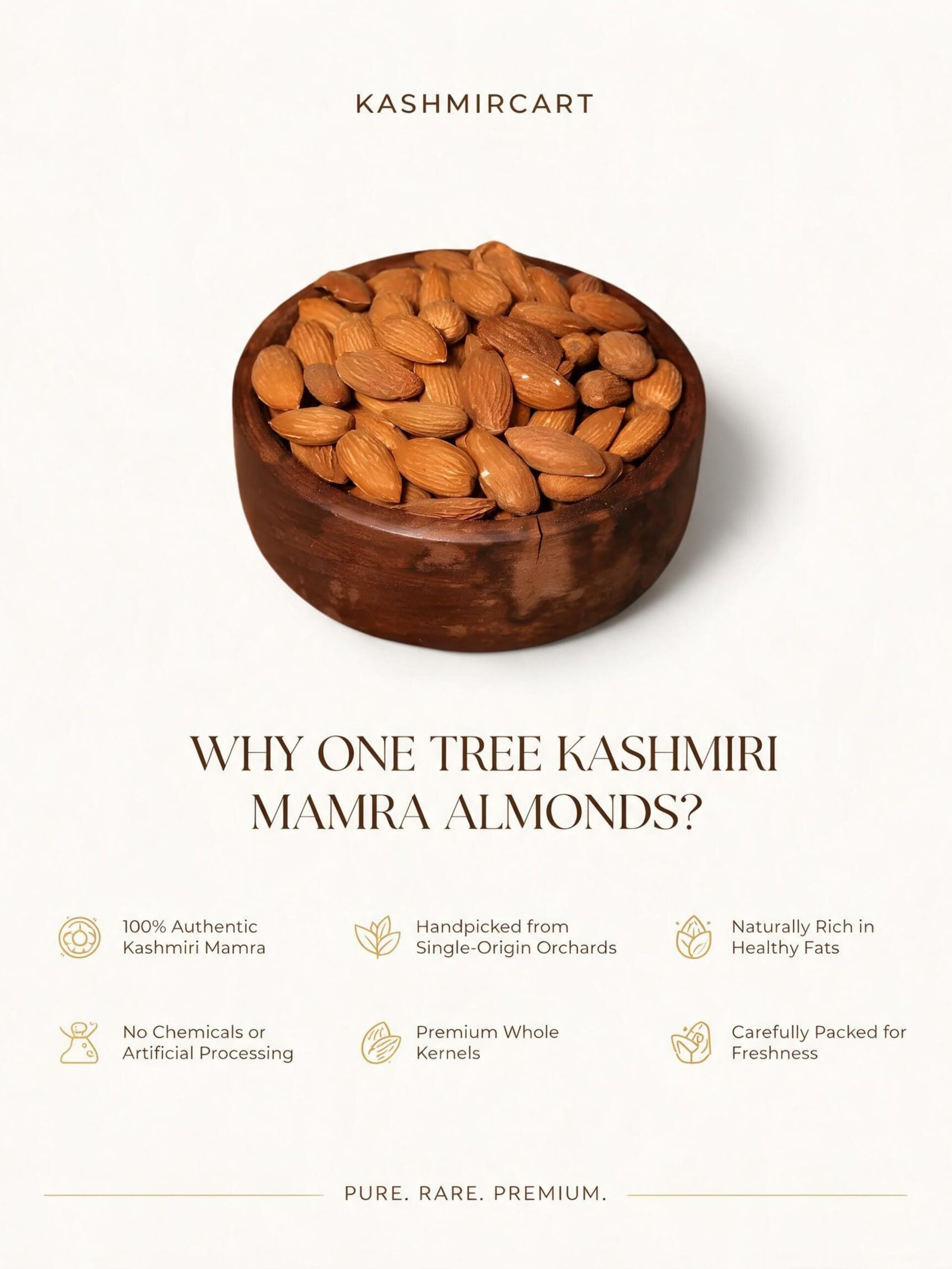


One Tree · Mamra Badam Giri
Kashmiri Mamra Almond Kernels
Small, curved and quietly distinctive — the kernel, as Kashmir keeps it.
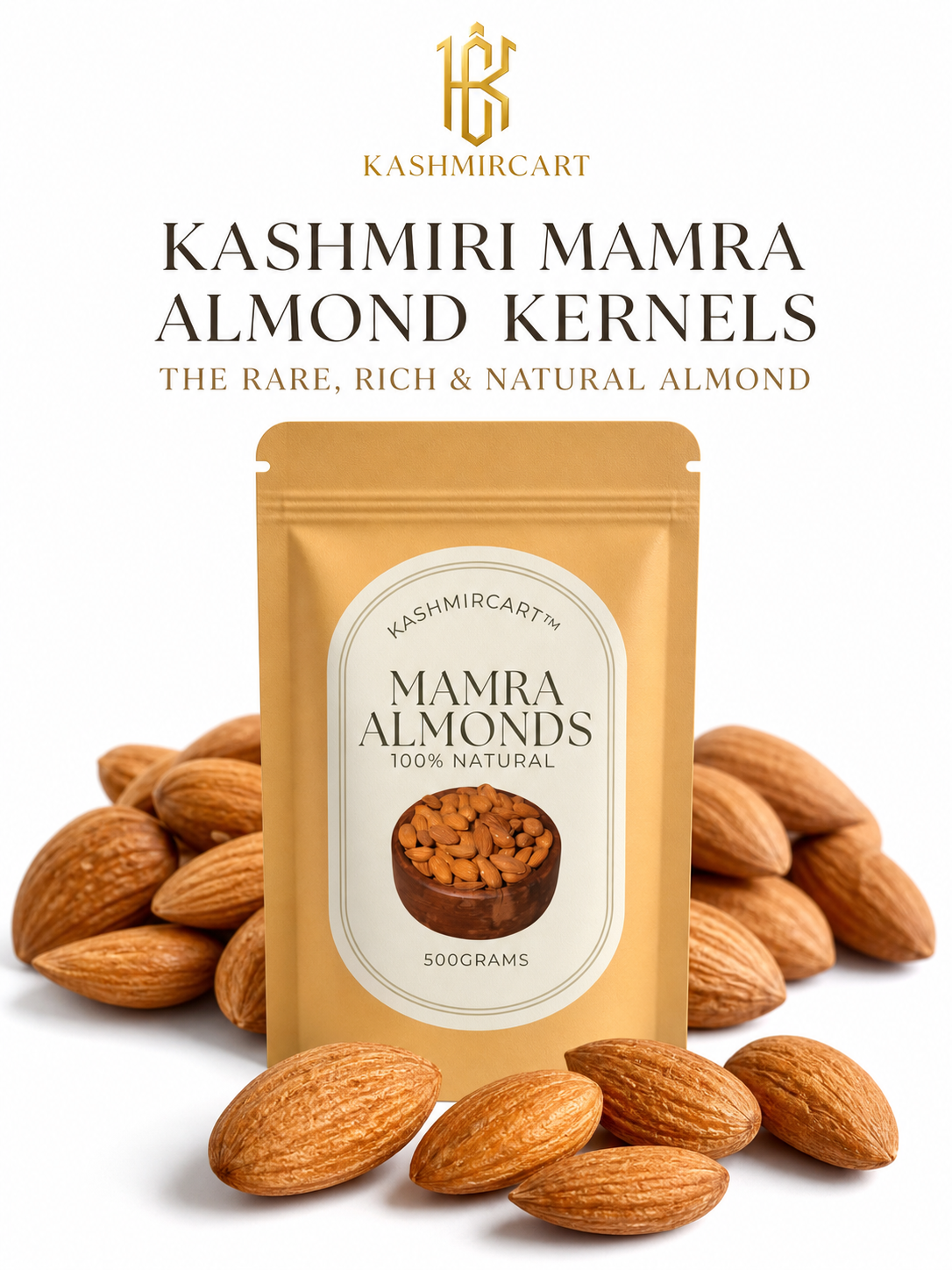
Whole, shelled almonds of the traditional Mamra type, with Kashmir given as their origin. KASHMIRCART keeps the natural brown skin on, cracks the shell by hand, and cleans and sorts the kernels before packing. They are ready to eat, soak or cook with.
- Origin
- Kashmir
- Variety
- Mamra
- Form
- Whole kernel
- Selection
- One Tree
Also called Mamra badam, Mamra badam giri or premium Mamra almond kernels. Pack choices are shown with the product options above.

-
OriginKashmir
-
VarietyMamra type
-
HandledHand-cracked
-
Kept naturalSkin on
First, the name
What are Kashmiri Mamra Almond Kernels?
They are whole, shelled almonds of the traditional Mamra type — the edible kernel, or badam giri, with the hard shell removed and the natural brown skin left on. This listing gives Kashmir as their origin, and the kernels are ready to eat, soak or cook with.
“Mamra” is the name long used in the Indian dry-fruit trade for a traditional type of sweet almond, sold as Mamra badam. It is recognised less by a label than by the kernel itself: smaller and more curved than the broad, flat almonds of large commercial orchards, with a ridged skin and a flavour many households regard as fuller.
The name describes a kind of almond, not a single place. Almonds sold as Mamra are also grown outside Kashmir, notably in Iran and Afghanistan. “Kashmiri Mamra badam” on this listing refers to the stated origin of this particular product. No geographical-indication (GI) tag or certification is claimed.
In Hindi and Urdu, badam means almond and giri means kernel. Badam giri is the edible inner part of the almond with the hard shell removed, so Mamra badam giri simply means Mamra almond kernels.
Mamra almonds are not the same as the large, flat, uniform kernels usually sold as common commercial almonds. Both are almonds; the variety and the character of the kernel differ. This description does not rank one above the other on nutrition.
The kernel file
At a glance
- Product
- Kashmiri Mamra Almond Kernels (Mamra badam giri)
- Origin
- Kashmir, as given on this listing
- Variety
- Mamra — traditional type
- Form
- Whole, shelled kernel with the natural brown skin on
- Selection
- One Tree — a KASHMIRCART selection philosophy, not a certification
- Handling
- Cracked from the shell by hand; cleaned and sorted before packing
- Treatment
- Not bleached, not polished, not oil-sprayed for shine
- Pack sizes
- Choose from the product options above this description
- Allergen
- Contains almonds (tree nuts)
Natural variation in size, shape, colour and surface is expected of orchard produce. Where a pack label carries information, the label takes precedence.
Mamra almond kernels
The edible kernel with the shell already removed and the skin left on. Ready to eat, soak or cook with.
Mamra almonds with shell
The same type of almond inside its hard shell, which you crack yourself before eating.
See Kashmiri Mamra Almonds with shellCommon commercial almonds
Usually modern cultivars grown at scale, such as the California types. Kernels are typically larger, flatter and more uniform, and are generally shelled by machine.
New to the terminology? “Mamra almonds”, “Mamra badam” and “Mamra badam giri” are used here for the same traditional almond type, with giri specifying that the shell has been removed. “Premium Mamra almond kernels” is a trade description of the selection, not a certification.
The kernel
What makes Mamra almonds distinctive?
Mamra is identified by the kernel, not the label alone: short, curved and somewhat plump, with a lightly ridged natural brown skin and a rich, nutty flavour. It is a different almond, not a polished imitation of a commercial one.
Skin
Natural brown skin, left on. The surface is lightly ridged rather than smooth.
Shape
Short and curved, somewhat plump — unlike the long, flat teardrop of many commercial almonds.
Texture
Firm, with a clean crunch when the kernels are fresh and well kept. Not powdery.
Flavour
A rich, nutty almond taste that holds up on its own.
Mamra kernels and common almonds, side by side
Both are almonds. This description offers no laboratory comparison between the two, and we make no geographical-indication claim for this product.
The philosophy
One Tree: a way of selecting, not a certificate.
“Not every almond needs to look like every other almond.”
A varietal focus. The selection is Mamra, and is described as Mamra.
The kernel in its natural form. Shelled, skin on, and otherwise left as it is.
Variation respected. Differences in size, shape and surface are left as they are, not polished away.
What it is not: One Tree is KASHMIRCART’s brand philosophy. It is not an agricultural classification, a harvesting technique, an organic or sustainability certification, or a promise that the kernels in a pack come from a single tree.
The valley
The almond and the Kashmir valley
In Kashmir the almond announces the year. Its pale blossom opens while the air is still cold, before most of the orchards have stirred, and the valley reads it as the end of winter.
Through the long summer the fruit swells inside a green, downy hull. When the hull splits, the nuts are gathered and dried, and for kernels like these the shell is cracked away. That is the ordinary life of an almond: slow, seasonal work that depends on people who know when a tree is ready and when to wait.
Kashmiri almonds have long had a place in the valley’s larder, stored for winter and slivered into kahwa, the cup the valley offers its guests. KASHMIRCART is a family business from the Kashmir valley, and this listing gives Kashmir as the origin of these kernels.
On sourcing, said plainly. Across the KASHMIRCART range, orchard nuts come from growers in the Kashmir valley alongside the crops the family farms. We do not claim that every kernel was grown on our own land, and we do not offer tree-by-tree or farm-to-kernel traceability for this product.

Blossom
The almond opens before winter has fully left the valley.
Fruit in its hull
The fruit swells inside a green, downy hull through the summer.
Nut in its shell
Gathered and dried once the hull splits; the hard shell protects the kernel.
Kernel, or badam giri
The shell is cracked away by hand. The natural brown skin stays on.
Illustrations for orientation; they are not photographs of the product.
At table
Taste, texture and how to enjoy Mamra almonds
Expect a firm kernel with a clean crunch and a rich, nutty almond flavour that holds up on its own. The natural brown skin stays on, so the surface keeps its lightly ridged character. Fresh, well-kept kernels should be firm — not powdery.
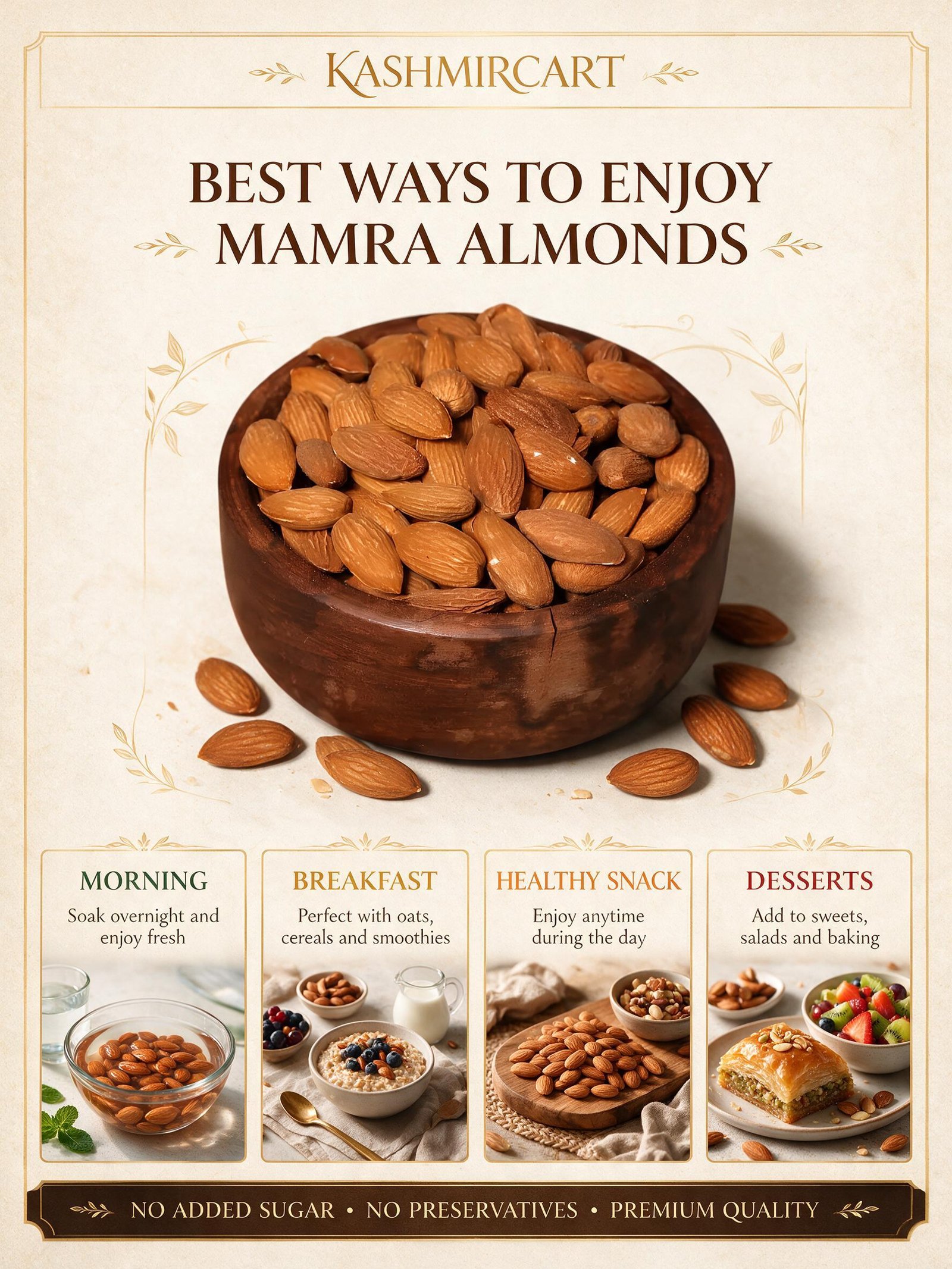
A simple snack, skin on
A small handful makes a simple snack. Eat the kernels as they are, with the natural brown skin on, or lightly roast them at home if you prefer a deeper flavour. Because almonds are energy-dense, portion matters alongside the rest of the day’s food.
About 28 g — roughly a small handful — is a common reference serving. It is not a prescribed portion.
Soaked, if you prefer a gentler bite
Leave the kernels in water overnight and slip off the skins, if you like a softer, milder bite. Soaked almonds are best eaten the same day. Soaking is a matter of preference, not a requirement.
Soaking does not add nutrients, and it should not be relied on to make almonds easier to digest for everyone.
Breakfast, porridge and bowls
Eat them alongside fruit, or scatter them whole or chopped over porridge, muesli or yoghurt. Their firm crunch and nutty flavour hold their own against grain, dairy and fruit without much coaxing.
Use clean, dry hands or a dry spoon when taking kernels from the pack, particularly if you will seal it again.
The Kashmiri table and the sweet course
Chop or sliver the kernels into kheer, halwa and other sweets. Sliver them into kahwa, the cup the valley offers its guests. Grind them to an almond paste for sweets and gravies, or use them wherever a Kashmiri or Indian recipe calls for almonds.
These are usage suggestions, not recipes attributed to a particular household or region beyond the traditions described on this listing.
On appearance: some kernels may be longer, smoother or darker than others. That variation is the point of a selection that respects orchard produce, and it is not a quality defect. Illustrations are not to scale.
Composition
What’s inside an almond? Reference nutrition, read honestly.
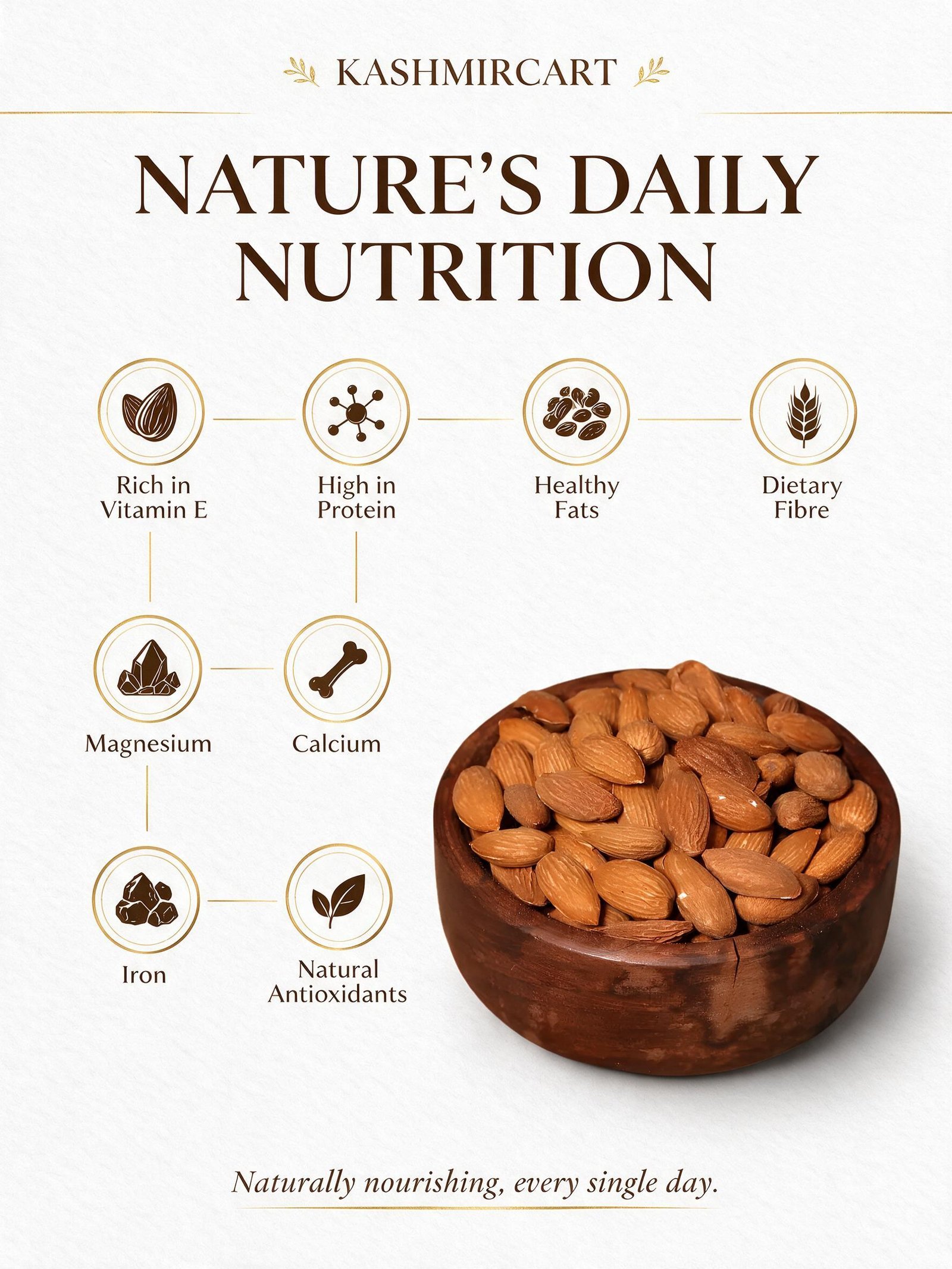
Almonds are an energy-dense food. By standard reference data, roughly half an almond’s weight is fat — most of it unsaturated — and about a fifth is plant protein. More than half of the carbohydrate is dietary fibre. These are general figures for almonds, not an analysis of this batch.
Reference composition of almonds
Not a lab result| Nutrient | Per 100 g | Per 28 g |
|---|---|---|
| Energy | 579 kcal | 162 kcal |
| Protein | 21.2 g | 5.9 g |
| Total fat | 49.9 g | 14.0 g |
| Saturated fat | 3.80 g | 1.1 g |
| Monounsaturated fat | 31.6 g | 8.8 g |
| Polyunsaturated fat | 12.3 g | 3.4 g |
| Total carbohydrate | 21.6 g | 6.0 g |
| Dietary fibre | 12.5 g | 3.5 g |
| Total sugars | 4.35 g | 1.2 g |
| Vitamin E | 25.6 mg | 7.2 mg |
| Magnesium | 270 mg | 76 mg |
| Calcium | 269 mg | 75 mg |
| Iron | 3.71 mg | 1.0 mg |
| Potassium | 733 mg | 205 mg |
Source. U.S. Department of Agriculture, FoodData Central, SR Legacy entry “Nuts, almonds”, FDC ID 170567 (opens in a new tab), published April 2019. Vitamin E is given as alpha-tocopherol. Total carbohydrate is calculated by difference and includes dietary fibre. Per-28 g figures are calculated from the per-100 g values and rounded.
How to read these figures
These figures describe almonds in general. They are not specific to the Mamra variety and are not laboratory results for any KASHMIRCART batch. Composition varies naturally with variety, growing conditions, harvest and storage. Where your pack label carries nutritional information, the label takes precedence.
A food, not a medicine
Nothing in this description is a health claim for this product. Almonds fit within a varied, balanced diet, and because they are energy-dense, portion is worth keeping in view. If you follow a prescribed diet or have specific dietary needs, seek appropriate advice.
Keeping
Storage and freshness: keeping the crunch
Keep the kernels sealed, cool and dry — away from heat, moisture, direct sunlight and strong odours. In warm or humid weather, refrigeration can help them stay fresh for longer. Always go by the best-before date printed on your pack.
Seal it properly
Keep the pack tightly sealed once opened, or move the kernels to a clean, airtight container.
Keep them cool
Store somewhere cool and dry, away from heat and moisture. In warm or humid weather, refrigeration can help them stay fresh for longer.
Avoid direct sunlight
Keep the container out of direct sunlight, and store it somewhere cool and dark.
Clear of strong odours
Almonds can pick up the smell of what sits beside them. Keep them clear of strongly scented spices and foods.
Handle them dry
Use clean, dry hands or utensils when handling the kernels, and reseal the pack promptly.
The short version
Airtight. Cool. Dry. Dark. Away from strong smells. Refrigerate in warm or humid conditions if you can, and bring the kernels out shortly before you eat them.
Best beforeWe do not quote a shelf life here. For the best-before date and batch details, go by what is printed on your pack.
No shelf life, storage duration or freshness guarantee is invented on this page. The pack label is the authority.
Candour
Quality and sourcing, stated plainly
These are Mamra-type almonds, sold as whole shelled kernels with the skin on. Kashmir is given as the origin on this listing. They are cracked from the shell by hand, not bleached, not polished and not oil-sprayed for shine, then cleaned and sorted before packing. These are KASHMIRCART’s own descriptions of how the kernels are selected and handled — not third-party product certifications.
Allergen notice: contains almonds (tree nuts)
Anyone with an almond or tree-nut allergy should avoid this product. The KASHMIRCART range also includes other tree nuts, such as walnuts, cashews and pistachios, and no claim is made that these kernels are free from cross-contact. Check the pack label for any further allergen or cross-contamination statement. If you are unsure whether you have a nut allergy, seek medical advice before eating. Whole nuts can be a choking hazard for young children.
As we describe these kernels
- Mamra-type almonds, sold as whole shelled kernels with the skin on.
- Kashmir given as the origin on this listing.
- Cracked from the shell by hand.
- Not bleached, not polished and not oil-sprayed for shine.
- Cleaned and sorted before packing.
What we do not claim
- A geographical-indication (GI) tag or certification.
- Organic, pesticide-free or chemical-free certification.
- A product-specific laboratory nutrition report.
- Farm-to-kernel traceability or single-tree origin.
- Any medical or therapeutic benefit.
- Freedom from cross-contact with other nuts.
A record of the KASHMIRCART business, not a certification of this particular almond product.
Certification held by KASHMIRCART for its quality management system, not product-specific certification.
No tree-by-tree or farm-to-kernel traceability is offered for this product.
Why so explicit? Premium claims are easy to make and difficult to check. We would rather be clear about the almond type, origin, handling and limits of what this listing supports than imply a certification, test result or guarantee that does not exist. Read more about KASHMIRCART.
The house behind the kernel
Why choose KASHMIRCART for Kashmiri Mamra almonds?
KASHMIRCART is a family business from the Kashmir valley, anchored in Lethpora, Pampore and Nowpora, Tral. The family was farming long before it was selling, and the online store came later as a way of carrying Kashmiri produce to homes across India.
That history shapes the eye brought to a harvest: a willingness to keep a kernel as it is, describe the variety as it is, and be clear about what a listing can and cannot prove.
“We don’t just sell Kashmiri products, we farm them.”
- A varietal focus. These are selected and described as Mamra-type shelled kernels, skin on, cracked from the shell by hand.
- A family’s farming roots. The family’s farming history begins in 1977; the work was incorporated as a company in 2013, and the online journey began in 2016.
- Claims that can be checked — and limits that are stated. FSSAI licence and ISO 9001:2015 records are business records, not certificates for this product. We say so plainly.
- 1977
- The family’s farming roots
- 2013
- The work is incorporated as a company
- 2016
- The online journey begins
That line describes where KASHMIRCART comes from and the eye it brings to a harvest. It does not mean every item in the range grows on the family’s own land. Some crops are farmed directly; many others, orchard nuts among them, come from Kashmiri growers. Read the full story.
Questions
Frequently asked questions about Mamra almond kernels
Direct answers about the almond type, origin, uses, storage and the claims this listing does — and does not — make.
They are whole, shelled almonds of the traditional Mamra type, sold by KASHMIRCART with Kashmir given as their origin. The kernels keep their natural brown skin and are ready to eat, soak or cook with.
In Hindi and Urdu, badam means almond and giri means kernel. Badam giri is the edible inner part of the almond with the hard shell removed, so Mamra badam giri simply means Mamra almond kernels.
Mamra is a traditional type of almond with smaller, more curved kernels and a ridged skin, and many people find its flavour richer. Common commercial almonds are usually modern cultivars with larger, flatter and more uniform kernels. Both are almonds. This description offers no laboratory comparison between them, and we do not claim that Mamra is nutritionally superior.
Kashmir is given as the origin on this listing. The name Mamra describes a kind of almond rather than one place, and Mamra-type almonds are also grown in Iran and Afghanistan. This product is not sold with a GI tag or GI certification. No tree-by-tree or farm-to-kernel traceability is offered.
No such claim is made for this product. Kashmir is given as the origin, but the kernels are not sold as GI-certified or as certified organic. KASHMIRCART’s FSSAI licence and ISO 9001:2015 certification are records of the business, not certifications of this particular almond product.
Yes. They are sold as edible kernels and can be eaten as they are, with the skin on. They can also be soaked, lightly roasted at home, chopped or ground.
Only if you prefer them that way. Soaking overnight softens the kernel and lets the skin slip off, giving a milder bite. It does not add nutrients, and it should not be relied on to make almonds easier to digest for everyone. Soaked almonds are best eaten the same day.
USDA reference data for almonds in general lists about 579 kcal, 21.2 g of protein and 12.5 g of dietary fibre per 100 g, along with unsaturated fats, vitamin E and magnesium, and smaller amounts of calcium, iron and potassium. These are general reference figures, not a laboratory result for this product.
Keep them sealed in an airtight container in a cool, dry place, away from heat, moisture, sunlight and strong odours. In warm or humid conditions, refrigeration can help them stay fresh for longer. Follow the best-before date printed on the pack.
No. These are almonds (tree nuts), and people with an almond or tree-nut allergy should avoid this product. KASHMIRCART’s range also includes walnuts, cashews and pistachios, and no claim is made that these kernels are free from cross-contact. Check the pack label for any further statement and seek medical advice if you are unsure. Whole nuts can be a choking hazard for young children.
Kernels are the edible part with the shell already removed, so they are ready to use. Shell-on Mamra almonds are sold inside their hard shell, which you crack yourself just before eating. KASHMIRCART lists the shell-on almonds as a separate product.
Size, shape, colour and surface vary naturally between kernels and between harvests. That variation is expected of orchard produce and is not a defect. No two kernels need look alike for the selection to be sound.
About this product description
Product details are drawn from KASHMIRCART’s own listing and house records for Kashmiri Mamra Almond Kernels. Nutrition figures are USDA reference values for almonds in general, not laboratory results for any KASHMIRCART batch, and are not specific to the Mamra variety. They do not constitute a health or medical claim. Where your pack label carries information, the label takes precedence.
Reference: U.S. Department of Agriculture, FoodData Central, SR Legacy entry “Nuts, almonds”, FDC ID 170567, published April 2019. Pack options, price and availability are shown with the product options above this description.
Rooted in Kashmir


