



Kashmiri Khurmani — Dried Apricot, Orange Colour: a product study by KASHMIRCART
Dried Apricot · Orange Colour · Khurmani
Some things are best left to the sun.
Ripe apricots, handpicked and transformed through the natural warmth of sunlight. Their moisture gradually reduces, their texture changes, and their naturally sweet character becomes more concentrated. This is Khurmani — dried fruit in its simple, familiar form.
- Origin
- Kashmir, India
- Process
- Handpicked & sun-dried
- Colour
- Natural orange — no added colour
- Texture
- Soft & chewy
- Packs
- 250 g · 500 g · 1 kg · 10 kg

Sun-dried · Naturally coloured · No added artificial colour
No. 01 — The Khurmani
A fruit with a name the valley knows.
Khurmani is the name Kashmir’s pantry has given to a very simple thing: an apricot, dried. Not candied, not glazed, not reconstituted — dried. Ripe apricots from Kashmir’s orchards are handpicked at their prime and dried in the natural warmth of the sun, until most of their water has gone and everything that remains has grown more concentrated.
The result is a small, wrinkled, orange fruit that keeps the apricot’s character — its fruitiness, its gentle tang, its soft chew — in a form that stores for the whole year. In the kitchen it moves freely: straight from the pack as a snack, stirred into morning porridge, folded into nuts and baked goods, cooked into traditional sweets and slow chutneys.
It is the kind of product whose whole story fits on one hand: the fruit, the sun, the time, the pack. The rest of this study is simply that story, told in full and checked where it should be checked.
- What it is
- Dried apricot, orange colour
- Local name
- Khurmani
- Origin
- Kashmir, India
- Process
- Handpicked, sun-dried
- Flavour
- Naturally sweet, gently fruity
- Texture
- Soft, chewy

No. 02 — The Natural Orange Story
An orange that grew, not one that was made.
The orange of Khurmani is not a decoration — it is the fruit’s own colour. A ripe apricot carries pale amber skin and orange flesh, the work of carotenoid pigments, the same family that colours tomatoes and autumn leaves. Drying does not paint the fruit; it simply takes the water away and lets that colour stand out more clearly.
As the fruit dries, its tone shifts with it. Fruit picked at full ripeness, flesh laid out where the sun struck it hardest, dense or thin, skin-on or skin-pale — each piece reads slightly differently. That is why no two pieces match perfectly, and no two packs look exactly alike.
Natural variation is a signature of sun-dried fruit, not a defect. And one honest note for the careful reader: colour alone never proves purity. It only shows what the fruit was and what the sun did to it.
Illustrative tones, not a specification. Every real pack varies naturally, piece by piece.
No. 03 — The Process
Slow work, done by the sky.
Sun-drying is the oldest drying method there is: ripe fruit, laid out, and the valley’s sunlight doing the work over a drying period. Moisture leaves slowly; the texture changes; the fruit’s own character concentrates. KASHMIRCART describes this product as sun-dried — the seven stages below are the shape of that tradition.
We describe the stages of the method as stated by KASHMIRCART. Drying durations, temperatures and batch details are not published by the brand, so none are stated here.
The ripe fruit
Apricots are handpicked from Kashmiri orchards at their best colour and ripeness — the point at which the fruit is sweetest and most ready to dry.
Selection
Fruit is chosen for drying: clean, sound and well ripened. Selection is where a good pack begins, long before the sun is involved.
Preparing to dry
The selected apricots are prepared for the drying process and kept as close to the simple, whole fruit as the method allows.
Under the sun
The fruit is laid out to dry in natural sunlight. The valley’s warmth — not a machine, not a chemical — does the work.
As the water leaves
Over the drying period, the fruit’s moisture gradually falls. The flesh softens and tightens at once, and what remains becomes more concentrated.
The dried Khurmani
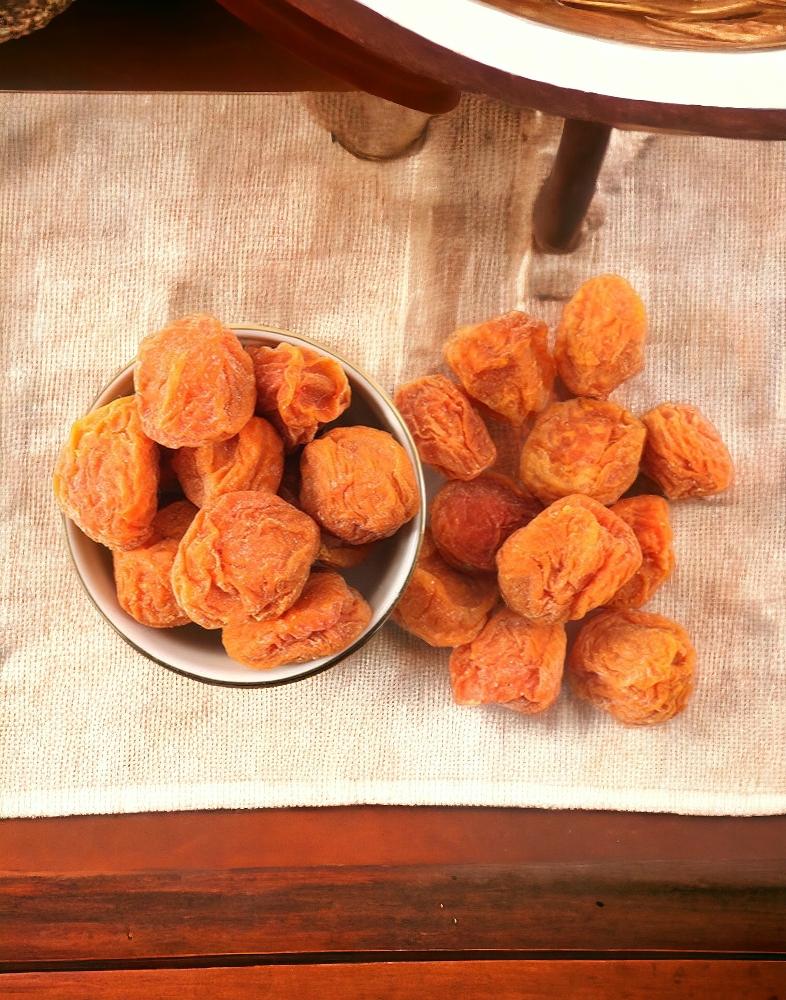
The finished fruit: smaller, deeper orange, wrinkled on the surface, soft and chewy inside, its natural sweetness at full strength.
Packed in the valley
Dried Khurmani is packed for the journey from Kashmir, with storage guidance and a best-before date printed on the pack.
No. 04 — Ingredient Philosophy
Orange by nature. Not by design.
The orange appearance of Khurmani should be understood as the natural colour of the fruit and its drying process — not as a colour effect added to make it look more attractive. Here is the ingredient ledger, and exactly how far each statement stands today.
-
No added artificial colour
Stated by KASHMIRCARTNo artificial colouring agents are added. The fruit’s orange is its own, deepened by drying — as the product page and brand positioning state.
-
No added chemical preservatives
Stated by KASHMIRCARTThe product is described as sun-dried without preservatives or artificial additives. Drying itself is the preservation — low moisture, sealed in an airtight pack.
-
No added artificial flavouring
Stated by KASHMIRCARTNothing is added to boost the apricot’s own aroma. The scent of the pack is the scent of the fruit.
-
No added sugar
Stated — spec under verificationThe product page states the fruit is naturally sweet with no added sugars. We repeat that statement and are confirming it against supplier specifications; the pack label is the official record.
-
Pesticide use in cultivation
Verification in progressKASHMIRCART’s sourcing commitment is to produce from growers who do not apply routine pesticides. Grower records are being gathered and documented for public verification; until they are, this is stated as a commitment, not a tested or certified guarantee.
These statements reflect KASHMIRCART’s product positioning and the information currently published on the product page. We deliberately do not claim organic certification, laboratory-tested batches, zero pesticide residues, or that every nutrient survives drying unchanged — none of those claims is supported by a published test report, and we won’t print them without one.
The ingredient list and FSSAI declarations printed on your pack are the official record for your specific batch, and they always take precedence over this page.
No. 05 — Appearance & Texture
Wrinkled, uneven, honest.

Nothing about Khurmani pretends to be uniform. It is fruit that was alive, ripened and dried under a real sun — and it keeps the evidence of all three.
- Orange to deep amber tones, shifting piece to piece
- A naturally wrinkled, slightly leathery surface
- A soft, chewy bite — pliable, never hard or brittle
- Individual shapes and sizes that vary
- No two packs looking exactly alike
No. 06 — Aroma & Taste
Sweetness you can see. Tang you can feel.
Open the pack and the first thing is smell: a mellow, unmistakably apricot aroma, the kind that reminds you of summer without being loud about it. The taste follows — naturally sweet, fruit-forward, with a gentle tang that keeps it from ever reading as cloying.
Texture does the rest: a soft, chewy give that lets a small quantity go a long way. Because drying concentrates the fruit’s own flavour, Khurmani asks for restraint — a few pieces is plenty.
And because every harvest, orchard and sun differs, the exact experience shifts with the batch. The profile below is an editorial reading of the product, not a laboratory measurement.
The sweetness comes from the apricot’s natural sugars, concentrated by drying — not from anything added.
Readily recognisable as apricot, with the round, stone-fruit character the fresh fruit is known for.
A light, bright edge in some pieces; quieter in others. It balances the sweetness rather than leading it.
Soft and chewy through the pack, with small piece-to-piece differences as is natural.
No. 07 — Nutrition
The numbers, plainly stated.
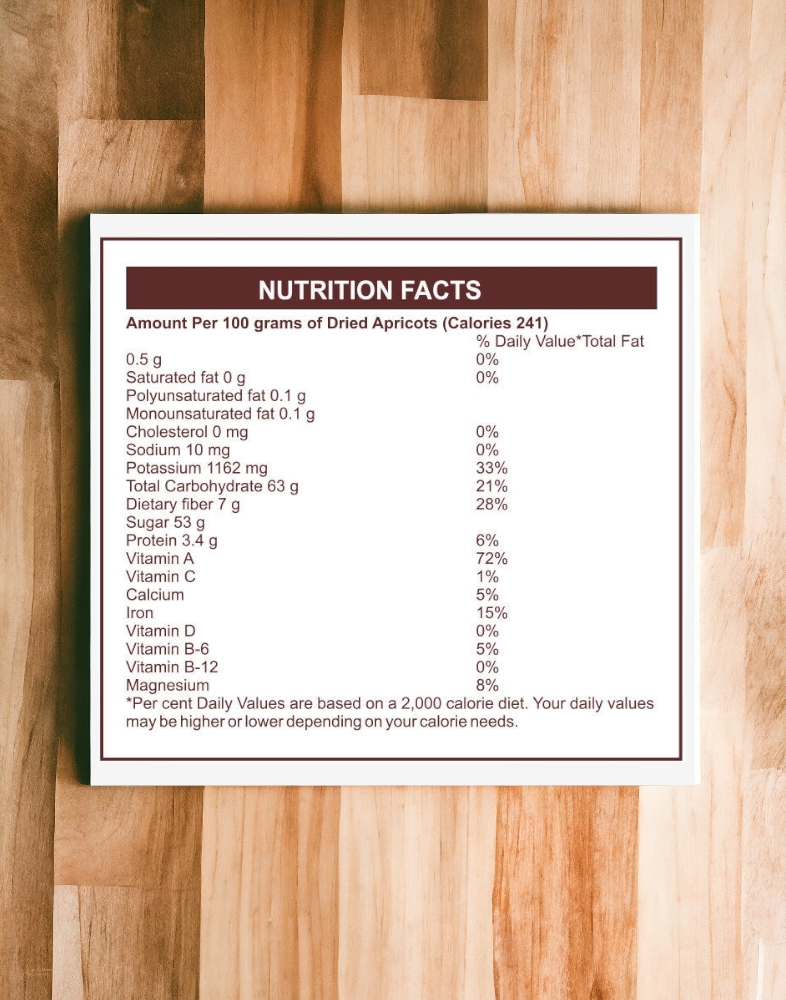
| Nutrient | Per 100 g |
|---|---|
| Energy | 243 kcal |
| Protein | 3.1 g |
| Carbohydrates | 63 g |
| — of which sugars | 50 g |
| Fat | 0.4 g |
| Dietary fibre | 7.8 g |
| Calcium | 69 mg |
| Iron | 1.4 mg |
How to read these numbers
- Reference, not lab result. These are the values KASHMIRCART currently publishes on the product page, per 100 g of edible product. They are not represented here as laboratory-verified for any specific batch.
- Sugars are the fruit’s own. The 50 g of sugars per 100 g are naturally occurring fruit sugars, concentrated by drying — consistent with the product’s no-added-sugar positioning.
- The label is authoritative. The FSSAI nutrition declaration printed on the pack is the official one for your specific batch; supplier specification and analytical basis are being verified against it.
- No per-serving figures. We do not calculate serving-size values that the pack label does not print.
No. 08 — Naturally Occurring Nutrients
What a fruit carries by itself.
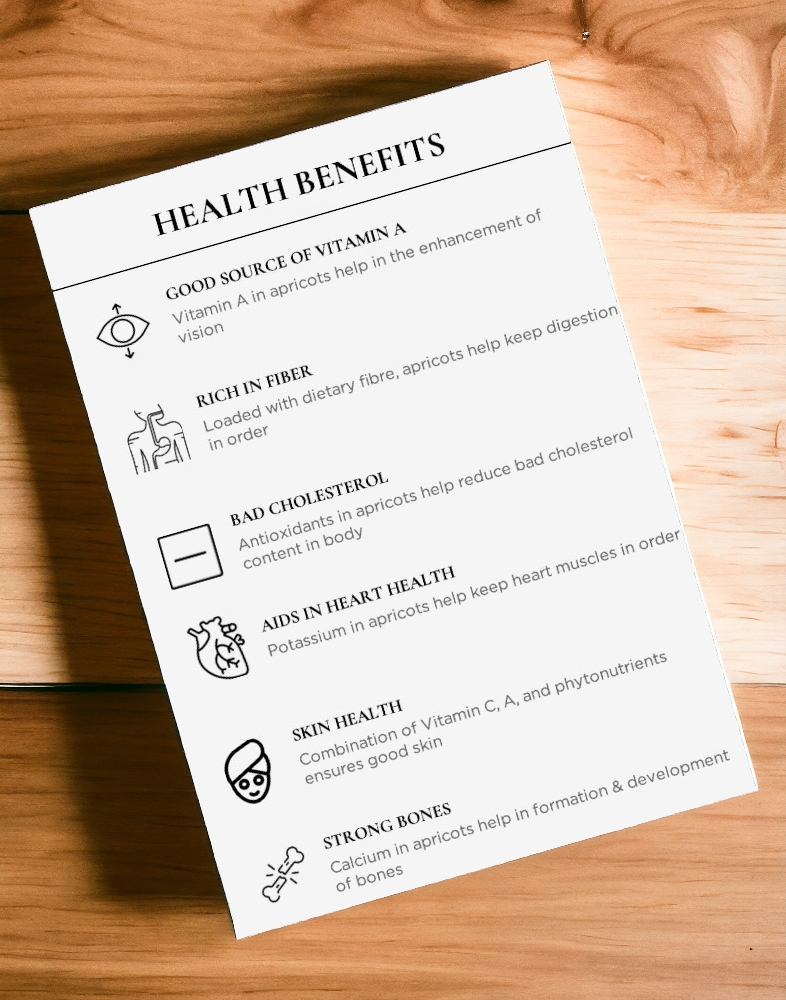
Dried apricots as a food group are well known to carry a useful range of nutrients naturally. Here is what that means for Khurmani — educationally, and without disease-curing superlatives.
Dietary fibre
Fibre is a meaningful part of what the fruit brings — the published reference lists 7.8 g per 100 g, a notable contribution for a fruit.
Natural carbohydrates
The reference table lists 63 g per 100 g, of which 50 g are the fruit’s own sugars. Dried fruit is energy-dense by nature — a little goes a long way.
Iron
A mineral rarely talked about in the context of fruit. The published reference lists 1.4 mg per 100 g — a quiet, real contribution.
Calcium
The published reference lists 69 mg per 100 g — one of the quieter but genuine mineral contributions of dried apricots.
Potassium
Dried apricots are generally regarded as a dietary source of potassium. The product page does not publish a figure, so none is printed here.
Vitamin A precursors
The fruit’s orange pigment, beta-carotene, is a vitamin A precursor in food-composition terms. Drying shifts nutrient profiles — we do not claim every nutrient survives unchanged.
No. 09 — How to Enjoy Khurmani
Ten ways into the pantry.
Khurmani is ready to eat straight from the pack — no soaking or cooking required. Soaking is optional, for recipes that want it softer. Otherwise: use it wherever a little concentrated fruit helps.
- 01
Straight from the pack
The everyday snack — a few pieces any time of day, no preparation at all.
- 02
Morning porridge
Stir whole or chopped pieces through hot porridge while the bowl is still warm.
- 03
With nuts & trail mix
Combine with walnuts, mamra almonds and kishmish for a pantry jar that lasts weeks.
- 04
Over yoghurt
Chop over plain yoghurt or milk for breakfast — the tang of the fruit meets the cream.
- 05
Cakes & baking
Fold chopped Khurmani into cakes, muffins and breads — it bakes into soft, sweet pockets.
- 06
Desserts & compotes
Cook gently with a little water or milk into a simple compote or pudding.
- 07
Traditional sweet dishes
A familiar player in traditional Kashmiri sweet preparations and festive tables.
- 08
Chutneys & preserves
Chop or grind into chutneys, jams and apricot preserves — the live product page’s own suggestion.
- 09
Salads
Fine dice into green salads for a burst of natural sweetness against the greens.
- 10
The kahwa table
A few pieces beside the cup — a natural companion to qahwa and the afternoon.
No. 10 — Storage
Keeping the valley’s dryness.
Dried fruit keeps the moisture it lost only if you keep the air out. Six habits do the work:
- Cool, dry, shaded
Keep unopened packs in a clean, dry place, away from direct sunlight and heat sources.
- Airtight after opening
Close the pack firmly or transfer the fruit to a clean, airtight container.
- Keep moisture out
Dried fruit reabsorbs humidity and turns sticky. Keep it away from steam, sinks and damp shelves.
- Clean, dry utensils only
Never scoop with a damp spoon — a little carried-in moisture is all the pack needs to suffer.
- Follow the best-before date
The best-before date printed on your specific pack is the authority for that batch.
- Respect the label’s guidance
The product page suggests enjoying the fruit within a few months of opening for optimal freshness — guidance, not a guarantee. Always follow the date on your pack.
No. 11 — Pack Sizes
Four weights, one fruit.

Khurmani is offered in four weights, from a first-taste pack to a bulk store of it. Weighed at packing and dispatched from Kashmir.
No. 12 — Frequently Asked Questions
Asked, and plainly answered.
Twenty-two questions customers actually ask about Khurmani — answered with the same rules as the rest of this page: what is stated is stated, what is being verified is marked, and nothing is invented.
01What is Khurmani?
Khurmani is the local name for this orange-coloured dried apricot. It is an apricot — ripe fruit from Kashmir, handpicked and traditionally dried in sunlight until its moisture falls and its natural sweetness deepens. No other fruit, no coating, no glaze.
02What is the difference between fresh and dried apricots?
Drying removes most of the water. The fruit shrinks, the skin wrinkles, the texture turns soft and chewy, and the fruit’s own sugars and flavour concentrate. A handful of dried apricots therefore carries more of the fruit’s natural sweetness per gram than the fresh fruit — and it stores far longer.
03How are these apricots dried?
Per KASHMIRCART’s product information, they are sun-dried: handpicked at their prime and dried using natural sunlight rather than chemical processing. Drying reduces the fruit’s moisture and changes its texture and concentration. The brand does not publish exact drying durations, temperatures or batch records on the product page, so none are stated here.
04Are these apricots sun-dried?
Yes — the product is described on the KASHMIRCART product page as sun-dried. That means the fruit’s moisture is reduced through natural sunlight and time, not artificially coloured or chemically processed in the process.
05Is the orange colour naturally occurring?
Yes. Orange is the natural colour of the ripe apricot, and it deepens as the fruit dries. The colour of this product comes from the fruit itself and the drying process — not from colour added to make it look more attractive. See part 02 for the full story.
06Is artificial colour added?
No. The product is positioned by KASHMIRCART as containing no added artificial colour or synthetic colouring agents. As with every ingredient statement, the ingredient list printed on the pack is the official record for your batch.
07Are chemical preservatives added?
No. KASHMIRCART describes the product as sun-dried without preservatives or artificial additives. The preservation is the drying itself — low moisture, sealed in an airtight pack.
08Is sugar added?
The product page states the fruit is naturally sweet with no added sugars. The sweetness comes from the fruit’s own natural sugars — the reference table lists 50 g per 100 g, which are the fruit’s, not additions. Supplier specification for this claim is under verification.
09Are pesticides used during cultivation?
To be careful and honest: the product page does not claim organic certification or laboratory-tested zero residues. KASHMIRCART’s stated sourcing commitment is to produce from growers who do not apply routine pesticides, and grower records are being gathered for public verification. Until those are published, we do not present this as a tested or certified pesticide-free guarantee.
10Are these apricots organic certified?
No — this product is not presented as organic certified, and we do not use the word “organic” anywhere in this study. “Naturally dried, naturally coloured” describes how the fruit is processed; it is not a certification claim.
11What does “naturally dried” mean?
It means the fruit is dried by natural means — here, sunlight and time — rather than by chemical processing. Drying changes the fruit’s moisture, texture and concentration. It does not sterilise the fruit, and it is not a substitute for sensible storage.
12Why do individual pieces differ in colour?
Every apricot is an individual: slightly different ripeness, flesh density and sun exposure during drying. Those differences show up as slightly different orange tones. Variation is a signature of naturally dried fruit, not a defect.
13Why do some pieces look darker than others?
More ripe fruit, and fruit that saw more direct sun, tends to dry to a deeper amber orange. Both lighter and deeper pieces are natural. Uniformity of colour, in fact, would be the sign of an artificial colourant — the opposite of this product.
14What is the texture of dried Khurmani?
Soft and chewy — pliable, never hard or brittle. Individual pieces vary slightly with ripeness and how long each spent drying, which is normal.
15What does Khurmani taste like?
Naturally sweet and unmistakably apricot, with a gentle tang in some pieces. Drying concentrates the fruit’s own flavour, so a small quantity goes a long way — a few pieces is plenty.
16What nutrients are found in dried apricots?
Dried apricots are a natural source of dietary fibre, carbohydrates, iron, calcium, potassium and vitamin A precursors such as beta-carotene. The reference values KASHMIRCART currently publishes are in part 07, with a note on how to read them. These are educational notes, not health advice.
17How should dried apricots be stored?
Keep unopened packs in a cool, dry place away from direct sunlight. After opening, close the pack tightly or transfer the fruit to a clean airtight container, protect it from moisture, use clean dry utensils, and follow the best-before date printed on the pack. Full guidance in part 10.
18Can Khurmani be eaten directly?
Yes. Khurmani is ready to eat straight from the pack — no soaking or cooking is required. Soaking or cooking is optional, for recipes that prefer the fruit softer.
19How can dried apricots be used in cooking?
Chop into salads and breakfast bowls, fold into cakes, muffins and breads, cook into compotes, chutneys, jams and traditional sweets, or serve over yoghurt and porridge. Ten full uses, with notes, are listed in part 09.
20What pack sizes are available?
Four weights: 250 g, 500 g, 1 kg and 10 kg. Choose in the pack selector on the product card above this description — price and availability follow the store’s live listing.
21Are the nutritional values laboratory-tested?
They are not presented as such. The figures in part 07 are the reference values currently published by KASHMIRCART on the product page, per 100 g of edible product. We do not claim batch-by-batch laboratory verification for them; the FSSAI declaration on the pack is the official label for your specific batch.
22Does the product contain added preservatives?
No. The product is described as sun-dried without added chemical preservatives or artificial additives. For the complete ingredient record of your batch, see the pack label.
No. 13 — The KASHMIRCART Story
We don’t just sell Kashmiri products. We farm them.
KASHMIRCART is a Kashmiri food house — part working farm, part pantry. The family’s agricultural roots go back to 1977, the company was incorporated in 2013, and it has sold online since 2016, from Lethpora in Pampore and Nowpora in Tral.
What “we farm them” means — and what it does not — is explained in three tiers, and every product in the store is held to the same rule: say plainly where it comes from.
This apricot’s own origin is described on its listing: sourced from apricot orchards in Kashmir. Follow the product listing and the pack for the precise sourcing relationship of your batch.
i.Grown by the family
Crops connected to the family’s own fields around Pampore and Tral. Where that is the case, KASHMIRCART says so and speaks from first-hand knowledge of the land and the season.
ii.Sourced from Kashmiri growers
Products bought from farmers, orchardists and makers across the valley — described honestly as sourced, not as farmed by KASHMIRCART itself.
iii.Sourced from other regions
Where a product comes from outside Kashmir, it is not presented as Kashmiri-grown. Each product page carries its own origin details.
The sun does its part. The fruit does the rest.
Naturally sweet, sun-dried and ready for your pantry. Khurmani brings the familiar character of dried apricots to everyday snacking and traditional cooking — nothing added to the story that the fruit can’t back up.


Reviews
There are no reviews yet.