


KASHMIRCART™The Morel Archive
Kashmiri Gucchi
A study of Kashmir’s distinctive Himalayan morel
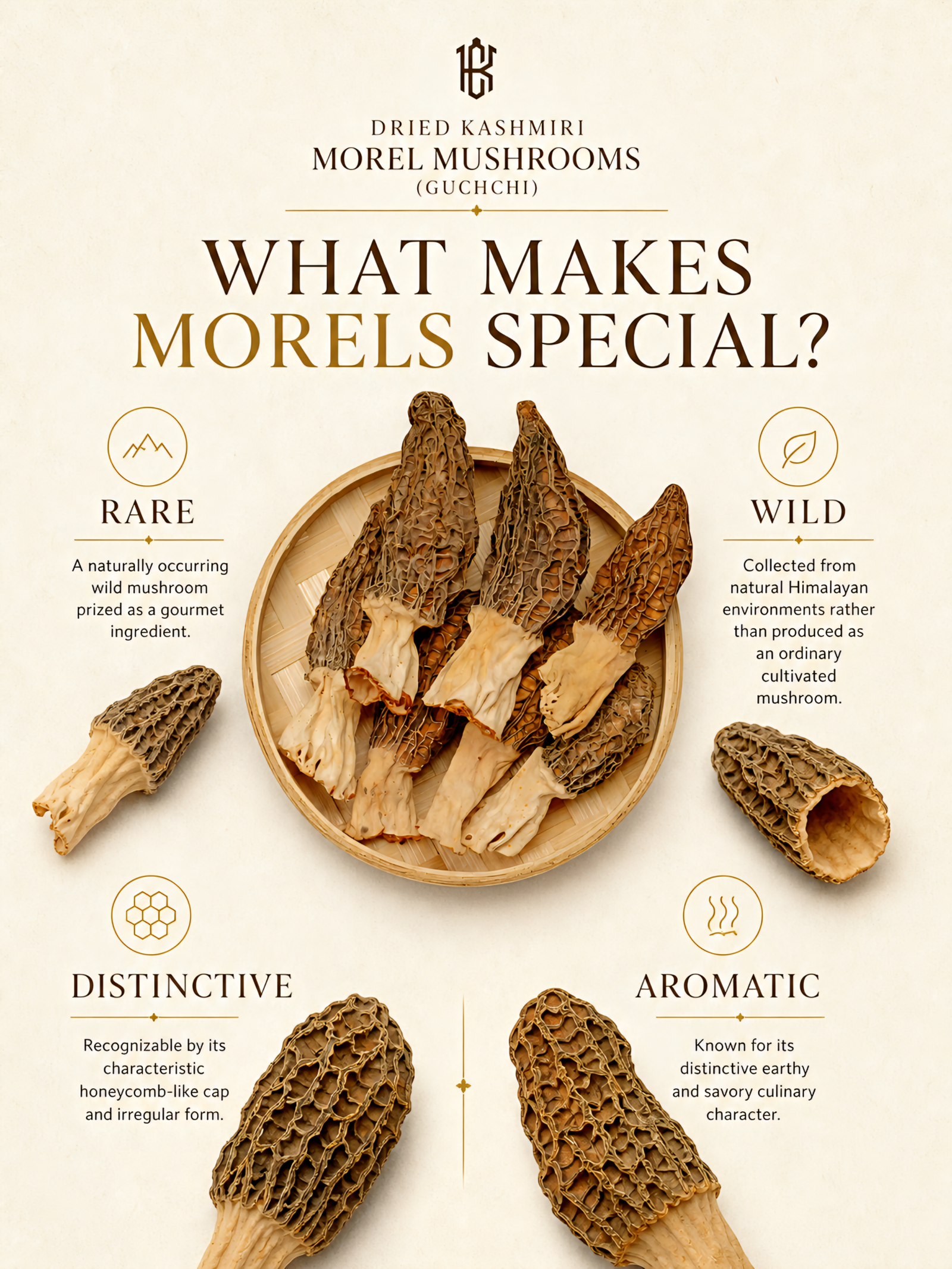
Naturally occurring morels with a deeply honeycombed cap, an earthy aroma and a savoury, umami-rich character — a rare Himalayan ingredient, offered by KASHMIRCART in dried form.
- Region
- Kashmir
- Mushroom
- Morel
- Form
- Dried
- Character
- Natural

Not ready to eat. Dried morels must be inspected, cleaned, rehydrated and cooked thoroughly before eating. See the food-safety guidance.
01 — At a glance
The Morel at a Glance
- Product
- Dried morel mushrooms
- Common name
- Gucchi / Guchhi / Guchchi
- Region
- Kashmir · Himalayan association
- Form
- Dried
- Character
- Earthy · Savoury · Aromatic
- Cap
- Deeply ridged · Honeycomb-like
- Use
- Cooking · Gourmet preparations
- Storage
- Cool · Dry · Airtight
02 — Natural & rare
Not made by a factory.Not shaped by a machine.A product of nature.
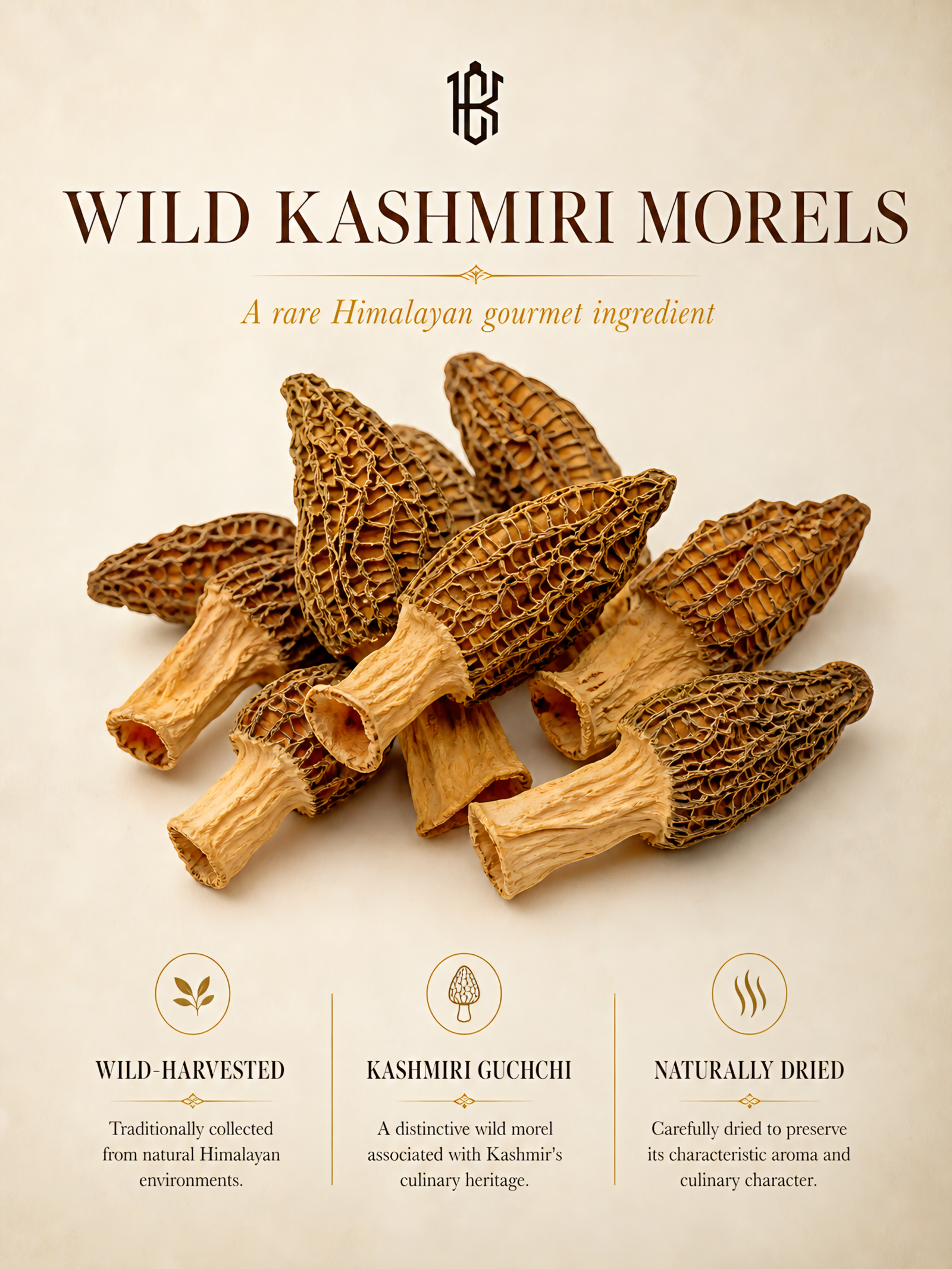
Gucchi is a remarkable natural morel associated with the mountains of Kashmir. Its appearance depends on the conditions in which it develops, and its seasonal availability makes it a difficult ingredient to find. Its distinctive form, irregular honeycomb cap and natural variation are part of what makes it special.
It is a natural mushroom, not a manufactured imitation. Naturally occurring morels depend on suitable environmental and seasonal conditions. They are not an ordinary, consistently available everyday mushroom — which is why Gucchi has long been treated as a specialty ingredient, one that arrives when the mountains decide rather than when a production schedule allows.
What you receive is offered in dried form, so that this seasonal ingredient can be kept in the pantry and used well beyond its natural season.

Why Gucchi is difficult to find
Shaped by conditions
Naturally occurring morels depend on suitable environmental and seasonal conditions. Their shape, size, cap structure and colour reflect how each one developed.
Seasonal availability
Availability is limited by natural growing conditions and seasonality. It cannot be scheduled the way an ordinary manufactured product can.
Hard to find and collect
Finding and collecting naturally occurring Gucchi can be difficult, which is why it is regarded as a specialty ingredient rather than an everyday one.
Nature creates it. Its natural availability cannot be scheduled like an ordinary manufactured product.
03 — The ingredient
What Is Kashmiri Gucchi?
Gucchi (also spelled Guchhi or Guchchi) is a commonly used name for morel mushrooms associated with Kashmir and other Himalayan regions. It is not just another mushroom from a supermarket shelf — it is a specialty culinary ingredient with its own character, its own rules of preparation and its own place in Kashmiri food culture.
Morels belong to a distinctive group of mushrooms recognised instantly by their deeply textured, honeycomb-like caps. Where many familiar cultivated mushrooms are smooth and rounded, morels are irregular, pitted and sculpted — more like a natural lattice than a dome.
When dried, their aroma and flavour concentrate significantly, which is why most Gucchi reaches the kitchen in dried form, ready to be rehydrated when a recipe calls for it.
- Also written
- Gucchi, Guchhi, Guchchi
- Group
- Morels (genus Morchella)
- Association
- Kashmir & the Himalayan region
- Origin
- Naturally occurring
- Offered as
- Dried, for rehydration
04 — The signature
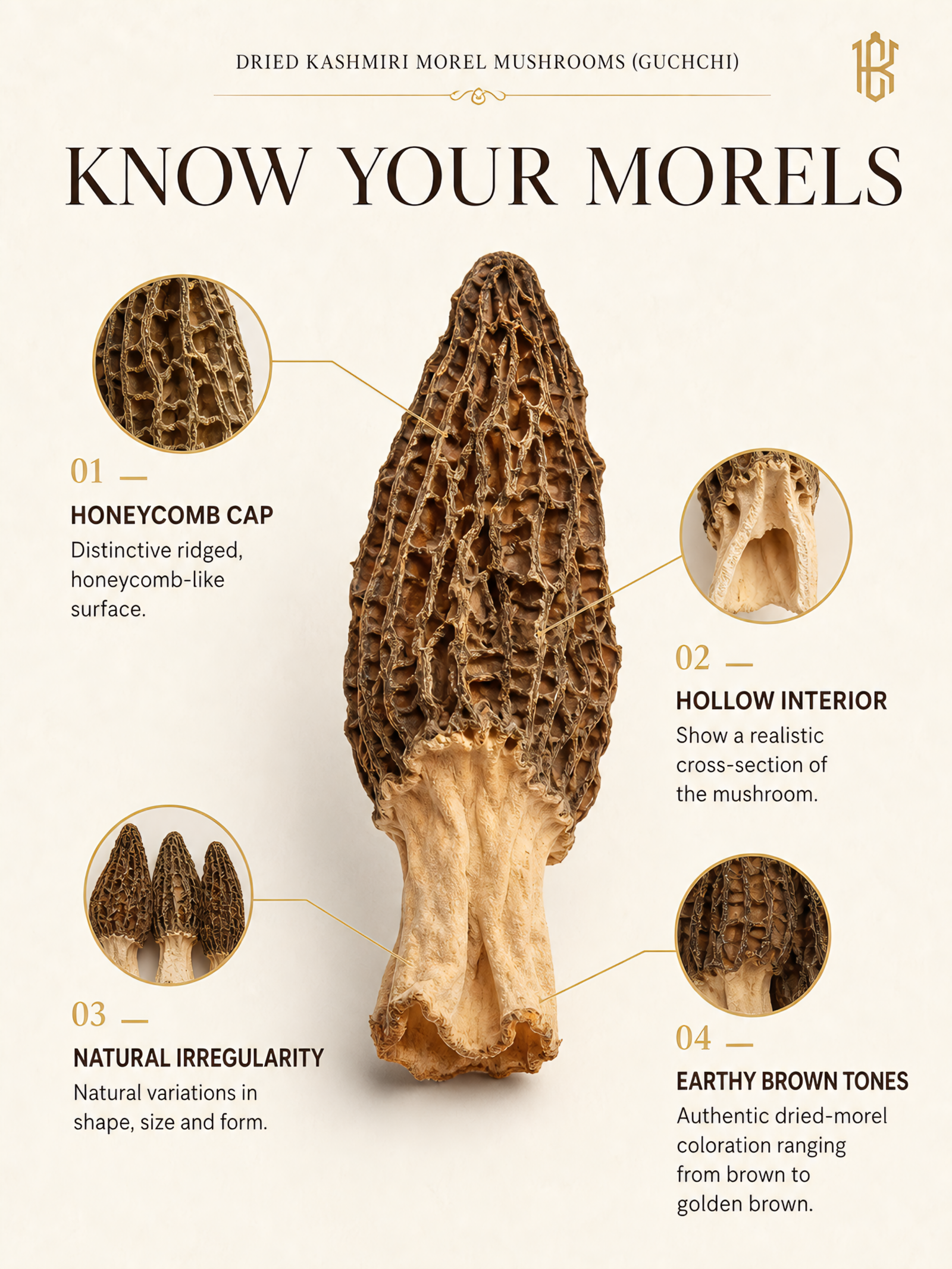
Look Closer. The cap is the signature.
Tap a numbered marker on the specimen — or a label below — to read about each feature.

1 · Honeycomb cap
Interconnected ridges and deep pits form a lattice-like surface. It is the feature that identifies a morel at a glance — and the pits are why sauces cling so well in cooking.
2 · Hollow interior
A morel is hollow from cap to stem, which is visible when a piece is cut or broken open. That hollow, together with the pitted cap, is also why careful cleaning matters: fine grit can lodge inside.
3 · Natural irregularity
Elongated or rounded, slim or squat — never geometric. Each mushroom varies in length, width, thickness and cap structure, and that variation is exactly as nature intended.
4 · Earthy brown tones
Dried morel colour ranges naturally from beige through golden brown to deep brown, depending on the individual mushroom and its drying.
- Interconnected ridges forming a lattice-like surface.
- Deep pits and cavities that trap sauces beautifully in cooking.
- Elongated or rounded forms — never geometric.
- Naturally varying colour, from beige to deep brown.
- Irregular sizing — part of what makes Gucchi, Gucchi.
05 — The palate
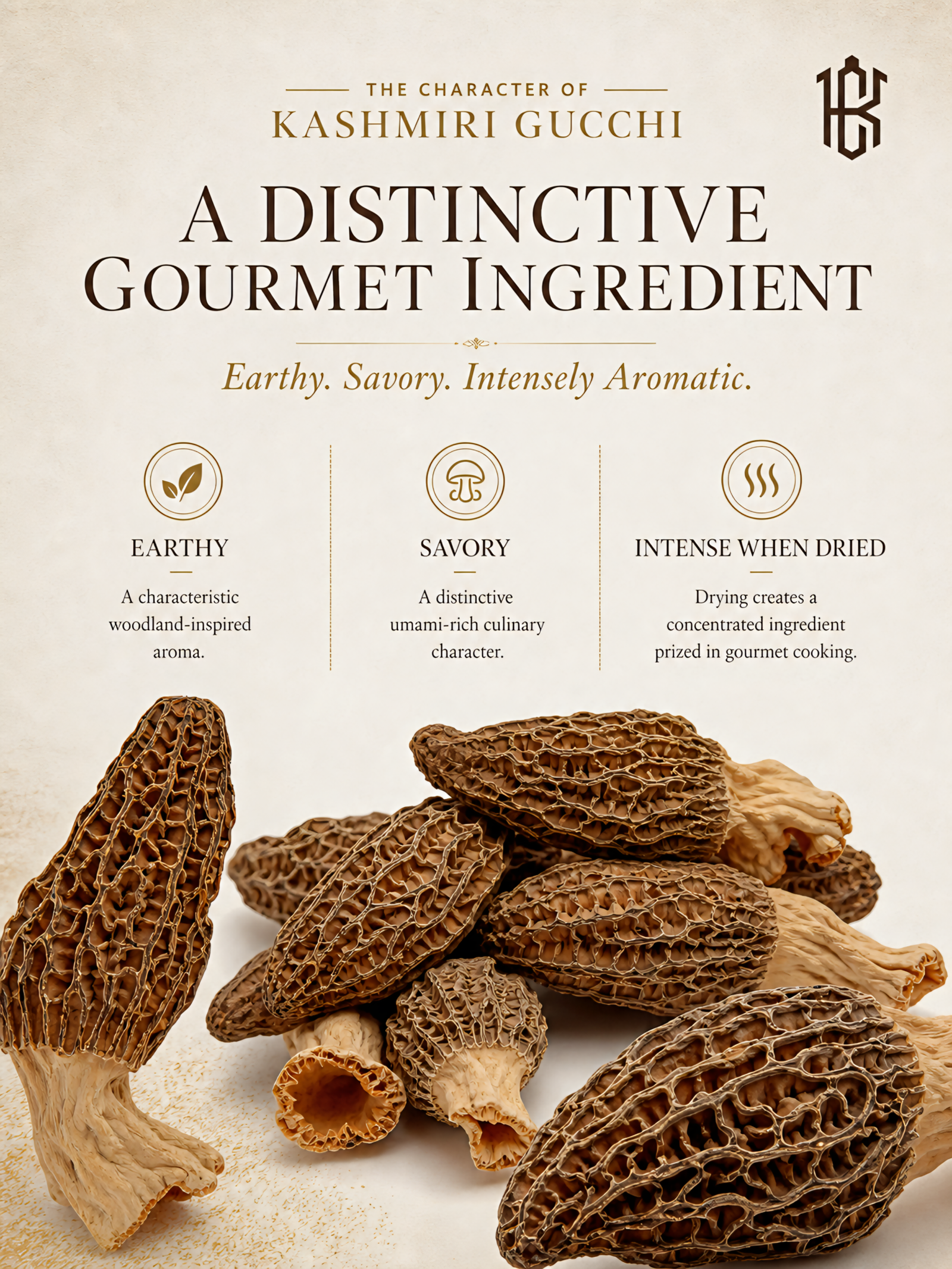
The Flavour of Gucchi
Small quantity. Big culinary presence.

Aroma
Earthy, deep and distinctly aromatic — recognisable the moment the pack is opened.
Palate
Savoury, umami-rich and firmly mushroom-forward.
Texture
Tender and pleasantly chewy when properly rehydrated and cooked.
Finish
A deep, lingering savoury character that holds its own in rich dishes.
Flavour and aroma can vary with the individual mushroom, drying, storage, rehydration and cooking method.
Dried Gucchi carries concentrated aroma and flavour, which is why it is traditionally used in modest quantities. A small handful, properly prepared, can shape the character of an entire dish. This is an ingredient that rewards attention.
06 — The journey
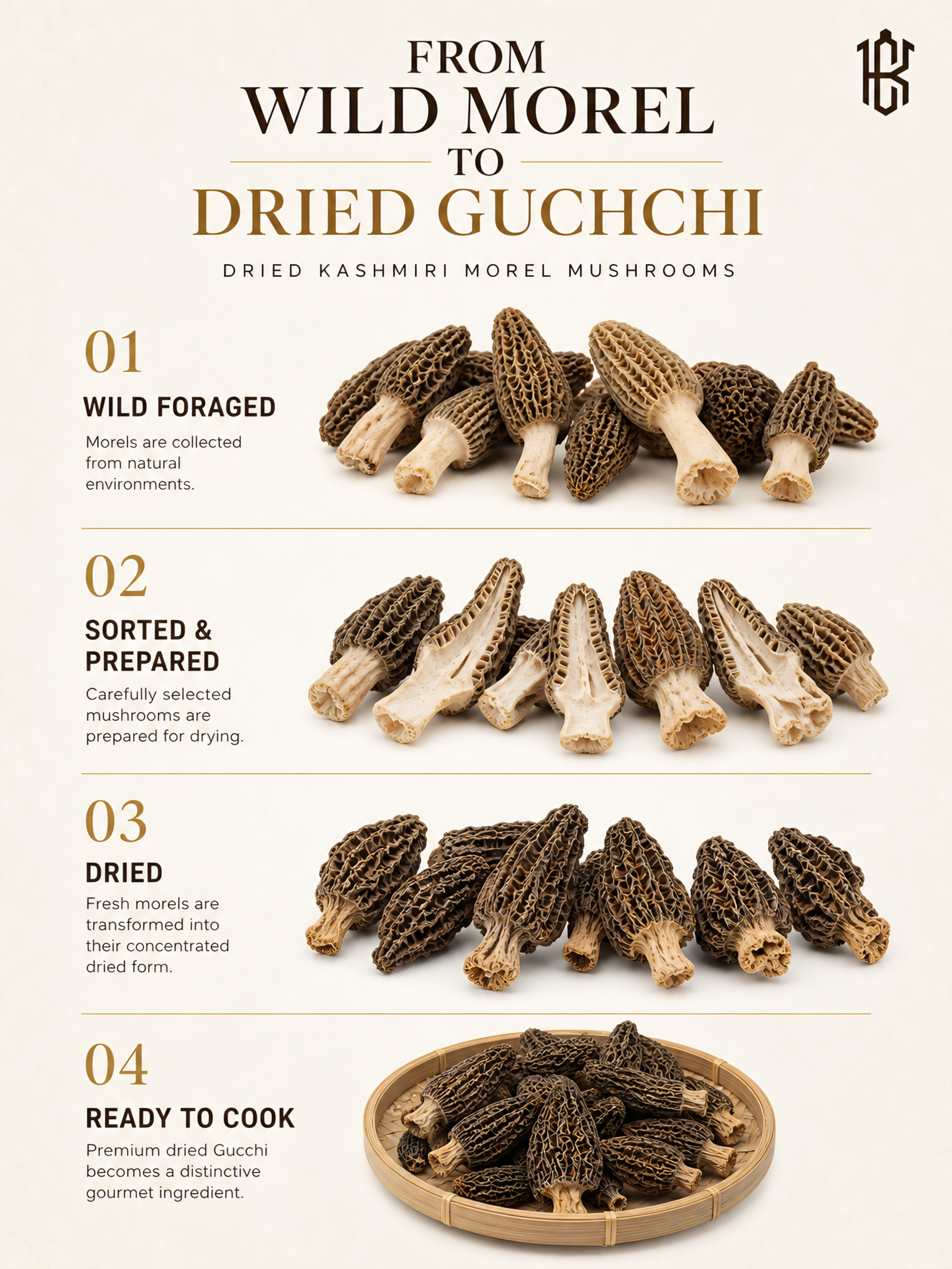
From Fresh to Dried
Why dried morels have become the standard pantry form.
Fresh morel
Harvested in its seasonal, natural form.
Sorted & cleaned
Inspected and prepared for drying.
Dried
Moisture is reduced so the mushroom becomes shelf-stable.
Stored
Kept airtight, dry and protected from heat.
Rehydrated
Soaked back to tenderness before cooking.
Cooked
Added to the dish, where its aroma takes over.
Drying preserves the mushroom, concentrates its aroma and flavour, and allows it to be used well beyond its natural season.

07 — The difference
Gucchi vs Common Cultivated Mushrooms
Not better. Not worse. Different.
| Attribute | Common cultivated mushrooms | Gucchi / morels |
|---|---|---|
| Growth | Commercially cultivated varieties | Naturally occurring morel character |
| Cap | Generally smoother cap structures | Deep honeycomb-like texture |
| Appearance | Generally more uniform | Irregular, individual shapes |
| Flavour | Varies according to mushroom variety | Earthy, savoury, deeply aromatic |
| Availability | Generally available through the year | Seasonal and limited by natural conditions |
| Form sold | Usually fresh | Most often dried |
| Culinary role | Everyday ingredient | Specialty / occasion ingredient |
Form
Fresh vs Dried Morels
Fresh morels
- Higher moisture content
- Softer, more delicate texture
- Perishable
- Available only in season
- Still needs careful cleaning and thorough cooking
Dried morels (this product)
- Low moisture content
- Longer pantry practicality
- Concentrated aroma and flavour
- Rehydration required before cooking
- Convenient to store and use through the year
08 — Nutrition research
What Published Research Reports About Dried Morels
General scientific ranges for dried morels — kept clearly separate from this product.
| Nutrient | Published research range |
|---|---|
| Energy | 355.6–386.5 kcal |
| Protein | 7.5–35.8 g |
| Fat | 2.3–12.0 g |
| Carbohydrates | 36.8–80.5 g |
| Crude fibre | 4.8–28.8 g |
| Total sugars | 8.5–44.0 g |
| Ash | 6.7–18.2 g |
Source: published scientific research on morel mushrooms, PubMed Central (PMC10063854). Ranges are wide because they reflect different samples and methods.
Vitamins & minerals — in research context
Qualitative only. No amounts are stated for this product, and none should be inferred.
Vitamins
Published studies on morels discuss B-group vitamins and vitamin D precursors. Levels vary widely between species, samples and processing.
Minerals
Research reports minerals such as potassium, phosphorus, magnesium, iron, zinc and copper in morels, with considerable variation by origin and sample.
A culinary ingredient
Gucchi is a food ingredient used in small quantities. It is not a medicine, and nothing here is a health or therapeutic claim.
09 — Preparation
How to Rehydrate
Six careful steps for restoring dried morels.
Inspect
Examine the dried mushrooms and remove any visible unwanted particles.
Rinse / clean
Clean carefully according to the condition of the mushrooms.
Soak
Place the dried morels in clean water and allow them to rehydrate until sufficiently softened. Soaking time varies with size and dryness.
Check
Inspect the rehydrated mushrooms again for any remaining grit or particles trapped inside the cap.
Filter
If using the aromatic soaking liquid in your dish, filter it carefully before adding.
Cook thoroughly
Cook thoroughly as part of the chosen recipe. Soaking alone is not enough.
Clean the morel properly
- Dried natural mushrooms can carry fine particles from harvesting and drying — inspect each piece before use.
- Clean thoroughly; the pits and cavities of the cap can hold grit.
- Rehydrate appropriately before cooking.
- Check the softened mushrooms again after soaking.
- Filter the soaking liquid before reusing it in your dish.
- Cook thoroughly as part of the recipe.
10 — Food safety
Not Ready to Eat. Prepare It Properly.
Gucchi is a cooking ingredient. It must never be eaten as it comes from the pack.
- InspectLook over every piece.
- Clean carefullyPits and cavities hold grit.
- RehydrateSoak in clean water.
- Check againFor remaining grit.
- Cook thoroughlyBefore eating.
- Do not eat morels raw.
- Do not eat undercooked morels.
- Soaking alone does not make them safe.
- Thorough cooking is essential — and does not guarantee complete safety.
If you have concerns about eating mushrooms, or feel unwell after a meal, seek professional medical advice. For the public-health background on morels, read the primary sources:
11 — In the kitchen
From Pantry to Plate
Kashmiri cuisine
Rich gravies and traditional preparations where mushroom depth is welcomed.
Rice dishes
Pulaos and biryanis where the aroma of morel becomes part of the dish.
Sauces
Creamy or savoury sauces that benefit from a deep umami backbone.
Soups & broths
Add depth and earthiness to mushroom-based soups.
Gourmet plates
Dishes where the mushroom itself is meant to remain noticeable.
Vegetarian cooking
A distinctive savoury ingredient for plant-forward menus.
12 — Food culture
Why Gucchi Belongs to Kashmir’s Food Story
Kashmir’s kitchen is shaped by its landscape — by its mountains, its seasons and its slow rhythms. Ingredients here are not just raw material. They carry a sense of where they came from.
Gucchi sits firmly inside that story. It is one of the ingredients that signals specialty — reserved for celebrations, invited into richer preparations, and treated with the kind of respect that only certain foods receive in certain places.
13 — Transparency
No Two Morels Need to Look Alike
Natural dried morels vary in size, shape, colour, cap pattern, thickness and dryness. We do not sort them to look like identical pieces off a machine — because they aren’t.
What arrives in your pack is a selection of naturally shaped mushrooms, honest to how they grew. Uniformity is a feature of mass production, not of natural ingredients. With Gucchi, variety is the authenticity.
14 — Storage
Keep the Morel Dry
Airtight
Store in a tightly sealed container after opening.
Cool
Keep in a cool environment away from heat sources.
Dry
Protect from humidity and any contact with moisture.
No sunlight
Avoid direct sunlight to protect aroma and colour.
Clean handling
Use clean, dry utensils when scooping.
Inspect
Check each time before use.
15 — Pack sizes
Available Weights
Choose your preferred weight from the product options above.
- 50 gPack
- 100 gPack
- 250 gPack
- 500 gPack
- 1 kgPack
16 — The brand
From Kashmir to Your Kitchen
- Rooted in KashmirA Kashmir-based family brand built around the valley’s produce.
- Established 1977Nearly five decades close to Kashmiri agriculture.
- Online since 2016Delivering across India.
- Honest listingsThe ingredient speaks, not the marketing copy.
The KASHMIRCART difference
Kashmiri focus
Products connected to Kashmir and the Himalayan landscape.
Care in selection
Attention to the condition and character of each specialty ingredient.
Food-safe packing
Packed carefully to protect the mushroom in transit.
Nationwide delivery
Dispatching across India from our Kashmir base.
17 — FAQ
Frequently Asked Questions
What is Kashmiri Gucchi?
Kashmiri Gucchi (also spelled Guchhi or Guchchi) is a commonly used name for morel mushrooms associated with Kashmir and other Himalayan regions. It is a specialty culinary ingredient, usually sold dried.
What are morel mushrooms?
Morels are a distinctive group of mushrooms recognised by their deeply ridged, honeycomb-like caps and irregular natural shape.
Is Gucchi a natural mushroom?
Yes. Gucchi is a naturally occurring morel associated with Kashmir and the Himalayan region, not a manufactured imitation. Its shape, size, cap structure and colour are the result of natural growth, which is why individual pieces differ.
Why is Gucchi difficult to find?
Naturally occurring morels depend on suitable environmental and seasonal conditions, so availability is limited and cannot be scheduled like an ordinary manufactured product. Finding and collecting naturally occurring Gucchi can be difficult.
Are Gucchi mushrooms cultivated or natural?
Gucchi traditionally refers to naturally occurring morels, and this product is offered as naturally occurring and naturally sourced. Some Morchella species have been cultivated elsewhere using specific indoor or field-soil methods, but that does not describe every morel or this product.
Why are Gucchi mushrooms considered a specialty ingredient?
Because of their natural, seasonal character, distinctive honeycomb structure, concentrated aroma when dried, and their long-standing culinary role in Kashmiri and gourmet cooking.
What does dried Gucchi taste like?
Earthy, savoury, deeply aromatic and umami-rich, with a tender yet pleasantly chewy texture after rehydration.
What does Gucchi look like?
Irregularly shaped mushrooms with a deeply ridged, honeycomb-like cap, varying in colour from beige to deep brown.
Why are dried morels irregular in shape?
Because they are natural mushrooms. Individual pieces vary in size, shape, colour, thickness and cap pattern — that variation is normal.
Why does the colour vary between mushrooms?
Natural variation. Morel colour can shift between beige and deep brown depending on the individual mushroom and its drying.
Why are some Gucchi pieces larger than others?
Because they are a natural ingredient. Pack contents are not calibrated to identical sizes.
Is dried Gucchi ready to eat?
No. Dried morels must be inspected, cleaned carefully, rehydrated, checked again for grit and cooked thoroughly before eating. Soaking alone does not make them safe.
Can morels be eaten raw or undercooked?
No. Do not eat raw or undercooked morels. Thorough cooking is essential, although thorough cooking does not guarantee complete safety. See the FDA and CDC links in the food-safety section.
How do I rehydrate dried Gucchi?
Inspect and clean the dried mushrooms, then soak them in clean water until sufficiently softened. Soaking time can vary with size and dryness. Check them again afterwards and cook thoroughly.
How should I clean dried morels?
Inspect each piece carefully, rinse to remove surface particles, and check the softened mushrooms again after soaking, especially inside the cap cavities.
Can the soaking liquid be used in cooking?
Yes — it carries aroma and flavour. Filter it carefully before adding it to your dish so that any grit remains behind.
How do I cook Gucchi mushrooms?
After rehydration and cleaning, cook them thoroughly as part of your recipe — typically in gravies, rice dishes, sauces, soups or gourmet preparations.
What dishes can I make with dried morels?
Kashmiri gravies, pulaos and biryanis, creamy sauces, mushroom soups, vegetarian specialities and gourmet dishes where the mushroom is meant to stand out.
How should I store dried Gucchi?
In an airtight container, in a cool, dry place, away from moisture, direct sunlight and heat.
What is the difference between fresh and dried morels?
Fresh morels are higher in moisture, more delicate and seasonal. Dried morels are shelf-stable, carry concentrated aroma, and need to be rehydrated before cooking.
Does this page give nutrition values for this product?
No. The nutrition section shows published research ranges for dried morels in general, per 100 g dry weight. They are not tested values for this batch, not guaranteed specifications and not an FSSAI nutrition declaration for this product.
What pack sizes are available?
Kashmiri Gucchi is available in 50 g, 100 g, 250 g, 500 g and 1 kg packs. Choose your preferred weight from the product options above.
Is Gucchi the same as an ordinary mushroom?
No. Gucchi is a morel — a specialty mushroom with a distinctive honeycomb cap, natural seasonal character and a particular culinary role, quite different from common cultivated varieties.
Is Gucchi a medicinal mushroom?
No. Gucchi is a culinary mushroom and should be treated as a food ingredient rather than a medicine.
18 — Research references
Sources & Further Reading
The nutrition ranges and safety guidance on this page come from the sources below.
The Himalayan Morel. The Kashmiri Gucchi.
The mushroom you don’t mistake for any other. Bring one of Kashmir’s most distinctive specialty ingredients into your kitchen.
Select your preferred weight in the product options above, then use the Add to Cart button to order.


Anil Singhaniya –
Boht badya 👌