



KASHMIRCART · Field notes on a dark mountain honey
Black Pahadi Honey A distinctive dark honey from the mountains of Kashmir
Some honeys are pale and quick to pour. This one is neither. Black Pahadi Honey sits in the jar a deep, near-opaque brown and leaves the spoon slowly — a thick, dark honey with a malty, earthy sweetness and a faintly bitter edge at the finish. This description sets out what it is, what is known about where it comes from, why it is dark and how to enjoy it — plainly, and without claims we cannot support.
What is Black Pahadi Honey?
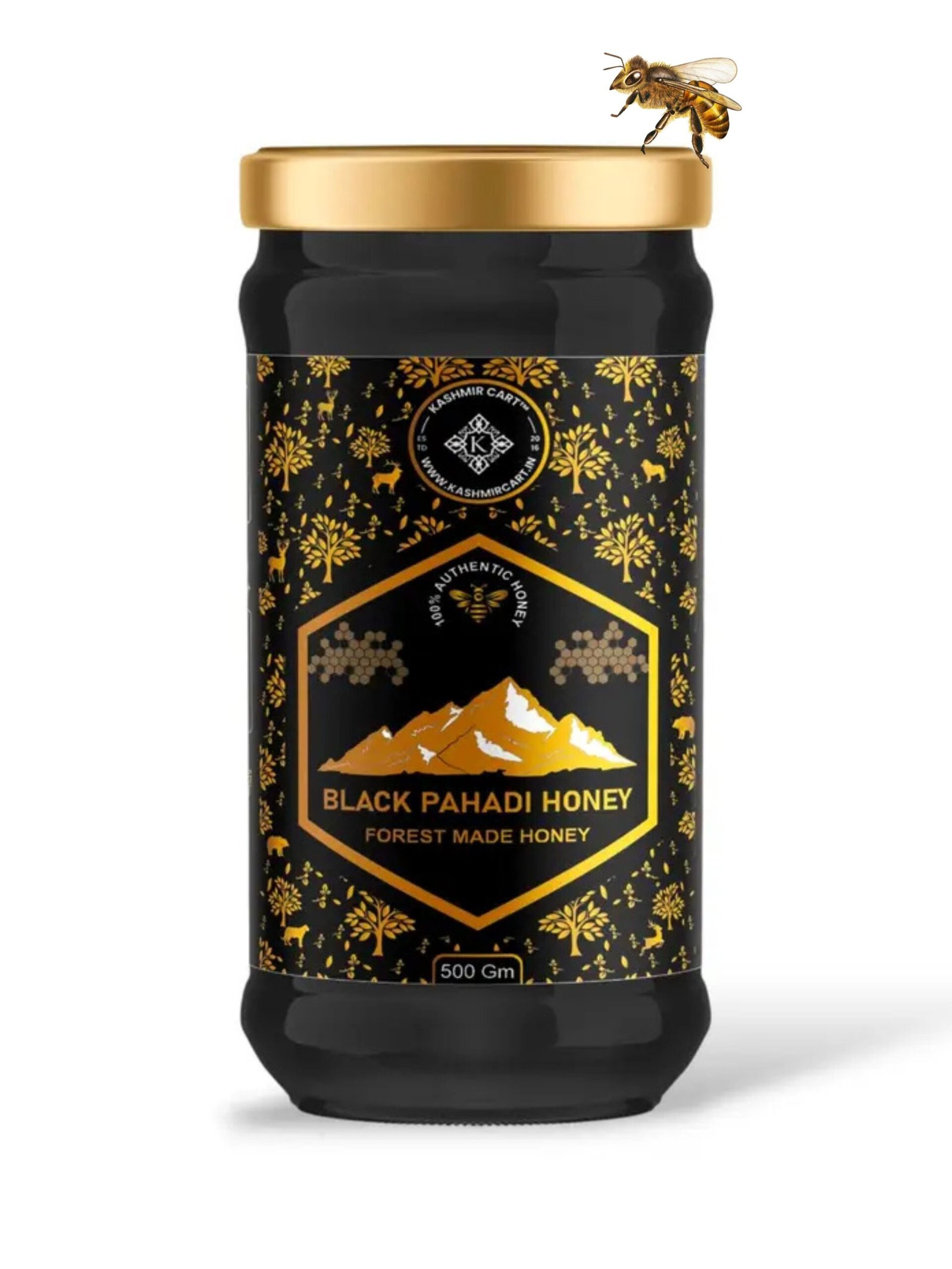
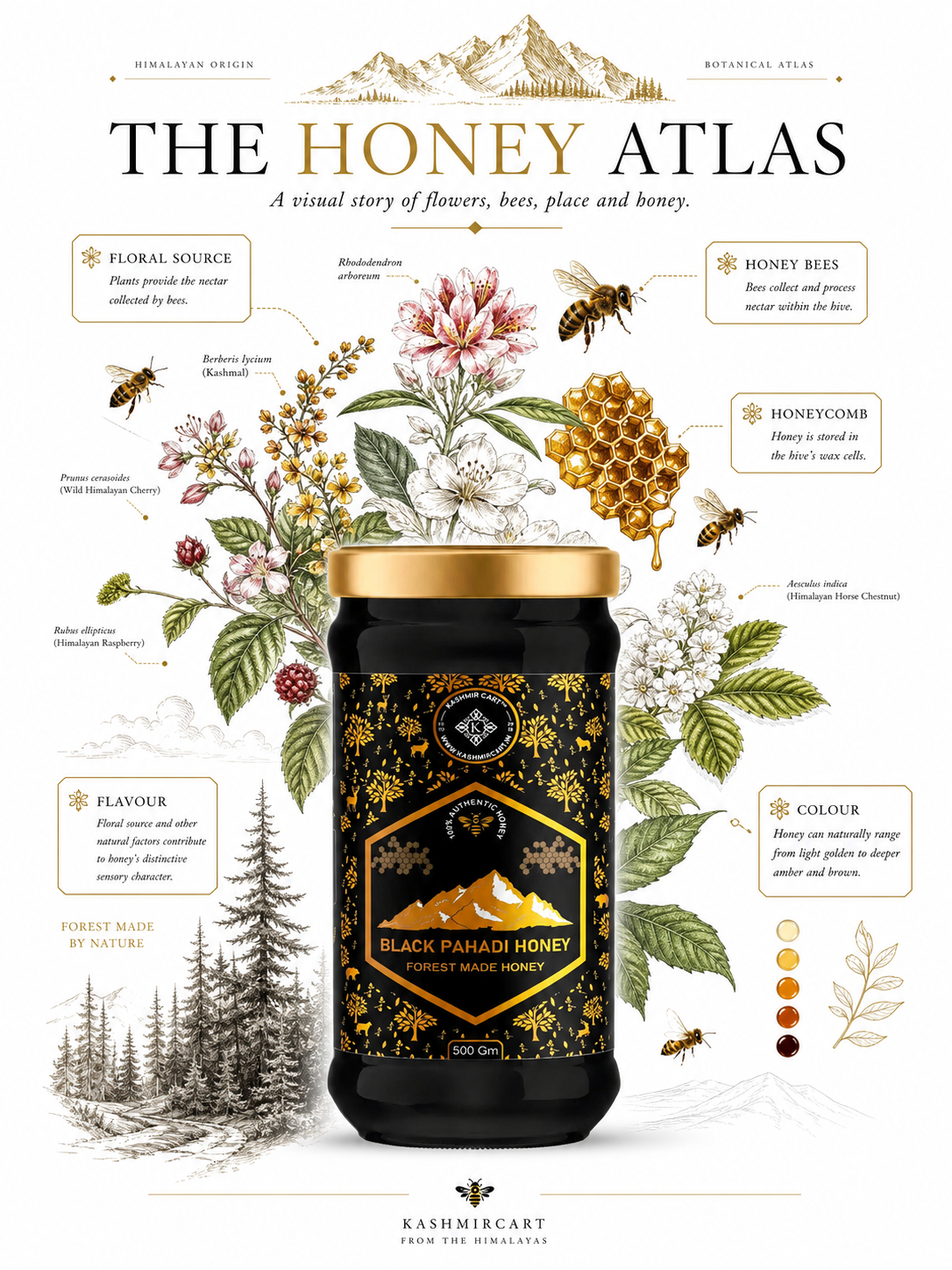
Black Pahadi Honey is a dark, thick honey selected by KASHMIRCART and associated with the mountain landscapes of Kashmir. Pahadi (पहाड़ी) means “of the mountains”, and the honey is also searched for as Kashmiri black honey or pahadi black honey. Like all honey, it is made by honeybees (Apis spp.) from plant nectar or honeydew; it is not extracted from plants directly.
What makes it distinctive?
Its colour and its character. Honey colour is set mainly by what the bees forage on, together with minerals, plant phenolics, age and handling. Dark colour is a trait, not a certificate: on its own it does not prove purity, origin or nutrient content.
- Colour
- Deep brown, near-opaque in the jar
- Flavour
- Malty and earthy, with a faintly bitter finish
- Texture
- Thick, dense and slow-pouring
House tasting notes. Honey is a natural product and varies from batch to batch.
We don’t just sell Kashmiri products. We farm them.

Origin, stated plainly
Where does Black Pahadi Honey come from?
From Kashmir, through KASHMIRCART — a family-run farming house rooted in Pampore and Tral, in the Pulwama district of Jammu & Kashmir. By the house’s own published sourcing statement, its honey comes from growers and apiarists across the Kashmir valley, and every order is weighed, sealed and dispatched from the valley itself.
Origin is not one fact but several. Where the bees foraged, what they foraged on, where the comb was harvested, where the supplier is based and where the jar was filled can be five different answers. Honest labelling keeps them apart, and so does this section.
KASHMIRCART began as a farming family: saffron on the karewa plateaus of Pampore since 1977, alongside the orchards of Tral, and an online shop since 2016. Saffron and certain crops are grown by the family itself. Honey is different. It is one of the goods the house carries from other Kashmiri producers — beekeepers it has worked with for years. KASHMIRCART does not present itself as the owner of the hives, and does not claim that its own people collect each batch.
The landscape is well documented. The Kashmir valley lies between the Pir Panjal and the Great Himalayan ranges, and its bee forage runs from orchards and field crops on the valley floor to wild shrubs and conifer forest on the slopes. Published studies of Kashmir valley honeys have characterised types as different as acacia, apple, cherry, saffron, the wild bush Plectranthus rugosus, multifloral honey and pine honeydew honey. Which of these sources, if any, dominates a given batch of Black Pahadi Honey has not been established by pollen analysis — and we do not guess.
Beekeeping here is equally varied. Regional apiculture literature describes the indigenous Asian honeybee (Apis cerana), traditionally kept in wall niches and clay pots, alongside the introduced western honeybee (Apis mellifera), now widely managed and often moved between forage areas with the seasons. Because the species behind this honey has not been established, this description uses the broad identification Apis spp. only.
The origin ledger — five different questions
- Geographic origin
- Stated by KASHMIRCART
Kashmir, Jammu & Kashmir, India — on the house’s statement that its honey comes from growers and apiarists across the valley. - Botanical origin
- Not established
No pollen analysis or supplier floral record is reproduced here. The honey is not described as monofloral. - Harvest location
- Not established at batch level
No specific village, forest or altitude is asserted in this description. - Supplier
- Stated by KASHMIRCART
Kashmiri growers and apiarists, per the house’s published sourcing statement. Individual suppliers are not named here. - Packing and dispatch
- Stated by KASHMIRCART
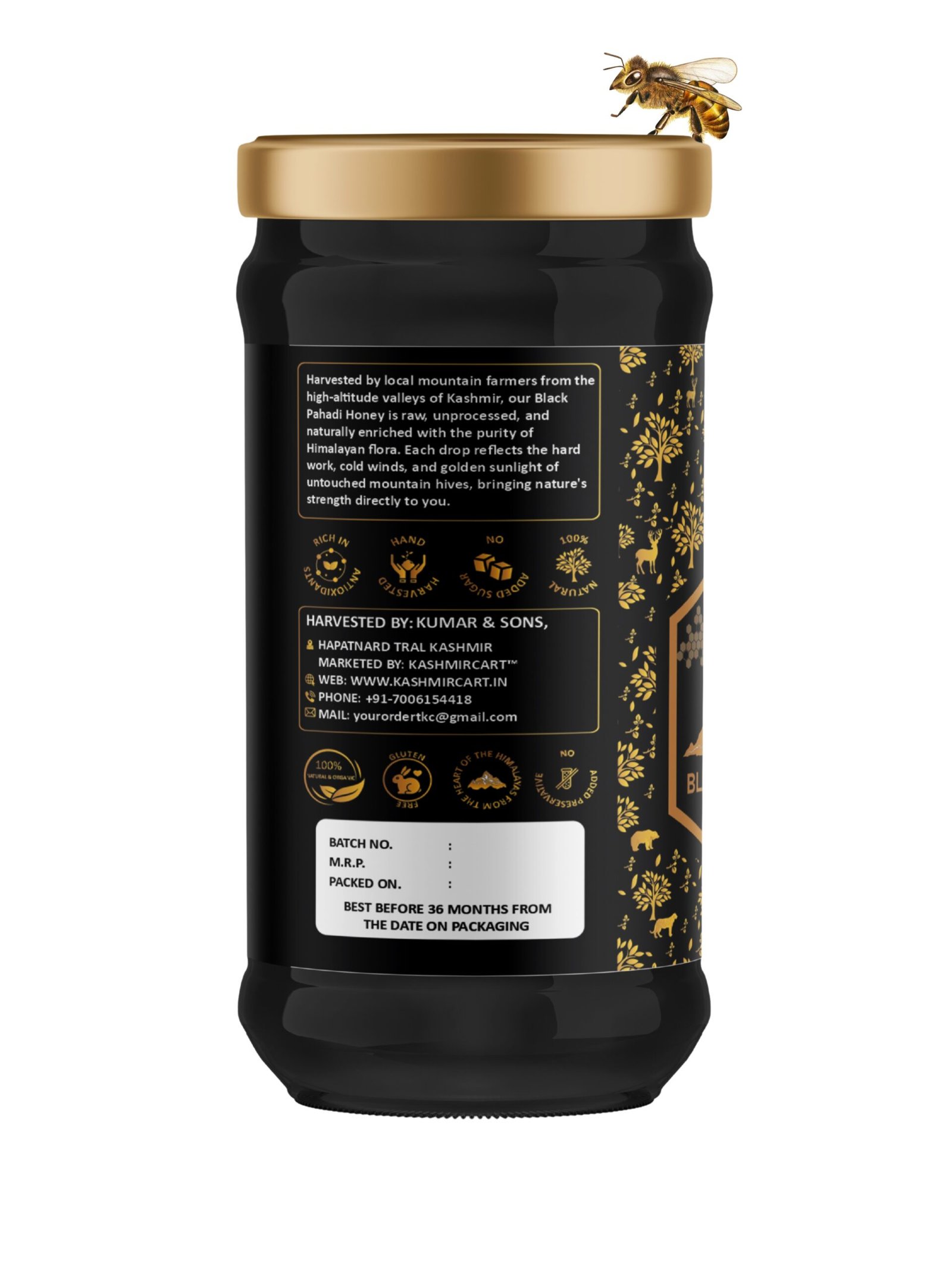
Weighed, sealed and dispatched from the Kashmir valley. The packer’s name and address are printed on the label.
And Tral? Tral, with Pampore, is KASHMIRCART’s home ground, and the name runs through the house’s story. This description names Tral as part of the brand’s home geography. It does not assert Tral as the verified harvest site of every batch. If the harvest locality of your jar matters to you, ask us for the batch record.
What this description states
- A dark, thick honey selected by KASHMIRCART.
- Associated with the mountain landscapes of Kashmir.
- Supplied through Kashmiri growers and apiarists, by the house’s own statement.
- Weighed, sealed and dispatched from the Kashmir valley.
- Listed in 500 g, 1 kg, 5 kg and 10 kg packs.
What it deliberately does not claim
- That the honey is taken from wild hives, or never from managed apiaries.
- That it is harvested once a year, from a single site or a single flower.
- That KASHMIRCART owns the hives or collects every batch itself.
- That the forage area is pesticide-free, pristine or untouched.
- Any specific altitude, forest, bee species or floral source.
The world of honeybees
How honey is made, from flower to sealed comb
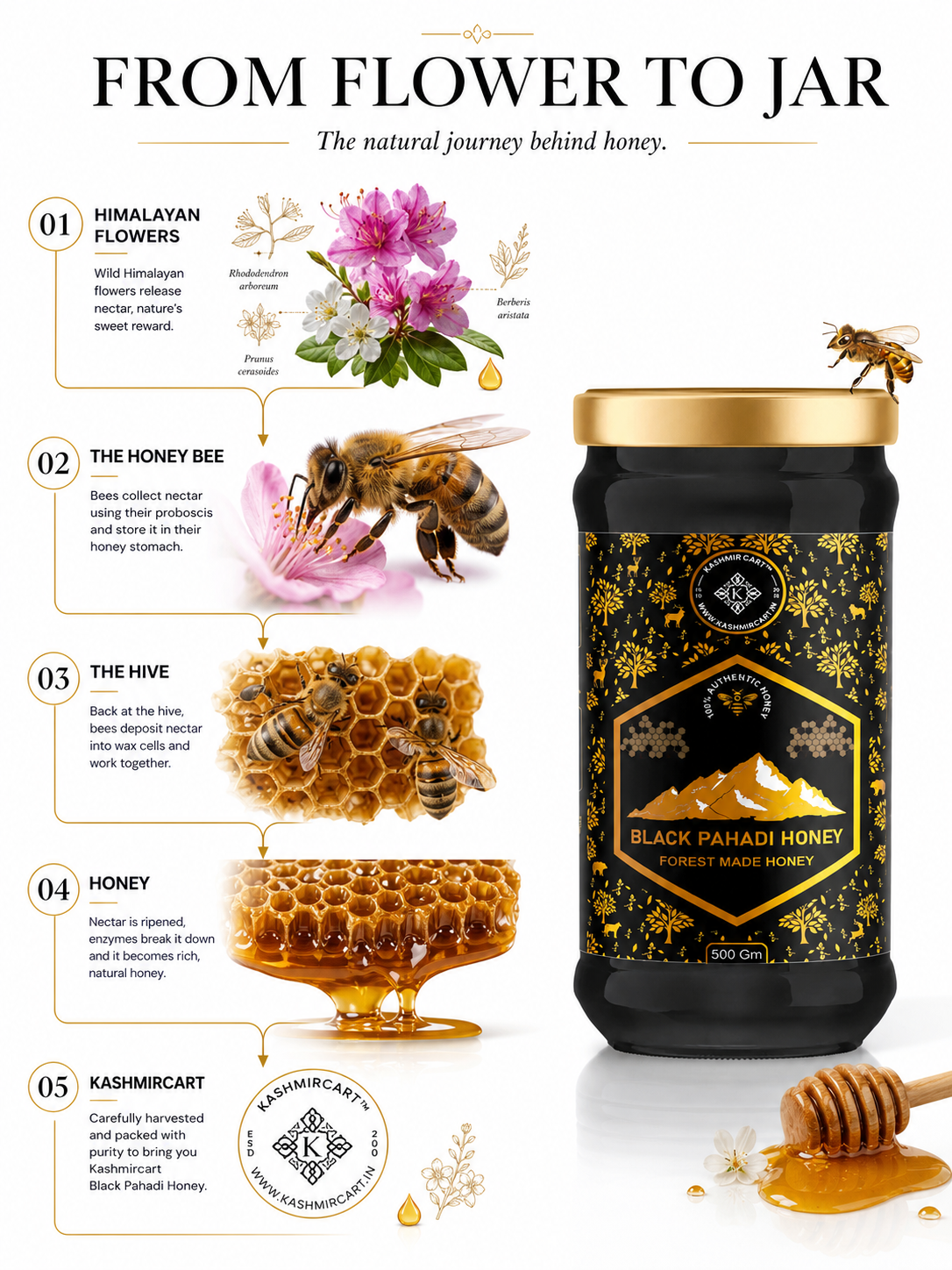
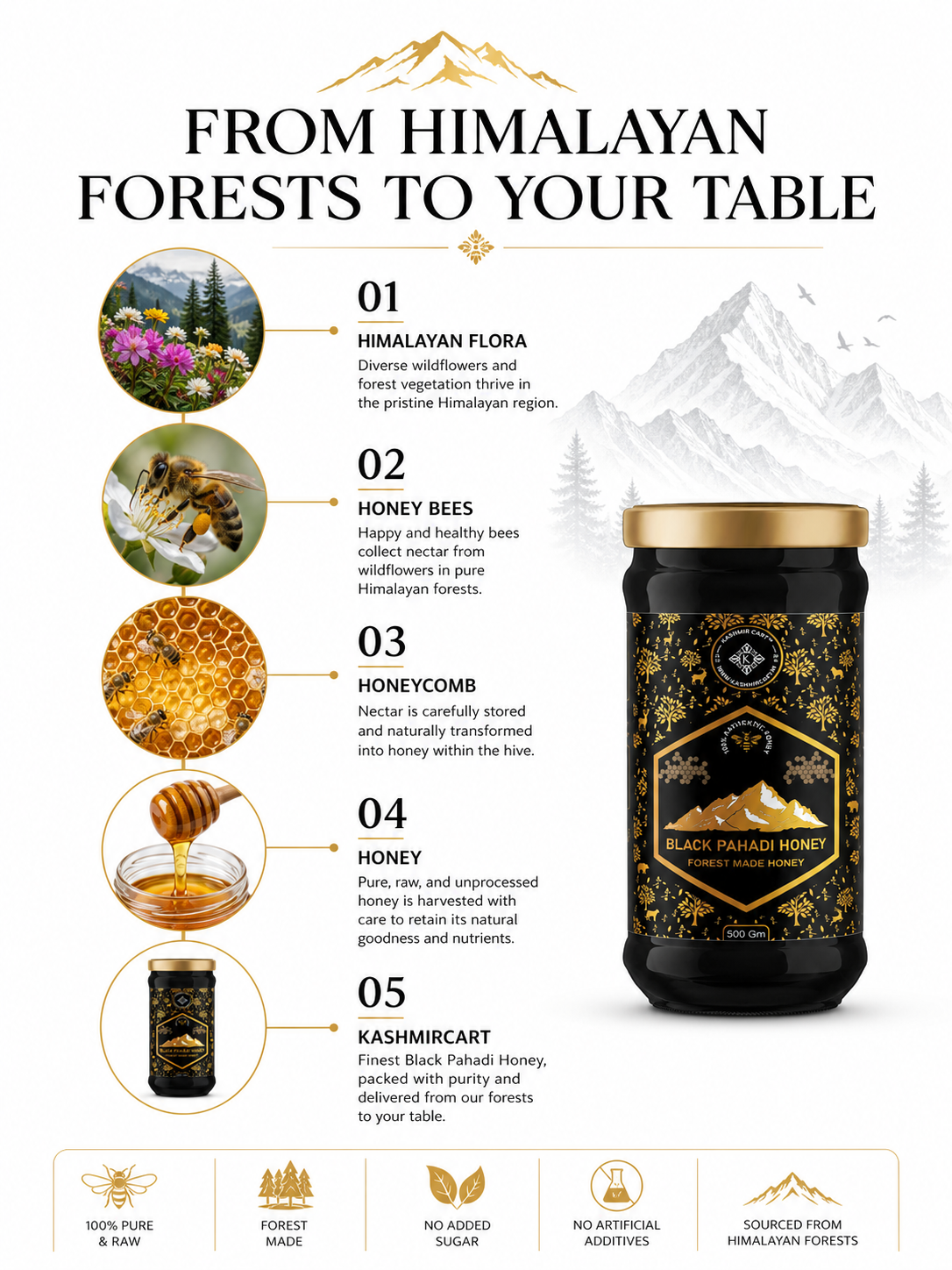
Honey is not squeezed from flowers. It is made by honeybees, which collect nectar or honeydew, transform it with substances of their own, dry it and leave it in the comb to ripen. The plant supplies the raw material; the colony does the work.
Who does what in the colony
- Foragers
- Older workers that fly out to flowering plants, gather nectar and pollen, and carry nectar home in the honey stomach.
- Receiver bees
- Younger house bees that take nectar from foragers mouth to mouth and go on working it inside the nest.
- Fanning bees
- Workers that beat their wings to move air through the nest, carrying water vapour away from ripening honey.
- Wax builders
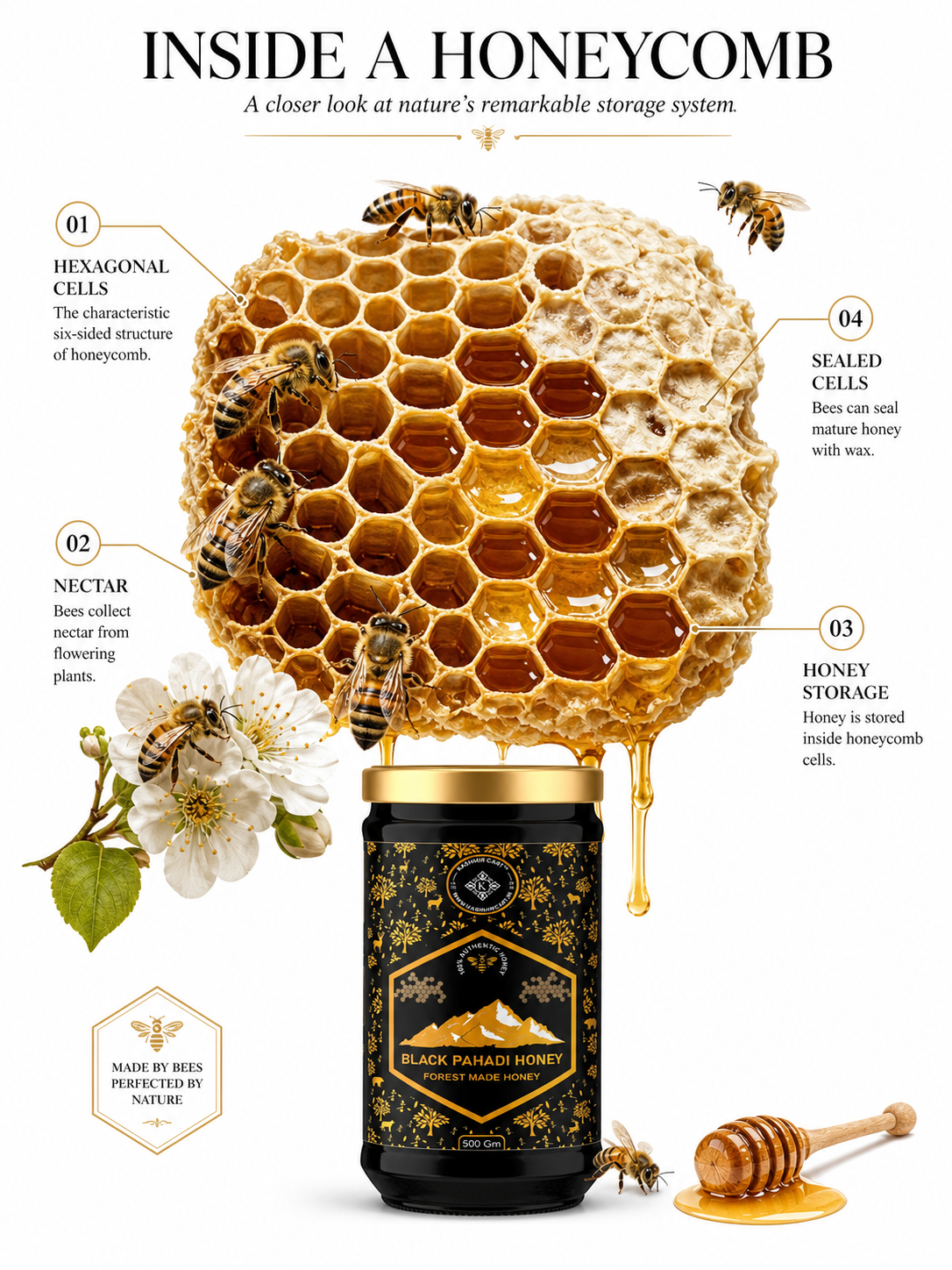
- Workers that secrete wax, build the six-sided cells and seal ripe honey beneath a wax cap.
Bee foraging
Forager bees leave the nest in search of flowering plants — or, on some trees, honeydew, the sugary liquid left by sap-feeding insects. Successful foragers recruit nest-mates to good sources.
Nectar collection
A bee draws nectar through her proboscis into the honey stomach, a storage organ kept apart from digestion. Nectar is mostly water and sugars, and its make-up differs from plant to plant.
Nectar transformation
Glandular secretions are mixed in during collection and transfer. Back at the nest the load is passed from bee to bee and worked repeatedly on the mouthparts.
Enzymatic activity
Invertase splits sucrose into glucose and fructose. Glucose oxidase forms gluconic acid — the main acid in honey — and small amounts of hydrogen peroxide. Diastase is also present.
Moisture reduction
Droplets are spread in thin films and placed in open cells while bees fan air through the nest. Water evaporates until the liquid thickens; food standards generally expect finished honey to hold no more than about 20% water.
Honey maturation
As water falls and sugars concentrate, nectar becomes honey: acidic, low in available water and — kept sealed — stable for a long time.
Storage in the comb
Ripe honey is sealed beneath a thin wax cap. Capped comb is the colony’s pantry, and the usual sign to a beekeeper that honey is ready.
Harvesting and extraction
People take comb in different ways. Framed comb from managed hives is commonly uncapped and spun in a centrifugal extractor; comb may also be cut, drained or pressed. Honey from naturally nesting colonies is collected as whole comb.
Straining or filtering
Straining through mesh removes wax and coarse debris while letting fine particles such as pollen pass. Fine filtration, often with heat and pressure, removes far more — including most pollen.
Packaging
Honey is settled, filled into clean, dry, food-grade containers and sealed, because honey readily takes up water from humid air.
Colour, explained
Why is this honey so dark?
Mostly because of what the bees were feeding on. Honey ranges from almost colourless to nearly black, and the plant source sets most of that range. Minerals, plant phenolics, age and heat move it further. Black Pahadi Honey sits at the dark end — as you can see in the jar.
- Light
- Golden
- Amber
- Dark amber
- Deep brown
Black Pahadi Honey sits toward this end — as observed, not instrument-graded.
Nine things that shape the colour of a honey
Botanical source
The strongest single influence. Each nectar carries its own pigments and precursors, which is why acacia honey is pale and buckwheat or chestnut honey dark.
Nectar and honeydew
Honeydew honeys, made from the sugary excretions of sap-feeding insects on trees, are typically darker than blossom honeys and conduct electricity better. Whether this honey contains honeydew has not been tested.
Pollen and plant compounds
Fine plant material and pigments such as carotenoids travel with nectar into honey and contribute to its hue and clarity.
Minerals
Across many studies, darker honeys tend to carry more mineral matter, with potassium usually the most abundant element.
Phenolic compounds
Plant-derived phenolic acids absorb light, and are repeatedly found at higher levels in darker honeys.
Flavonoids
A sub-group of phenolics. Reviews of honey research report a particularly consistent link between colour intensity and total flavonoid content.
Storage conditions
Honey darkens with time, and faster when kept warm, as its sugars and amino acids slowly react with one another.
Processing and heating
Heat speeds the same browning reactions and raises hydroxymethylfurfural (HMF). A honey can therefore be dark by nature, by handling, or both.
Natural batch variation
Forage shifts with weather, season and place. Two batches under one name can differ visibly in shade, and that is normal.
What a dark colour can suggest
- A forage source that yields dark honey — certain blossoms, or honeydew.
- A tendency, seen across studies, toward more minerals and phenolic compounds than very pale honeys.
- A fuller, less delicate flavour.
What a dark colour cannot prove
- Purity or authenticity. Colour can come from age or heat as readily as from flowers.
- The mineral or antioxidant content of this batch. Only a laboratory report for that batch can state it.
- Geographic origin, floral source, or that a honey is unheated.
- That a dark honey is “better” than a light one.
From the literature. In studies of honeys from the Kashmir valley (Nayik & Nanda, 2015–2016), pine honeydew honey fell in the dark colour category and carried the highest mineral levels among the types compared, while acacia and multifloral samples were light. A 2021 review in the journal Antioxidants brings together many studies linking darker colour with higher phenolic and flavonoid content. These findings describe other samples. They are context — not a measurement of Black Pahadi Honey.
Sensory profile
Tasting notes: dark, malty, unhurried
The notes below are KASHMIRCART’s house description of Black Pahadi Honey. They are not the result of a trained sensory panel, and honey is a natural product — expect each batch to speak a little differently.

Black Pahadi Honey — a tasting card
House notes · to be confirmed by your own spoon
- Appearance
- Deep brown and near-opaque in the jar. Like any dark honey, it shows more amber where the layer is thin — on a spoon, or held to the light.
- Aroma
- Described by the house as earthy, with floral notes. Honey aroma comes from volatile compounds that vary with forage and fade with heat and age.
- First taste
- A robust sweetness that reads as less sugary than pale honeys. That is perception, not arithmetic: this is still a food made mostly of sugars.
- Mid-palate
- Malty undertones, with woody and floral layers.
- Finish
- Lingering and herbal, turning faintly bitter at the very end.
- Texture
- Thick, dense and slow to pour. Viscosity depends on water content, composition and temperature; all honey stiffens in the cold.
How to taste a honey properly
- Taste it at room temperature, from a clean, dry spoon.
- Smell first. Then let a small amount melt on the tongue rather than swallowing at once.
- Notice the sweetness, then the body, then what is left a few seconds later. The finish is where dark honeys differ most.
We have not compared this honey to other foods or attached numbers to its flavour. If your jar tastes different from these notes, tell us — it helps us describe the next batch honestly.
Label language
Raw, unheated and unfiltered: what do these words mean?
These words appear on a great many honey labels and are often read as guarantees. They are descriptions of handling — useful when backed by records, vague when not.
Raw honey
Generally meansIn food marketing, honey that has had little processing — typically not pasteurised and not finely filtered.
Does not guaranteeA fixed standard. “Raw” is not a laboratory-defined quality grade, and producers draw the line in different places. It says nothing by itself about purity, origin or safety.
Unheated honey
Generally meansHoney that was not deliberately heated during extraction and packing. Temperature history matters: heat raises HMF, lowers enzyme activity and drives off aroma.
Does not guaranteeThat the honey never became warm — a summer hive, a lorry or a sunny shelf all add warmth. Only handling records, supported by markers such as HMF and diastase, can describe heat history.
Unfiltered honey
Generally meansHoney that has not been finely filtered. Most honey is still strained through mesh to remove wax and debris; coarse straining is not the same as fine filtration, which removes most pollen.
Does not guaranteeVisible particles, pollen or propolis in every jar. An unfiltered honey can be perfectly clear, and a cloudy honey proves nothing.
Natural pollen
Generally meansPollen grains that reach honey naturally, carried in by foraging bees. Under the microscope they help specialists assess botanical and geographical origin.
Does not guaranteePurity or origin on its own. Pollen content varies widely by plant and by handling, and reading it requires trained analysts and reference data.
Enzymes
Generally meansProteins added largely by the bees — diastase, invertase and glucose oxidase among them — that take part in turning nectar into honey.
Does not guaranteeA fixed or full level of activity. Enzyme activity varies with floral source and colony, and declines with heat and storage. Enzymes are not alive; “living enzymes” is not a scientific description.
How these words apply here. Black Pahadi Honey has been described elsewhere as raw, unheated and unfiltered. Batch handling and processing records are not reproduced in this description, so we do not present those words here as verified product claims. If handling history matters to you, ask KASHMIRCART for the details of the batch you receive.
Quality and authenticity
How is honey quality actually checked?
In a laboratory, with several tests that each answer a different question. India’s food regulator, FSSAI, sets compositional standards for honey and publishes reference methods in its Manual of Methods of Analysis of Foods — Honey and Other Bee Hive Products (August 2024). The table summarises the main parameters for general education.
| Parameter | What it measures | Why it matters | Indian standard for honey* |
|---|---|---|---|
| Moisture | Water content, usually by refractometer | Too much water invites fermentation; a marker of ripeness | Not more than 20% by mass |
| Fructose and glucose | The two main sugars and their ratio | Reflects honey type and influences crystallisation; unusual ratios prompt further checks | Fructose-to-glucose ratio 0.95–1.50 |
| Reducing sugars | Chiefly fructose and glucose together | Low values may indicate unripe honey or dilution | Not less than 65% (60% for honeydew honey) |
| Sucrose | The sugar of cane and beet | Raised levels can point to sugar feeding, added sugar or unripe honey | Not more than 5% (a higher limit applies to honeydew honey) |
| Free acidity | Organic acids, by titration | High acidity can signal fermentation | Not more than 50 milliequivalents per kg |
| Electrical conductivity | How well a honey solution conducts current; tracks minerals and acids | Helps tell blossom honey from honeydew honey | Up to 0.8 mS/cm for blossom honeys; 0.8 mS/cm or more for honeydew honeys |
| Hydroxymethylfurfural (HMF) | A compound formed from sugars with heat and time | Indicates overheating or long, warm storage | Not more than 80 mg/kg |
| Diastase activity | Activity of a bee-derived enzyme | Falls with heat and age; a freshness indicator | Not less than 3 Schade units |
| Proline | The main free amino acid in honey | Indicates ripeness; low values raise questions about dilution | Not less than 180 mg/kg |
| Pollen and plant elements | Microscopic count of pollen grains and plant particles | Supports checks on botanical and geographical origin and on over-filtration | A minimum count is specified |
| Water-insoluble matter | Wax, debris and other solids | Shows how cleanly the honey was extracted | Not more than 0.10% by mass |
| Adulteration markers | Carbon-isotope ratios, C4 sugars, foreign oligosaccharides and rice-syrup markers | Detect added cane, corn, rice or other syrups that basic tests can miss | Limits are set marker by marker |
| Residues and contaminants | Antibiotics, pesticide residues and heavy metals | Food-safety limits that apply regardless of composition | Per the applicable FSSAI contaminant and residue regulations |
*Summarised from the Food Safety and Standards (Food Products Standards and Food Additives) Regulations as amended; limits may be revised, so consult the current FSSAI text for authoritative values. These are regulatory thresholds for honey in general. They are not test results for this product.
Why kitchen tests cannot settle it
No single home test can conclusively establish that a honey is authentic. The popular ones measure thickness, moisture or sweetness — properties that genuine honeys vary in, and that syrups can imitate.
- Water-glass testSinking or dissolving depends on density and viscosity. Thick sugar syrups behave the same way.
- Thumb testWhether a drop holds its shape reflects water content and temperature, not purity.
- Flame testWhether a honey-dipped wick burns reflects moisture, which varies in genuine honey.
- Ant testAnts are drawn to sugars of many kinds, honey included.
- Crystallisation testGenuine honeys may set quickly, slowly or hardly at all, depending on their sugars.
- Viscosity testThickness changes with water, composition and temperature — and syrups can be made thick.
- Colour testDark and light honeys can both be genuine; colour also shifts with age and heat.
No laboratory values are printed here
This description quotes no test results for Black Pahadi Honey, because none are reproduced here that we can tie to the batch in your hands.
A meaningful certificate of analysis names four things beside every value:
- the testing laboratory;
- the test date;
- the batch identification;
- the test methods used.
Ask KASHMIRCART whether a batch report is available for your jar. A food-business licence, by itself, is permission to pack and sell food. It is not a test result.
The science of honey
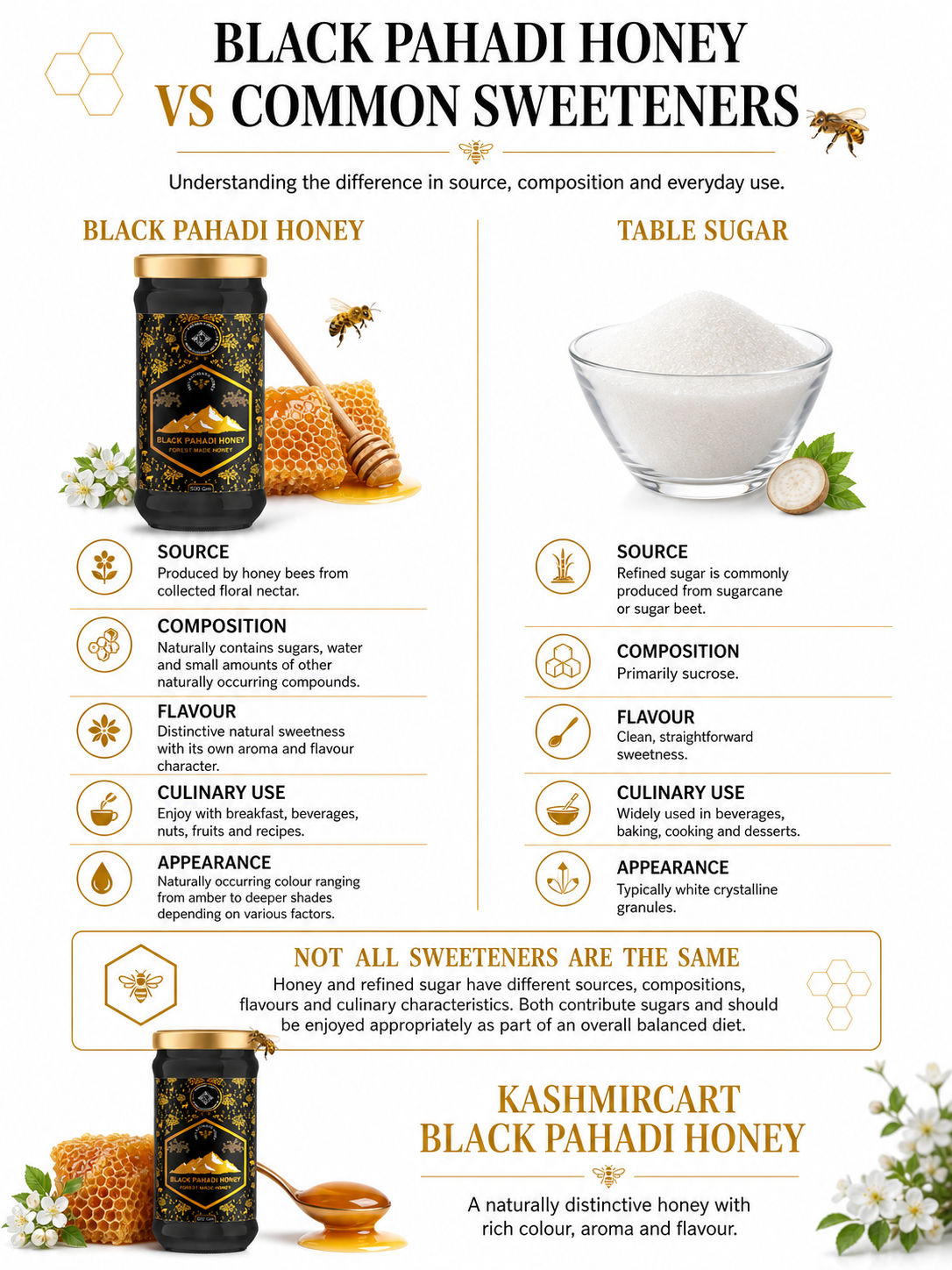
What is honey made of?
Honey is a concentrated solution of sugars in a small amount of water, with a long tail of minor constituents that give each honey its character. The proportions below are typical of honey in general — not a measurement of this product.
- Fructose — about 38%
- Glucose — about 31%
- Water — about 17%
- Other sugars — about 10%
- Minor constituents — about 3–4%
- Fructose
- Usually the most abundant sugar and the sweetest-tasting. Honeys richer in fructose tend to stay liquid longer.
- Glucose
- The second major sugar, and the one that crystallises. Its ratio to fructose and to water largely governs how quickly a honey sets.
- Water
- Typically around 17%. Low water is what keeps honey stable; added moisture is what lets it ferment.
- Minor carbohydrates
- Maltose, sucrose and a range of other di- and oligosaccharides, some formed by enzyme action while honey ripens.
- Organic acids
- Chiefly gluconic acid, produced by glucose oxidase. They make honey acidic — average pH is around 3.9 — and sharpen its flavour.
- Amino acids
- Present in small amounts. Proline, contributed largely by the bees, is the most abundant and is used as a ripeness indicator.
- Minerals
- A small fraction, with potassium normally predominant. Amounts vary widely with plant source and soil; darker honeys often carry more.
- Pollen
- Microscopic grains carried in by foragers. Negligible in quantity as a nutrient, but valuable evidence of what the bees visited.
- Enzymes
- Diastase, invertase and glucose oxidase, mostly added by bees. Activity varies, and declines with heat and time.
- Phenolic compounds
- Plant-derived phenolic acids that contribute to colour and flavour, and to the antioxidant activity measured in laboratory assays.
- Flavonoids
- A family of phenolics that arrive through nectar, pollen and propolis. Their profile differs by botanical source.
What makes composition vary
- Floral source
- Geographical origin
- Climate
- Season
- Maturity at harvest
- Processing
- Storage
No concentrations for Black Pahadi Honey are quoted here, and its antioxidant capacity has not been verified by laboratory assay in this description. Two dark honeys can share a colour and differ in almost everything else.
Nutritional profile
Honey nutrition: reference values, clearly labelled
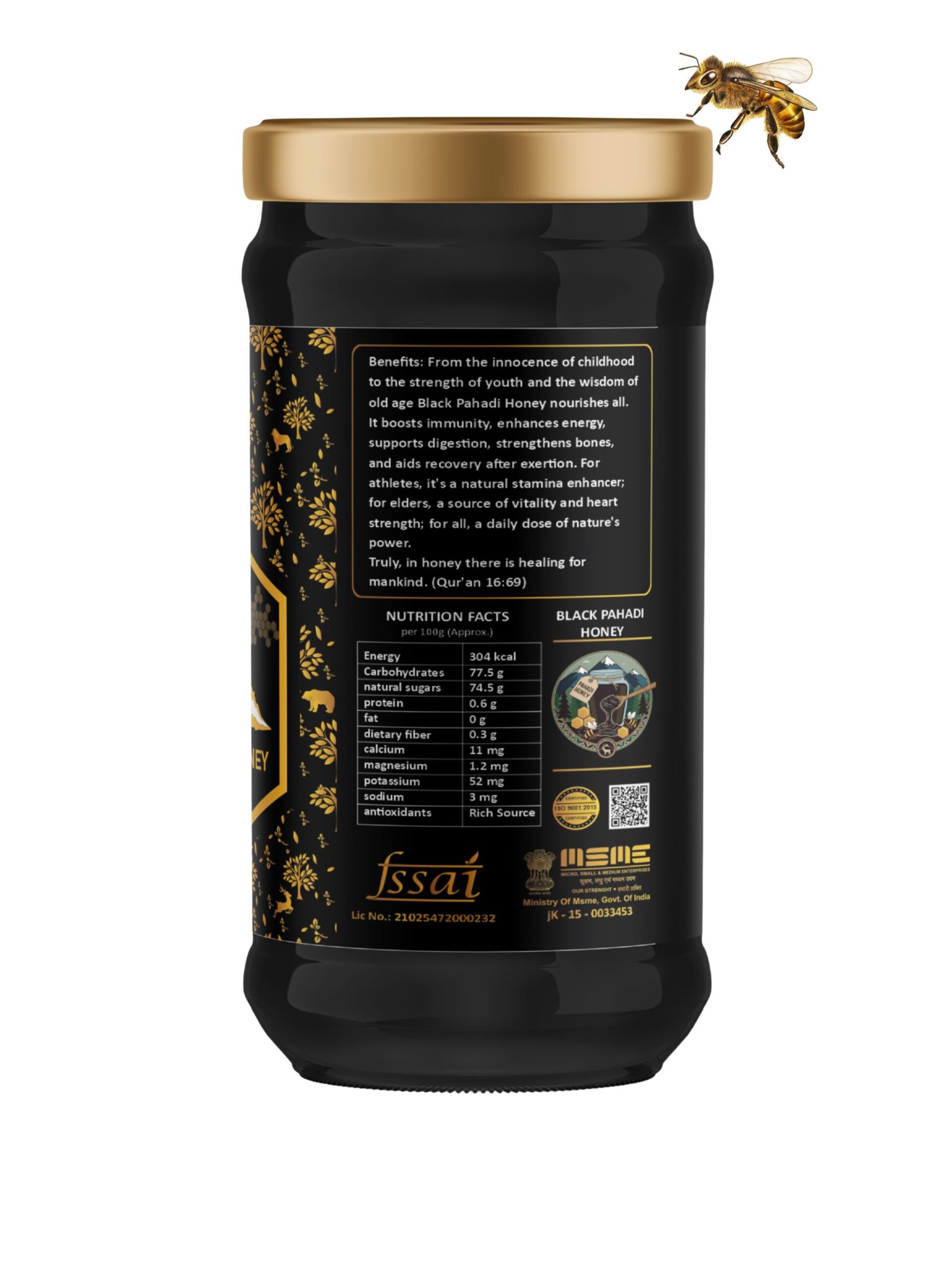
Honey is an energy-containing food made up predominantly of sugars. The figures in the table are reference values for honey as a food type, from USDA FoodData Central. They are not a laboratory analysis of this product.
Reference data · honey in general
| Nutrient | Per 100 g | Per tablespoon (21 g) |
|---|---|---|
| Energy | 304 kcal | 64 kcal |
| Total carbohydrate | 82.4 g | 17.3 g |
| Total sugars | 82.1 g | 17.2 g |
| — fructose | 40.9 g | 8.6 g |
| — glucose | 35.8 g | 7.5 g |
| Protein | 0.3 g | 0.06 g |
| Total fat | 0 g | 0 g |
| Water | 17.1 g | 3.6 g |
| Potassium | 52 mg | 11 mg |
| Calcium | 6 mg | 1.3 mg |
| Sodium | 4 mg | 0.8 mg |
| Magnesium | 2 mg | 0.4 mg |
| Iron | 0.42 mg | 0.09 mg |
Per-tablespoon figures are calculated from the per-100 g values and rounded.
This product · batch-tested data
Laboratory-tested nutrition for this Black Pahadi Honey batch
Not published in this description. A product-specific nutrition table has to come from a laboratory report for a named batch, and we will not improvise one. For the nutritional declaration that applies to your jar, read the nutrition panel printed on the product label.
Reading the numbers sensibly
- A tablespoon of honey supplies roughly 64 kcal, almost entirely from sugars.
- The minerals in honey are present in milligram amounts per 100 g. At ordinary serving sizes, honey is not a significant source of them.
- Dark colour does not tell you how much iron, magnesium, potassium or any other mineral a given jar contains.
- Honey is not sugar-free, not low-calorie and not suited to unlimited consumption.
Tradition and responsibility
Traditional use, and what we will not promise
Honey is among the oldest sweeteners people have used, and a familiar presence in South Asian kitchens and households. That history is real. It is also a different thing from clinical proof.
In the kitchen and the household
How honey has traditionally been used:
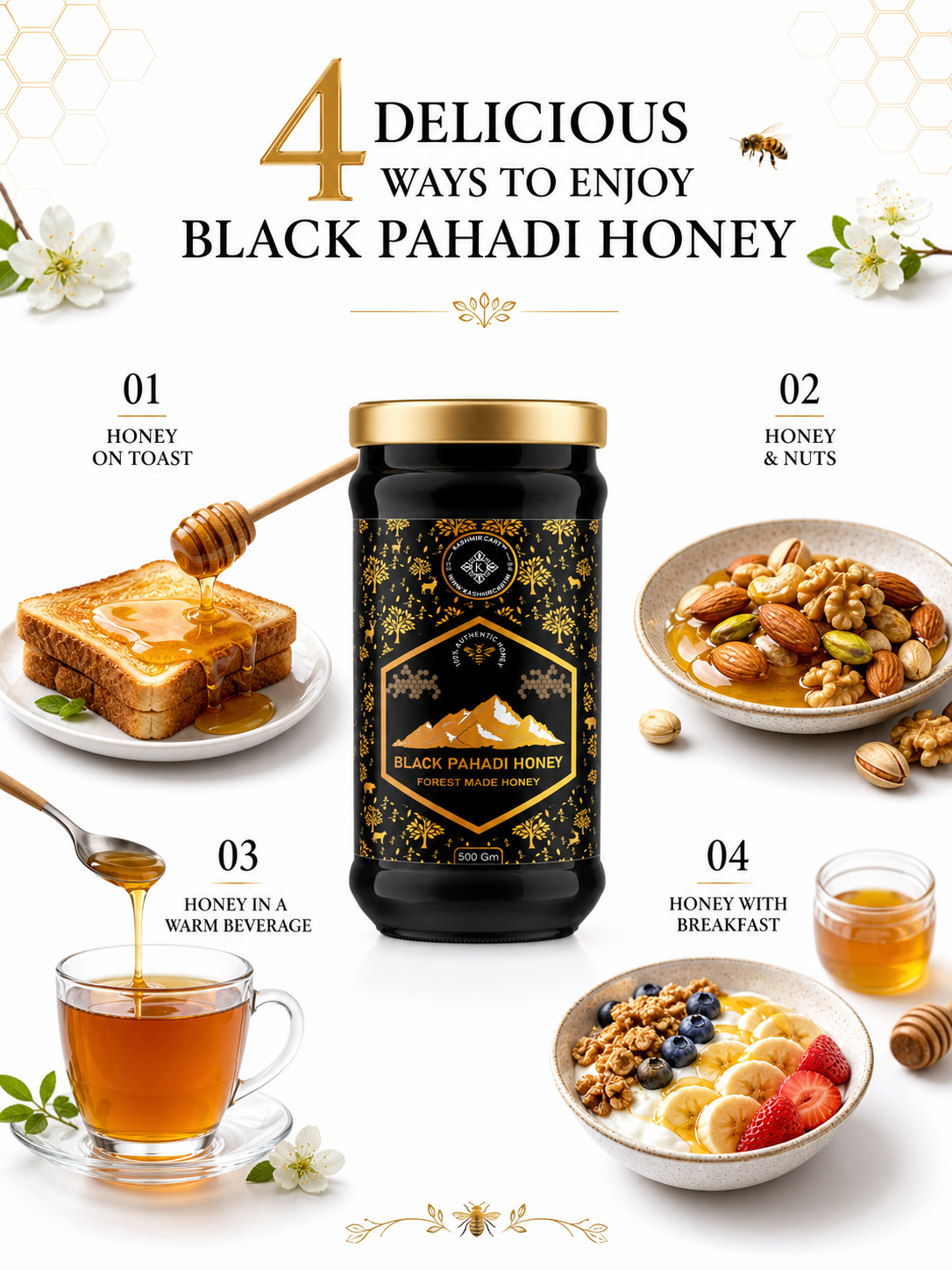
- As a food in its own right — by the spoon, with bread, with nuts.
- To sweeten tea, kahwa, milk and other drinks.
- Stirred into a warm drink as a familiar household comfort when the throat feels scratchy.
- In food preparation: glazes, dressings, marinades, sweets and baking.
- As a pantry staple valued for keeping well when stored dry and sealed.
Where the evidence stands
Honey has a long record in traditional systems, including Ayurveda. Modern research on honey in general is active — on its sugars, acidity and phenolic compounds, and on its behaviour in laboratory tests — and some clinical studies have examined honey for cough symptoms in children over one year of age.
That research concerns honey as a category. Results differ between honeys and between studies, and none of it was carried out on Black Pahadi Honey.
What this means for you. Enjoy this honey as a food. We do not claim that it cures, treats or prevents any disease or condition, that it guarantees any effect on immunity, digestion, weight, sleep or blood sugar, or that it can stand in for medical care. If you are unwell or managing a health condition, speak to a qualified healthcare professional.
At the table
How to enjoy Black Pahadi Honey
A dark honey has enough character to stand alone, and enough depth to hold its ground beside nuts, grains, dairy and fruit. Ten ways to begin.
By the spoonful
The simplest way to understand a honey. Taste it plain, at room temperature, before you pair it with anything.
On bread or toast
Over buttered toast or warm flatbread, where its malty depth has room to show.
Over oats
Drizzle it onto porridge once it is in the bowl, rather than cooking it in.
With yoghurt
Dark honey against plain, tart dahi is a classic contrast.
With walnuts and almonds
Kashmiri kernels and dark honey are natural companions — sweet, bitter and rich in turn.
With cheese
Good beside mild, fresh or lightly aged cheeses. A little goes a long way.
In kahwa and tea
Stir it in after pouring, to taste, in place of sugar.
In warm water
Let the water cool to a comfortable drinking temperature, then stir the honey in.
In desserts
As a finishing drizzle over fruit, phirni, pancakes or ice cream.
With dried fruits
Alongside apricots, figs and raisins on a sharing plate.
A note on heat. Heating honey changes some of its chemical characteristics: delicate aromas are lost, enzyme activity falls and HMF rises with temperature and time. That is a matter of flavour and quality — cooking and baking with honey are long-established culinary practice. If you want to taste this honey at its fullest, add it at the end.
Honey is a food for older children and adults; it must never be given to infants under 12 months. No daily amount is recommended here. Honey is a concentrated source of sugars, so let your own diet set the portion.
Kitchen notes
Eight simple recipes with Black Pahadi Honey
These are culinary suggestions, not medicinal preparations. Honey contains naturally occurring sugars; treat the quantities as a starting point and adjust them to your taste and your own diet. One tablespoon of honey weighs about 21 g.
Honey and walnut breakfast bowl
Ingredients
- 40 g rolled oats (about ½ cup)
- 200 ml milk or water
- 20 g walnut kernels, roughly broken
- ½ apple or 1 small banana, sliced
- 1 tbsp (21 g) Black Pahadi Honey
- A pinch of ground cinnamon, optional
Method
- Simmer the oats in the milk or water for 4–5 minutes, stirring, until creamy.
- Spoon into a bowl and rest for a minute.
- Top with the fruit and walnuts, then drizzle the honey over just before eating.
Variation. Use almonds or mixed seeds in place of walnuts, or soak the oats overnight in the fridge for a no-cook version.
Kashmiri walnut and honey toast
Ingredients
- 2 thick slices of bread — sourdough, or a Kashmiri girda if you have one
- 2 tsp butter or ghee
- 30 g Kashmiri walnut kernels
- 1 tbsp (21 g) Black Pahadi Honey
- A small pinch of flaky salt
Method
- Toast the walnuts in a dry pan over low heat for 3–4 minutes until fragrant, then crush lightly.
- Toast the bread and spread it with butter or ghee while hot.
- Scatter with walnuts, drizzle with honey and finish with the salt.
Variation. Add a layer of fresh cheese or hung curd under the walnuts, or a few slices of ripe pear.
Honey and saffron warm milk
Ingredients
- 250 ml milk
- 5–6 strands of saffron
- 1 green cardamom pod, lightly crushed, optional
- 1–2 tsp Black Pahadi Honey
- 1 tsp slivered almonds
Method
- Warm 2 tablespoons of the milk and steep the saffron in it for 10 minutes.
- Heat the remaining milk with the cardamom until it just begins to steam, then take it off the heat.
- Stir in the saffron milk and let the cup cool to a comfortable drinking temperature.
- Stir in the honey, top with the almonds and serve.
Variation. Use an unsweetened plant-based milk, or add a small pinch of ground nutmeg.
Adding honey once the milk has cooled avoids unnecessary heat exposure. It does not preserve every property of the honey, and it is not a health guarantee.
Honey-lemon beverage
Ingredients
- 250 ml water
- 1–2 tsp lemon juice
- 1–2 tsp Black Pahadi Honey
- A thin slice of fresh ginger or a few mint leaves, optional
Method
- Warm the water, with the ginger if using, then let it cool until comfortable to sip.
- Stir in the honey until dissolved.
- Add lemon juice to taste.
Variation. For a cold drink, dissolve the honey in a little warm water first, then top up with chilled water or soda and ice.
A pleasant drink, not a remedy. Letting the water cool first simply avoids unnecessary heat exposure.
Honey and dried-fruit platter
Ingredients
- 40 g walnut kernels
- 40 g almonds
- 6 dried apricots
- 4 dried figs, halved
- 30 g raisins
- 2 tbsp (about 42 g) Black Pahadi Honey, in a small bowl
- 80 g mild cheese, sliced, optional
Method
- Arrange the nuts, dried fruit and cheese on a board or plate.
- Set the bowl of honey in the centre with a small, dry spoon.
- Let everyone drizzle or dip as they like.
Variation. Add slices of fresh apple or pear in season, or swap the cheese for thick hung curd.
Honey yoghurt bowl
Ingredients
- 150 g plain yoghurt (dahi)
- 1 tbsp (21 g) Black Pahadi Honey
- 15 g chopped nuts
- 50 g fresh fruit, such as pomegranate seeds or berries
- A pinch of ground cardamom, optional
Method
- Spoon the yoghurt into a bowl.
- Top with the fruit and nuts.
- Drizzle the honey over and dust with cardamom.
Variation. Use hung curd for a thicker bowl, or add two spoonfuls of muesli for crunch.
Honey dressing for salads
Ingredients
- 3 tbsp (45 ml) olive oil
- 1 tbsp (15 ml) lemon juice or mild vinegar
- 2 tsp Black Pahadi Honey
- 1 tsp mustard
- Salt and black pepper, to taste
Method
- Put everything in a small, clean jar.
- Close the lid and shake hard until the dressing is thick and even.
- Taste, then adjust the acid, salt or honey.
Variation. Replace part of the olive oil with walnut oil, or add a little crushed garlic or chilli flakes. Good on leaves with apple and walnuts.
Honey-based dessert glaze
Ingredients
- 2 tbsp (about 42 g) Black Pahadi Honey
- 1 tbsp (15 g) butter
- 1 tbsp (15 ml) orange or lemon juice
- A small pinch of salt
Method
- Melt the butter in a small pan over low heat.
- Take the pan off the heat and whisk in the honey, juice and salt until glossy.
- Spoon or brush over baked apples or pears, a plain sponge, or pancakes.
Variation. Add a pinch of cinnamon or ground cardamom. For a dairy-free glaze, leave out the butter and loosen the honey with the juice alone.
From flower to door
The honey journey, and where KASHMIRCART stands in it
Eight stages take a honey from mountain flowers to a kitchen shelf. Bees and their keepers handle the first five; a seller’s responsibility begins with selection. Each stage below is described in general terms, then marked with what is — and is not — documented for this product.
Mountain flora
Orchards, field crops, wild shrubs and forest trees flower in sequence up the slope, setting what bees can collect.
Not documented here
The plants behind this honey have not been identified.Bee foraging
Colonies work whatever is in flower within flying range of the nest.
Not documented here
Bee species not established: Apis spp.Nectar collection
Nectar or honeydew is carried home in the honey stomach, load by load.
General process
True of all honey.Honey maturation
House bees add enzymes, evaporate water and seal ripe honey under wax.
General process
True of all honey.Harvesting
Comb is taken from managed hives or, in honey-hunting traditions, from naturally nesting colonies. The two are different things and should not be confused.
Not documented here
The collection method for this product is not documented in this description.Selection and quality checks
A responsible seller chooses its lots and, ideally, has them tested for composition and residues.
Stated by KASHMIRCART
KASHMIRCART selects this honey. No batch test results are printed in this description.Packaging
Honey is filled into clean, dry containers and sealed against moisture.
Stated by KASHMIRCART
Weighed and sealed in the Kashmir valley.Delivery
Sealed packs travel to the customer. Honey needs no refrigeration on the way.
Stated by KASHMIRCART
Dispatched from Kashmir to homes across India.
Where KASHMIRCART stands
KASHMIRCART is a farming family before it is a shop. Saffron and certain crops are grown on land the family knows first-hand. Honey is one of the goods it carries from other Kashmiri producers.
Our part of this journey is the last three stages: choosing the honey, packing it in the valley and standing behind it by name. We would rather show you that boundary clearly than blur it with a mountain-harvest story we cannot document.
Storage and handling
How to store honey, and what crystallisation means
Honey keeps well because it is low in water and naturally acidic. Storing it is mostly a matter of keeping it that way.
Keep the lid closed
Honey absorbs moisture and odours from the air. Close the pack firmly after every use.
Keep water out
Even a little added water can allow fermentation. Never return a wet spoon to the honey.
Use a clean, dry spoon
Crumbs, butter and other foods carry moisture and microbes into the honey.
Avoid excessive heat
Store it away from the stove, the oven and other warm spots. Heat darkens honey and dulls its aroma.
Keep out of direct sunlight
A closed cupboard at room temperature is ideal. Refrigeration is unnecessary and tends to speed crystallisation.
Follow the label
The storage instructions and best-before date printed on the pack take precedence over this guide.
Does honey crystallise?
Many honeys do. Honey holds more glucose than its water can keep dissolved, and over time some of that glucose can form crystals. How quickly depends on the glucose-to-fructose ratio, water content, botanical origin, fine particles, temperature and storage. Cool rooms favour it; honeys rich in fructose resist it.
Crystallisation is a physical change. It is not spoilage — and it is not proof of purity either, any more than staying liquid is proof of adulteration. Black Pahadi Honey may crystallise, partly or fully, or may stay liquid for a long time. We promise neither.
To soften crystallised honey
- Close the lid and stand the container in a bowl of warm — not hot — water.
- Leave it, replacing the water as it cools, and stir now and then until the crystals dissolve.
- Avoid boiling water and direct heat. Microwaving heats unevenly and is not the method we suggest.
Shelf life: as printed on the pack. We do not quote a shelf life in this description.
Food safety and precautions
Important safety information
Honey is a food with a long record of safe use by older children and adults. “Natural” and “raw” describe how a food is made — not who it is safe for. Please read this section before serving.
Do not give honey to children under 12 months of age.
Honey can contain spores of Clostridium botulinum. In an infant’s immature gut these spores can germinate and produce toxin, causing infant botulism — a rare but serious illness. This applies to all honey, of any kind or origin, raw or processed, whether eaten plain or mixed into food or drinks.
The World Health Organization advises that honey should not be fed to infants before the age of one year.
Allergy and sensitivity
Honey can contain traces of pollen and other bee-derived substances. People with known allergies to pollen or bee products, or who have reacted to honey before, should be cautious and seek medical advice. Stop eating it if you notice any reaction.
Blood glucose and diabetes
Honey is a concentrated source of naturally occurring sugars and raises blood glucose. People with diabetes, and anyone monitoring blood glucose, should count its carbohydrate content and follow their individual dietary advice. We do not describe this honey as suitable for people with diabetes.
Portion awareness
On reference values, about 82 g in every 100 g of honey is sugars. Treat it as you would any other sweetener within your overall diet.
Clean handling and moisture
Use a clean, dry spoon and keep water out. Honey that smells sour or alcoholic, or that foams, may have fermented and should not be eaten.
Storage
Keep the pack sealed, at room temperature, away from heat and sunlight, and out of the reach of small children.
Batch traceability
Keep the label. The batch or lot details, packing date and best-before date printed on the pack identify what you received if you ever have a question or concern.
This is general food-safety information, not medical advice. For questions about your own health or diet, consult a qualified healthcare professional.
Product information
Black Pahadi Honey at a glance
Verified information only. Where a fact has not been established, the table says so rather than filling the gap.
| Field | Information |
|---|---|
| Product name | Black Pahadi Honey |
| Brand | KASHMIRCART |
| Product category | Honey |
| Product form | Honey, as packaged |
| Colour | Dark — deep brown, as observed in the product |
| Taste | House tasting notes: malty and earthy, with a faintly bitter finish. Not a trained-panel evaluation; varies by batch. |
| Texture | House tasting notes: thick and slow-pouring. Varies with temperature and batch. |
| Bee species | Apis spp. — species not established |
| Botanical source | Not established. Not described as monofloral. |
| Geographic origin | Kashmir, Jammu & Kashmir, India — as stated by KASHMIRCART. Harvest locality not specified at batch level here. |
| Collection method | Not documented in this description. KASHMIRCART’s published sourcing statement lists honey among goods supplied by Kashmiri growers and apiarists. No wild-hive claim is made. |
| Processing | Not documented in this description. |
| Heating | Handling records are not reproduced here. No “never heated” claim is made. |
| Filtration | Handling records are not reproduced here. No “never filtered” claim is made. |
| Ingredients | As printed on the packaging. |
| Available pack sizes | 500 g · 1 kg · 5 kg · 10 kg — as listed at the time of writing. See the product options on this page for current availability. |
| Storage | Follow the instructions on the packaging. In general: sealed, dry, at room temperature, away from heat and direct sunlight. |
| Shelf life | As printed on the packaging. |
| Manufacturer / packer | As printed on the label. |
| FSSAI details | As printed on the label. KASHMIRCART publishes its food-business licence number as 21025472000232. A licence permits the packing and sale of food; it is not a purity certificate for any product. |
| Not suitable for | Infants under 12 months of age. |
Frequently asked questions
Black Pahadi Honey: thirty questions, answered plainly
Select a question to read its answer.
About the honey
What is Black Pahadi Honey?
Black Pahadi Honey is a dark, thick honey selected by KASHMIRCART and associated with the mountain landscapes of Kashmir. “Pahadi” means “of the mountains”. It is a food made by honeybees from plant nectar or honeydew.
Why is Black Pahadi Honey dark?
Mainly because of the plants the bees foraged on. Honey colour also reflects minerals, phenolic compounds and flavonoids, and it deepens with age and heat. The exact reason for this honey’s shade has not been established by laboratory analysis.
Is dark honey always better than light honey?
No. Dark and light honeys differ in flavour and composition, not in rank. Studies often find more minerals and phenolic compounds in darker honeys, but that is a tendency across many samples, not a guarantee for any one jar. Choose by taste.
Origin and sourcing
Where is this honey sourced from?
From Kashmir, according to KASHMIRCART’s published sourcing statement, which lists honey among the goods it obtains from growers and apiarists across the valley. Orders are weighed, sealed and dispatched from the Kashmir valley.
Is this honey collected in Tral, Kashmir?
Tral, with Pampore, is KASHMIRCART’s home ground. This description does not assert Tral as the verified harvest site of every batch, because batch-level harvest records are not reproduced here. Ask us for the batch record if the locality matters to you.
Is it wild-hive honey or apiary honey?
This description makes no wild-hive claim. The collection method for individual batches is not documented here, and KASHMIRCART’s sourcing statement refers to growers and apiarists — that is, beekeepers. We will not call it wild-hive honey without records to support it.
What flowers do the bees forage on?
That has not been established. No pollen analysis or supplier floral record is reproduced here. Kashmir’s bee forage includes orchard blossom, field crops, wild shrubs and forest trees, but we do not attribute this honey to any particular plant.
Is it monofloral or multifloral?
It is not described as monofloral. Calling a honey monofloral requires botanical-origin evidence such as pollen analysis. Without that evidence, the honest answer is that its botanical origin has not been established.
What is the difference between wild honey and regular honey?
“Wild honey” usually means honey taken from colonies nesting naturally — in tree hollows, rock faces or other cavities — rather than from managed hives. It describes how the comb was collected. It is not a quality grade, and it does not by itself tell you about purity, composition or safety.
Processing and label terms
What does raw honey mean?
In food marketing, “raw” generally means honey that has had little processing — typically not pasteurised or finely filtered. It is not a laboratory-defined grade, and its meaning varies between producers.
Is this honey unheated?
We do not present “unheated” as a verified claim in this description, because batch handling records are not reproduced here. Heat history is best supported by handling records together with laboratory markers such as HMF and diastase activity.
Is this honey unfiltered?
We do not present “unfiltered” as a verified claim here, for the same reason. Note that most honey is strained through mesh to remove wax and debris; straining is different from fine filtration, which removes most pollen.
Does it contain natural pollen?
Honey commonly contains some pollen, which reaches it naturally through foraging bees. The pollen content of this honey has not been measured in this description. Pollen alone does not prove purity or origin.
Does it contain propolis?
Not as an ingredient. Propolis is a resinous material bees use in the nest. Traces can find their way into honey during harvesting, but the amount is not standardised and has not been measured here. People sensitive to propolis should take note.
Quality and science
Does dark colour prove purity?
No. Colour depends on forage, minerals, phenolic compounds, age and heat. It cannot confirm that a honey is unadulterated. Only laboratory testing can assess authenticity.
Does honey naturally crystallise?
Many honeys do. Crystallisation depends on the glucose-to-fructose ratio, water content, botanical origin, temperature and storage. It is a natural physical change — neither spoilage nor proof of purity. This honey may or may not crystallise.
How can honey authenticity be checked?
By laboratory analysis that uses several methods together: sugars, moisture, HMF, diastase, proline, electrical conductivity, pollen, and specific adulteration markers such as carbon-isotope and foreign-sugar tests. No home test — water, flame, thumb, ant or colour — is reliable.
What laboratory tests are relevant to honey?
Moisture, fructose and glucose, sucrose, reducing sugars, free acidity, electrical conductivity, HMF, diastase activity, proline, pollen count, water-insoluble matter, adulteration markers, and residue and contaminant screening. FSSAI’s 2024 manual of methods for honey describes the reference procedures.
Is honey a source of antioxidants?
Honey contains phenolic compounds and flavonoids that show antioxidant activity in laboratory assays, and darker honeys often contain more of them. The amounts are small and vary widely. The antioxidant capacity of this honey has not been verified, and we make no health claim on that basis.
What is the nutritional composition of honey?
On USDA reference values, 100 g of honey provides about 304 kcal, 82.4 g of carbohydrate (82.1 g of it sugars, mainly fructose and glucose), 0.3 g of protein, no fat and about 17 g of water, with small amounts of minerals such as potassium. These are generic values, not a test of this product.
Does honey contain natural sugar?
Yes. Honey is predominantly sugars — chiefly fructose and glucose — which occur in it naturally. On reference values, one tablespoon (21 g) contains about 17 g of sugars.
Use, storage and safety
Can people with diabetes consume honey?
Honey raises blood glucose and counts as carbohydrate. People with diabetes should consider its carbohydrate content and follow the advice of their doctor or dietitian. We do not describe this honey as suitable for people with diabetes.
Can I add this honey to tea or kahwa?
Yes. Stir it in after pouring, to taste. If you want to limit heat exposure, let the cup cool to a comfortable drinking temperature first.
Can I use it in warm milk?
Yes. Warm the milk, let it cool until it is comfortable to drink, then stir in the honey. This avoids unnecessary heat; it does not guarantee any particular benefit.
How should I store honey?
Tightly closed, in a dry place at room temperature, away from heat and direct sunlight. Use a clean, dry spoon and keep water out. Follow the instructions printed on the pack.
Can children consume honey?
Children over 12 months can eat honey as part of a normal diet, in sensible amounts, as with any sweet food. Honey must never be given to infants under 12 months.
Why must infants under one year avoid honey?
Honey can contain Clostridium botulinum spores. An infant’s gut is not yet mature enough to stop them germinating, which can lead to infant botulism, a rare but serious illness. This applies to all honey.
Choosing and verifying
What makes Black Pahadi Honey different?
Its character: a deep brown colour, a thick body and a malty, earthy flavour with a faintly bitter finish, as described in our house tasting notes. It also comes with an unusually plain account of what is, and is not, known about its origin.
What pack sizes are available?
At the time of writing, Black Pahadi Honey is listed in 500 g, 1 kg, 5 kg and 10 kg packs. Check the product options on this page for current availability.
How can I verify the product’s origin and quality?
Start with the label: the packer’s name and address, the FSSAI licence number, batch or lot details and dates. Then ask KASHMIRCART for the batch record, and whether a laboratory report exists for that batch. A meaningful report names the laboratory, the test date, the batch and the methods used.
The house behind the honey
We don’t just sell Kashmiri products. We farm them.
KASHMIRCART is a family-run house from Pampore and Tral, in the Pulwama district of Jammu & Kashmir. The family’s farming roots go back to 1977, in Pampore’s saffron belt. The company was incorporated in 2013 and has sold online since 2016, sending Kashmiri produce directly to homes across India.
- Farming roots
- 1977
- Company incorporated
- 2013
- Online since
- 2016
- Rooted in Kashmir
- Pampore & Tral
How the house sources, in three honest tiers
Farmed by the family
Saffron and certain crops, from fields around Pampore and Tral that the family knows first-hand.
Kashmiri growers and makers
Orchard nuts, honey, kahwa and other goods, from growers, apiarists and makers across the valley. Black Pahadi Honey belongs here.
Beyond the valley, labelled
A few lines in the wider catalogue come from trusted suppliers elsewhere, and are labelled as such.
Heritage, selection and plain speaking
A farming family reads a product differently from a trader: by the season it came from, the people who produced it and what can honestly be said about it. That is the standard this description holds itself to. Where we know something, we say it. Where we do not, we say that too.
What registrations do and do not mean
KASHMIRCART holds a food-business licence from FSSAI and an ISO 9001:2015 certificate for its quality management system. Both are company-level. A licence permits a business to pack and sell food; ISO 9001 concerns how a business manages quality. Neither certifies the purity, the geographical origin or any health property of this particular honey — and we do not present them as if they did.


Rohan Bakshi (verified owner) –
Jet-black, super thick and that slight bitter kick at the end — this is the real wild honey I grew up with in Himachal. Kashmircart delivered free in just 4 working days. Pure gold!
Dr. Sneha Malhotra (verified owner) –
Tested it myself — zero added sugar, high pollen count, dark amber on spectrometer. Best therapeutic honey I recommend to patients. Reached in 5 working days
Akshay Thakur (verified owner) –
One spoon in warm water every morning = no colds this season. Kashmircart’s free delivery in 4 days is cherry on top
Vivaan Kapoor (verified owner) –
Darkest honey I’ve ever seen in India. Smoky, strong, no fake sweetness. Delivered free in 5 working days
Ananya Koul (verified owner) –
Using for sore throat — works faster than any cough syrup. 100% raw and unprocessed. Kashmircart packing was flawless
Sahil Bhat (verified owner) –
Taste of Kashmir forests in every drop. Kashmircart you are keeping our heritage alive
Meera Pandit (verified owner) –
No crystallisation even after 3 months, stays thick and dark. That’s how you know it’s pure. Free delivery in 4 days
Rajveer Singh (verified owner) –
Best gift I gave my parents this year. They finished half jar in a week! Kashmircart delivered in 5 working days
Drishti Sharma (verified owner) –
Little pricey but you literally taste the difference. Worth every rupee for this purity
Aarav Tickoo (verified owner) –
My Kashmiri friend said ‘yeh asli wala hai’ — highest compliment! Delivered free in 4 days
Kavya Rajput (verified owner) –
Perfect for detox water. Dark colour, thick flow, unique flavour. Kashmircart never disappoints
Aditya Kachru (verified owner) –
Stronger than regular honey but in the best way. Best for winter health. Reached in 5 working days
Sana Mir (verified owner) –
Finally a brand that doesn’t dilute forest honey! Kashmircart delivered pure black gold in 4 days
Rishi Mehra (verified owner) –
One spoon at night = deep sleep. Works like magic for me. Free & fast delivery
Ayesha Wani (verified owner) –
My entire family is hooked now. Kashmircart’s quality is consistent every order
Tanya Gupta (verified owner) –
Slightly expensive but you get what you pay for — unmatched purity. Free delivery in 4 days
Arnav Koul (verified owner) –
Taste takes me straight to Gulmarg forests. Kashmircart delivered this memory in just 5 working days
Dr. Imran Lone (verified owner) –
Recommending to all my patients with respiratory issues. Works wonders. Kashmircart quality is excellent
Rhea Kapoor (verified owner) –
Perfect balance of sweet & bitter. My kids call it ‘chocolate honey’ 😂 Kashmircart delivered in 4 days
Aaditya Rajan (verified owner) –
Best black honey available online right now. Kashmircart delivered fresh bottle in 5 working days
Sahana Bhat (verified owner) –
Using for face packs too — skin glows! 100% pure forest honey. Free delivery in 4 days
Reyansh Malhotra (verified owner) –
Kashmircart has nailed authenticity. This is how real pahadi honey should taste
Aarohi Singh (verified owner) –
My go-to for cough & cold season. Works every single time. Delivered in 5 working days
Veer Thakur (verified owner) –
Thicker than any honey I’ve tried. Kashmircart delivered in just 4 working days — impressive!
Siya Sharma (verified owner) –
Best investment for health. Kashmircart’s purity is unmatched
Ayaan Raina (verified owner) –
Taste of Kashmir in Bangalore! Kashmircart delivered fresh in 5 working days
Inaya Koul (verified owner) –
Perfect for fasting too — breaks fast gently. 100% pure. Free delivery in 4 days
Rudra Bhatia (verified owner) –
Kashmircart is preserving a dying art. This honey is priceless
Aahana Mehra (verified owner) –
Best black honey I’ve bought in years. Kashmircart delivered in 5 working days — will keep ordering
Vihaan Tickoo (verified owner) –
Pure, raw, wild — everything promised. Kashmircart’s free delivery in 4 days is bonus
Saanvi Raina (verified owner) –
My search for real pahadi honey ends here. Kashmircart delivered perfection in 5 working days
Ayaansh Gupta (verified owner) –
Best gift for health-conscious friends. Kashmircart’s quality speaks for itself
Zoya Bhat (verified owner) –
Kashmircart brought Kashmir to my doorstep in just 4 working days. Pure love
Reyansh Sharma (verified owner) –
Dark, thick, medicinal taste — exactly what I wanted. Free delivery in 5 days
Aarush Koul (verified owner) –
Best honey for weight management too! Kashmircart delivered fresh in 4 working days
Sahil Mir (verified owner) –
My family’s new favourite. Kashmircart’s purity is addictive
Tanya Raj (verified owner) –
Slightly costly but you can taste why. Kashmircart delivered in 5 working days
Arnav Thakur (verified owner) –
Kashmircart has set the gold standard for black honey. Delivered free in 4 days
Mehak Singh (verified owner) –
Using for allergies — huge improvement! Kashmircart delivered pure medicine in 5 days
Aaditya Bhatia (verified owner) –
Best black pahadi honey in market right now. Kashmircart free delivery in 4 days
Sahana Koul (verified owner) –
Taste of my roots. Thank you Kashmircart for keeping it real
Rishi Malhotra (verified owner) –
Kashmircart delivered pure forest honey in just 5 working days. Will buy lifetime
Aarohi Raina (verified owner) –
Best honey I’ve ever bought online. Kashmircart’s quality is unmatched
Veer Gupta (verified owner) –
Pure, raw, wild — everything promised and more. Delivered in 4 working days
Siya Bhat (verified owner) –
Kashmircart brought real Kashmir to my home. Free delivery in 5 days
Ayaan Sharma (verified owner) –
Best immunity booster in my kitchen. Kashmircart delivered fresh in 4 working days
Inaya Thakur (verified owner) –
Pure love in a jar. Kashmircart’s 5 working days delivery was perfect
Rudra Koul (verified owner) –
Kashmircart has my full trust now. Delivered pure black honey in just 4 working days
Aahana Singh (verified owner) –
Best black honey experience ever! Kashmircart delivered fresh in 5 working days
Akshita Sharma (verified owner) –
Bhai sach mein itna kaala aur thick honey pehli baar dekha! Taste bhi alag level ka hai. Kashmircart ne 4 din mein free deliver kar diya
Dr. Vikram Singh (verified owner) –
Extremely pure, unprocessed forest honey with highest antioxidant levels I’ve tested. Perfect for respiratory health. Reached in 5 working days
Rahul Thakur (verified owner) –
Yaar yeh wahi asli pahadi shahad hai jo bachpan mein dadaji laate the! No sugar, no cheating. 4 din mein free aa gaya
प्रिया कुमारी (verified owner) –
यह शहद बिल्कुल जंगल का है, काला, गाढ़ा और थोड़ा कड़वा मीठा। कश्मीरकार्ट ने 5 दिन में फ्री डिलीवरी की। बहुत बढ़िया!
Kavya Menon (verified owner) –
இது ரொம்ப டார்க்கும் திக்கும் இருக்கு! சுவை வேற லெவல். காஷ்மீர்கார்ட் 5 நாள்ல ஃப்ரீ டெலிவரி பண்ணாங்க. சூப்பர்!
Arjun Malhotra (verified owner) –
Bilkul black, bilkul thick aur taste mein woh smoky kadwahat jo sirf real forest honey mein hoti hai. Kashmircart delivered in 4 days free
Sahil Bhat (verified owner) –
The darkest, richest honey I’ve ever had. Tastes like liquid forest. Kashmircart’s purity is unmatched. 5 days delivery
Neetu Verma (verified owner) –
Ek spoon subah garam pani mein daalte hi body mein jaan aa jaati hai! Kashmircart ne 4 din mein free deliver kiya
राकेश कुमार (verified owner) –
यह काला शहद सचमुच जादुई है। गला खराब हो तो एक चम्मच ले लो, आराम। 5 दिन में फ्री डिलीवरी मिली
Arnav Koul (verified owner) –
Finally found authentic black pahadi honey in Bangalore! Kashmircart delivered free in just 4 working days. Pure nostalgia
Shivani Raina (verified owner) –
Bhai yeh taste bhool hi nahi sakte! Thoda kadwa thoda meetha — perfect balance. 5 din mein free aa gaya
Dr. Sameer Ahmed (verified owner) –
Highest medicinal value among all honeys I’ve tested. Recommending to all my patients. Kashmircart packing perfect
Tanya Gupta (verified owner) –
Thoda costly hai lekin ek baar taste kar lo toh samajh aayega paisa vasool hai. Purity top level
विकास शर्मा (verified owner) –
यह शहद देखते ही पता चल जाता है कि शुद्ध है। काला रंग, गाढ़ापन सब असली। कश्मीरकार्ट ने 4 दिन में पहुँचा दिया
Arpit Bhatia (verified owner) –
Pure wild honey with zero adulteration. My whole family is loving it. Delivered free in 5 working days
Rohan Tikoo (verified owner) –
Yaar yeh jar kholo toh khushboo hi bata deti hai ki yeh asli hai! Kashmircart ne 4 din mein free pahuncha diya
Sana Mir (verified owner) –
Best honey for fasting and detox. Dark colour, thick texture, unique flavour. Kashmircart never disappoints
Pratham Singh (verified owner) –
Bhai ek baar try karo toh regular honey wapas nahi kha paaoge. Yeh level alag hai. 5 din mein free delivery
सोनिया मेहरा (verified owner) –
मेरी मम्मी को गला खराब रहता था, यह शहद लेने के बाद बहुत आराम है। कश्मीरकार्ट की सर्विस भी बहुत अच्छी
Vignesh Kumar (verified owner) –
கருப்பு தேன் ருசி அட்டகாசம்! குளிர் காலத்தில் தொண்டை பிரச்சனைக்கு உடனே ரிலீஃப். காஷ்மீர்கார்ட் 4 நாள்ல ஃப்ரீ டெலிவரி
Ananya Koul (verified owner) –
The real taste of Kashmir forests! Kashmircart delivered this treasure in just 4 working days free
Rishi Pandit (verified owner) –
Ek spoon raat ko sote waqt — neend kitni gehri aati hai! Kashmircart ne 5 din mein free deliver kiya
Mehak Qureshi (verified owner) –
Thoda mehnga hai but purity dekh ke lagta hai sahi price hai. Kashmircart 4 din mein free deliver kar deta hai
अजय कुमार (verified owner) –
यह शहद देखकर ही लगता है कि शुद्ध है। काला रंग और गाढ़ापन कमाल का। 5 दिन में फ्री मिला
Aarav Raina (verified owner) –
Pure, unfiltered, wild — everything I wanted in black honey. Kashmircart delivered free in 5 days
Shweta Thakur (verified owner) –
Bhai yeh jar khulte hi khushboo se pata chal jaata hai ki yeh asli hai! 4 din mein free aa gaya
Dr. Imran Lone (verified owner) –
Best medicinal honey available in India right now. Patients seeing great results. Kashmircart quality consistent
Tanya Raj (verified owner) –
Slightly bitter-sweet aftertaste jo sirf real honey mein hota hai. Kashmircart ne 5 din mein free deliver kiya
ரம்யா செல்வம் (verified owner) –
கருப்பு தேன் ரொம்ப நல்லா இருக்கு! சளி, இருமலுக்கு உடனே நிவாரணம். காஷ்மீர்கார்ட் 4 நாள்ல ஃப்ரீ டெலிவரி
Sahil Kachru (verified owner) –
The only honey that doesn’t crystallise even after months. Kashmircart delivered in 4 working days free
Nehal Bhatia (verified owner) –
Yaar yeh taste ek baar try karo toh baaki sab fake lagega! 5 din mein free delivery
सुनीता देवी (verified owner) –
हमारे यहाँ पहाड़ों में यही शहद मिलता था। कश्मीरकार्ट ने पुरानी यादें ताज़ा कर दीं। 4 दिन में फ्री डिलीवरी
Arnav Tickoo (verified owner) –
Pure wild honey with visible pollen grains. Kashmircart delivered this gem in just 5 days
Rohan Mir (verified owner) –
Bhai yeh jar kholo toh khushboo se dil khush ho jaata hai! Kashmircart ne 4 din mein free pahuncha diya
Dr. Priya Menon (verified owner) –
Best honey for PCOS and insulin resistance. Patients reporting great improvement. Kashmircart quality superb
Tanya Gupta (verified owner) –
Thoda costly hai lekin purity aur taste dekh ke lagta hai bilkul sahi price
अभिषेक सिंह (verified owner) –
यह शहद पीने से इम्यूनिटी बहुत बढ़ गई है। कश्मीरकार्ट की क्वाल really top class है
Aditi Rajan (verified owner) –
இந்த கருப்பு தேன் ருசி அட்டகாசம்! காற்று பிரச்சனைக்கு சூப்பர் ரிலீஃப். காஷ்மீர்கார்ட் 4 நாள்ல ஃப்ரீ டெலிவரி
Rohan Tickoo (verified owner) –
Bhai yeh honey itna kaala hai ki light bhi absorb kar leta hai 😂 Taste bhi killer hai. 5 din mein free aa gaya
सुमित शर्मा (verified owner) –
यह शहद बिल्कुल काला सोना है। सर्दी-खांसी में रामबाण। कश्मीरकार्ट की पैकिंग भी शानदार
Aarush Malhotra (verified owner) –
The only honey my diabetic father can have without worry. Kashmircart delivered safely in 4 working days
Pratham Bhatia (verified owner) –
Yaar yeh taste bhool nahi paaoge! Kashmircart ne 5 din mein free pahuncha diya. Ab permanent order
விக்னேஷ் குமார் (verified owner) –
கருப்பு தேன் சூப்பர் டேஸ்ட்! காஷ்மீர்கார்ட் 4 நாள்ல ஃப்ரீ டெலிவரி பண்ணாங்க. செம்ம டேஸ்ட்
Ananya Raina (verified owner) –
Pure, raw, wild — everything promised and more. Kashmircart delivered this piece of Kashmir in just 5 days