


KASHMIRCART · The Farmer’s Journal · Pampore, Kashmir
The Golden Threads of Kashmir
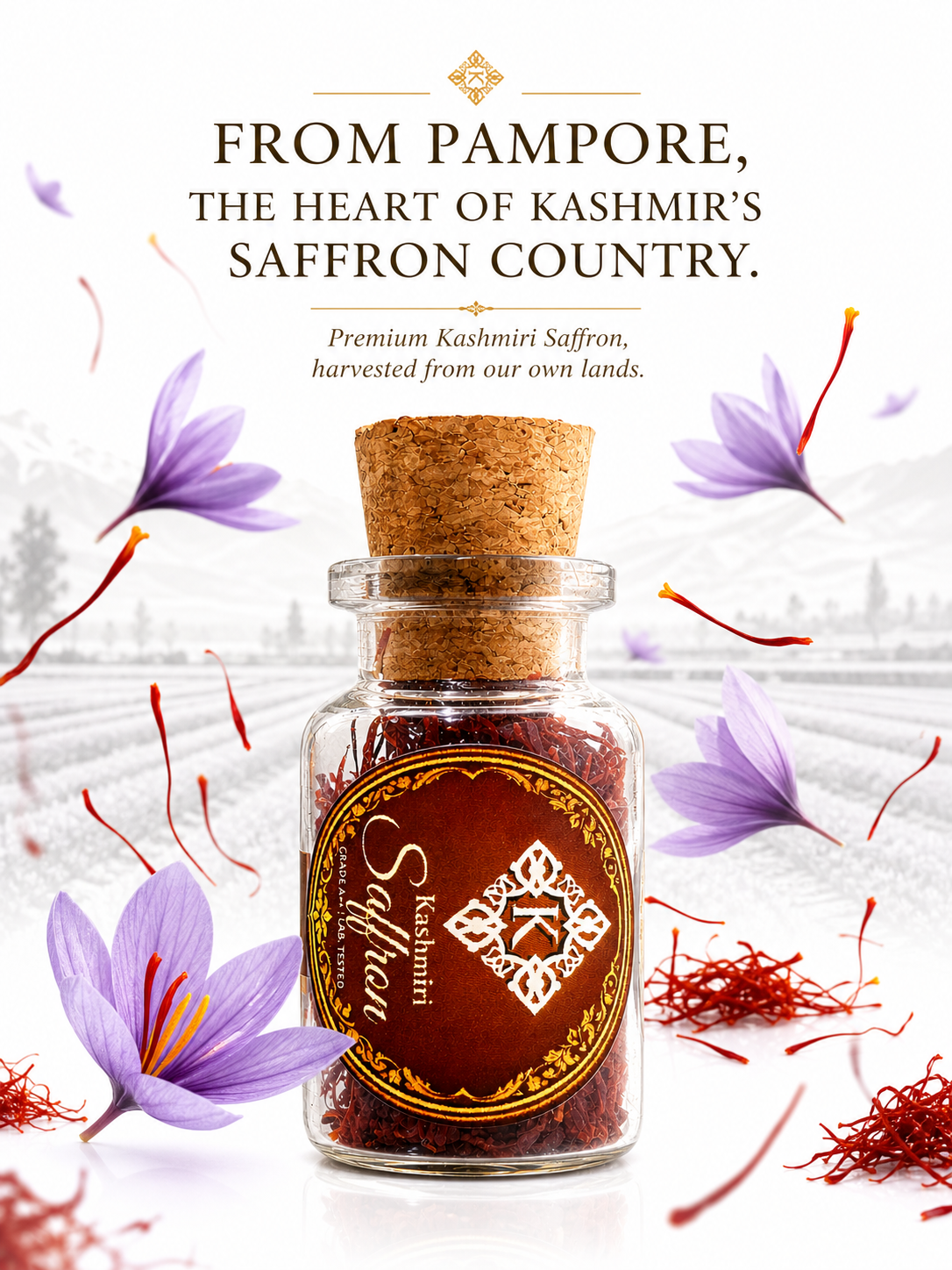
Every autumn, for a few short weeks, the karewa plateaus of Pampore turn violet with crocus flowers — and the whole valley rises before the sun to gather them. Inside each flower wait three crimson stigmas: the only part of the plant that becomes saffron. This is Kashmiri Saffron, Kashmiri Kesar as our grandmothers named it, and this journal is our attempt to tell you honestly how it grows, how it is harvested, how to judge it, and how to use it — told by the people who farm it.
II The Farmer’s Story
We know the land behind every harvest.
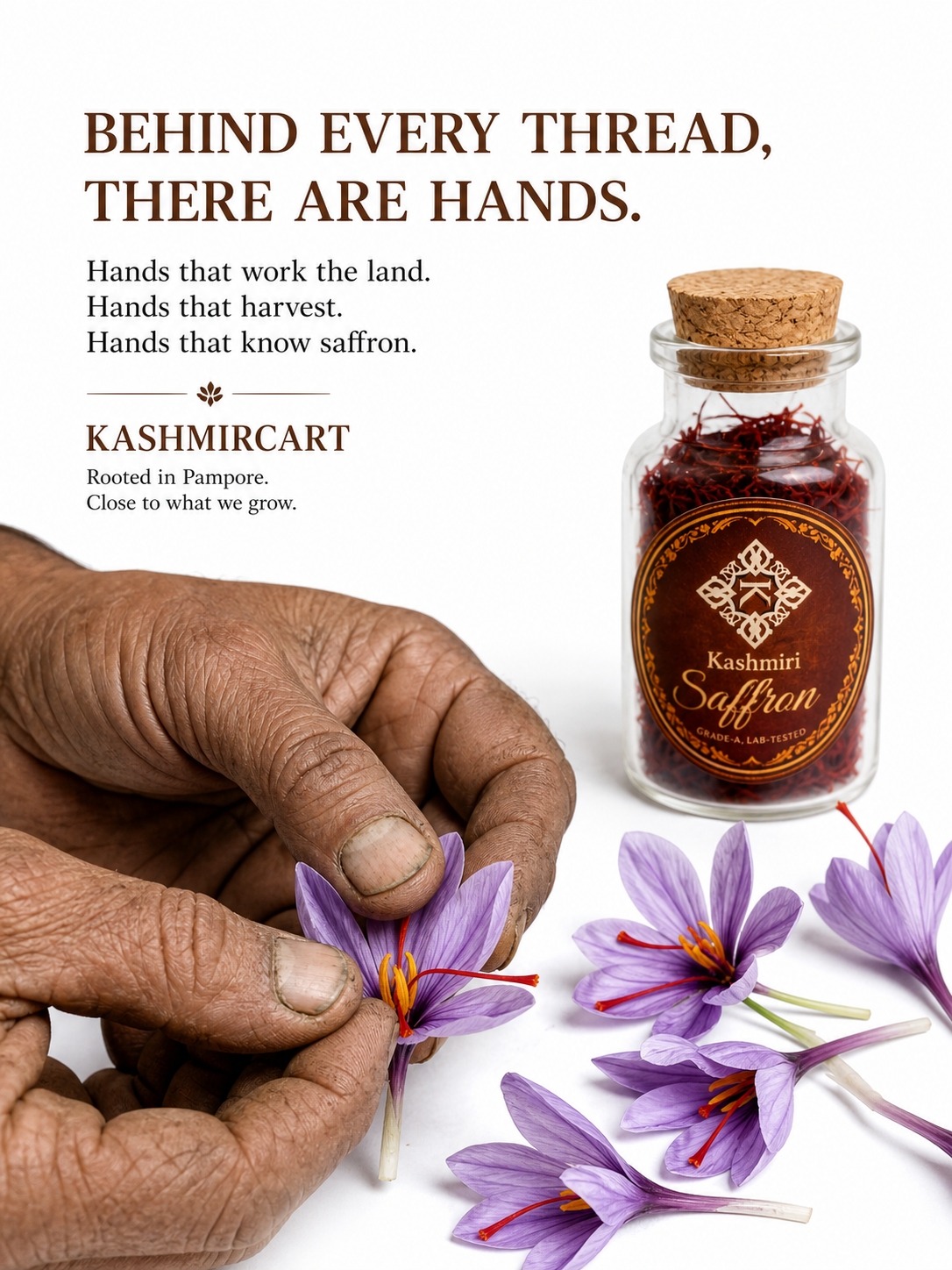
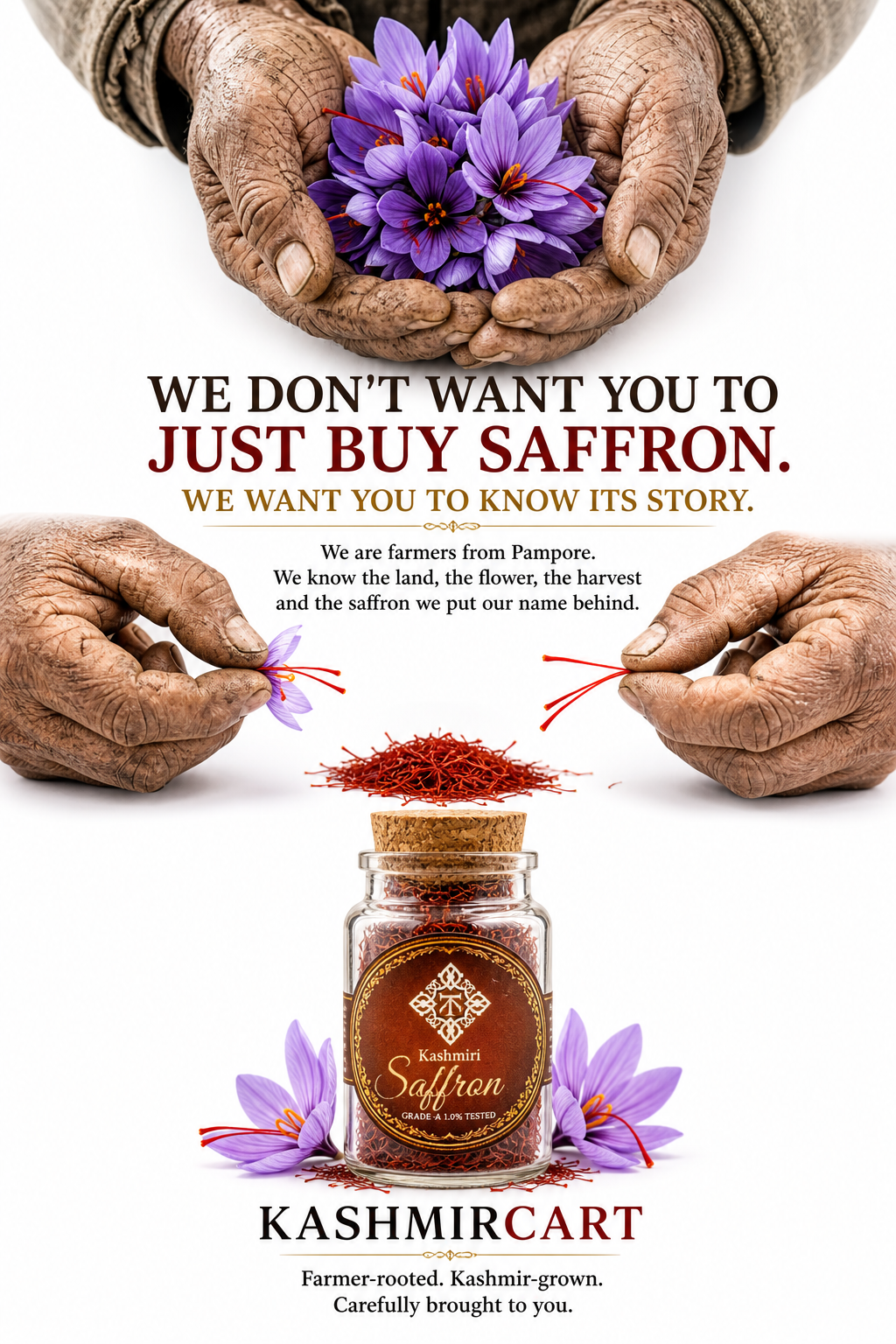
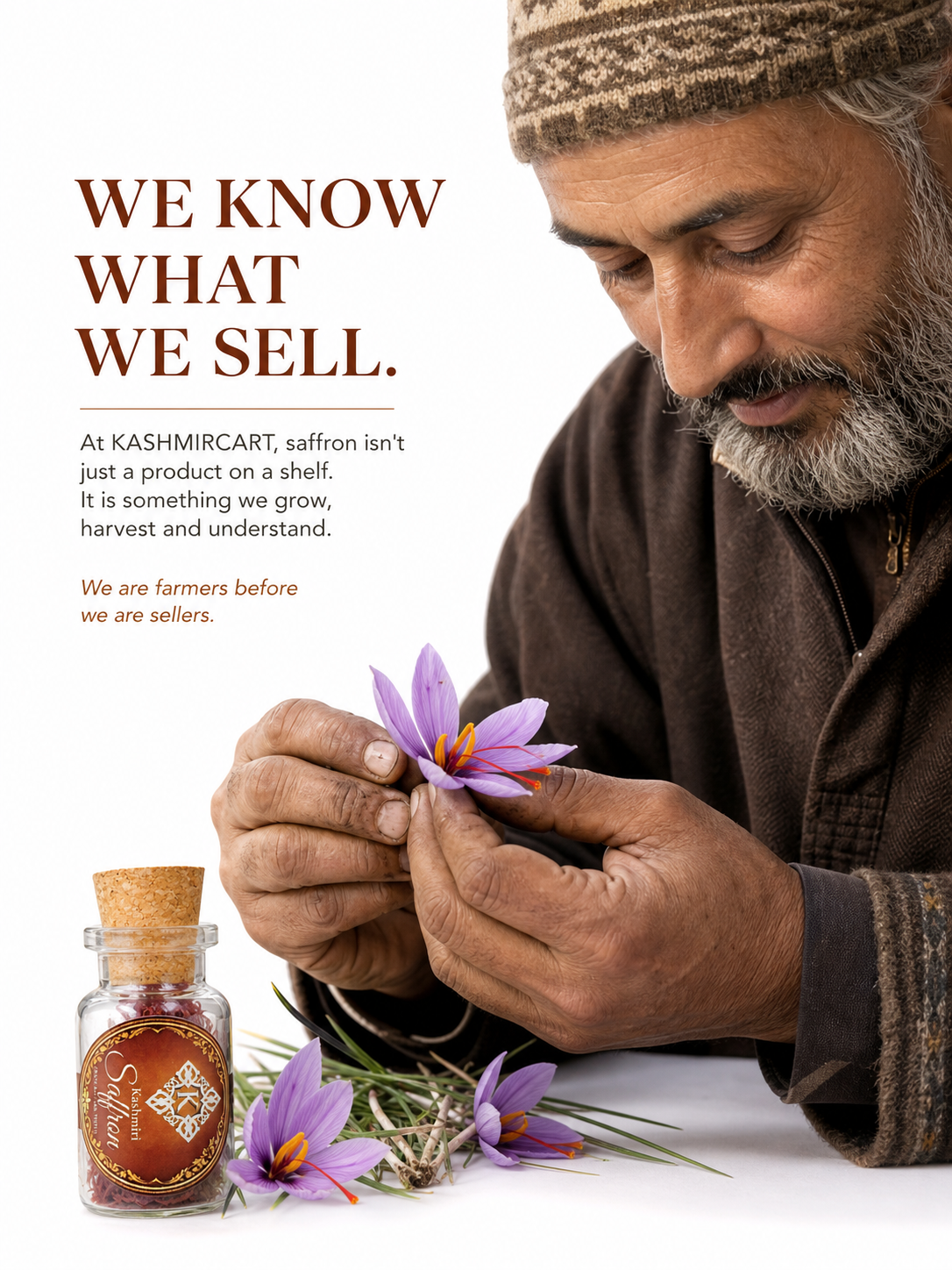
KASHMIRCART is a family-run house from Pampore and Tral, in the Pulwama district of Kashmir. Our farming roots go back to 1977 — the first karewa seasons our family worked in Pampore’s saffron belt — and three generations have farmed these plateaus since. We were farmers before we were a website. The company was incorporated in 2013, and only in 2016 did the harvest begin travelling directly to homes across India. The order of those dates matters to us: the field came first.
When we say we know this saffron, we mean it the way a grower knows a crop — by the feel of the soil in a dry September, by the date the first flower opens, by how a stigma snaps when it is properly dry. Our saffron and certain other crops come from fields around Pampore and Tral that our family knows first-hand, with picking, drying and packing overseen by the house itself. Other goods in our catalogue — orchard nuts, honey, kahwa, gucchi — come from Kashmiri growers and makers we have worked with for years, and the few lines sourced beyond the valley are labelled as such. Nothing is brokered silently.
That is the whole of our claim, and we think it is the only claim worth making: read the full story of the house, and judge the threads against it.

We don’t just sell Kashmiri products.
We farm them.
Own-farmed
Saffron and certain crops come from fields around Pampore and Tral the family knows first-hand — picking, drying and packing overseen by the house itself.
Kashmiri growers & makers
Orchard nuts, honey, kahwa, gucchi and spices come from growers, apiarists and makers across the valley we have worked with for years.
Beyond the valley — labelled
A few catalogue lines come from trusted suppliers outside Kashmir. They are labelled as such, never dressed up as valley produce.
III The Botanical Plate
Discover the saffron flower, part by part.
Saffron is not a petal, not a seed and not a stamen. It is the dried stigma of Crocus sativus — and knowing exactly which part you are buying is the first lesson in judging kesar.
Examine the plate
Choose a part to isolate it on the drawing. The rest of the flower fades so you can see exactly what we harvest — and what we leave behind.
One flower, three threads
A saffron crocus carries exactly three deep-red stigmas — never four, never fewer. Cut at their base and dried, these three threads are the entire harvest of one flower.
- Petals
- Six violet tepals that shield the spice; beautiful, but not saffron.
- Stigmas
- Three crimson, trumpet-tipped threads — the saffron of commerce.
- Style
- The pale yellow column the stigmas branch from; lighter and milder.
- Stamens
- Three yellow pollen-bearers, often mistaken for saffron by eye.
- Leaves
- Slender grass-like blades that feed the corm through winter.
- Corm
- A swollen underground stem; the plant multiplies through it, never seed.
Plate III · Crocus sativus L. — original drawing for this journalthe stigma is the spice
IV The Land
Pampore — the land of saffron.
A town in the Pulwama district, about fifteen kilometres south-east of Srinagar, whose name has been synonymous with kesar for centuries.
Plate IV · The Saffron Vale — original illustrationon small screens, slide the map sideways
Saffron grows in many parts of the world, but the karewas — the raised, flat-topped plateaus of glacial and lake-laid soil that flank the Jhelum — give Kashmiri saffron its particular character. This ground drains freely, so a corm never sits in standing water; the valley’s altitude of roughly 1,600 metres brings the cool autumn that triggers flowering, and cold winters that the crop needs before it sleeps. Pampore sits at the heart of this belt, which is why the town and the spice are spoken of in the same breath.
The flowering is a brief civic event. Sometime in late October, as the chinar leaves turn, the first violet buds appear — and for roughly forty days the picking runs, family by family, field by field. No calendar fixes the date; the soil’s warmth and the season’s turn do, and the knowledge of when to begin is inherited, not written. It is this local farming knowledge — which karewa dries first, which morning is too dewy to pick — that a buyer can never see in a jar, but always tastes.
A note on GI: “Kashmir Saffron” is a Geographical Indication registered crop (GI Certificate No. 366, granted 2020). That registration protects the region’s produce and attests origin — it belongs to the crop, not to any individual seller, and we do not present it as a certificate of this pack.

V The Harvest Ledger
From field to thread, eight movements.
The traditional Pampore method, stage by stage — with our own published practice marked where it applies. Green tags are the work our house oversees; the rest is the valley’s shared craft.
Stage 01 · Cultivation
Corm cultivation
Saffron is never sown from seed. Swollen underground stems — corms — are planted in the free-draining karewa soil, where each mother corm feeds the season’s flower and raises daughter corms for the next. The field is tended through the year: weeding, loosening, watching the drainage. A saffron bed is not a crop you plant once; it is a relationship you keep.
Our fields · Pampore–Tral beltStage 02 · Flowering
The autumn flush
As the valley cools in late October, the crocus opens — violet across the plateaus for a window of roughly forty days. Each flower lives only a day or two, so the whole farm reorganises itself around the bloom. The first picking date, our family says, is still set the way it was in 1977: by walking the field.
The valley’s calendarStage 03 · Harvest
Picking at first light
Flowers are lifted at dawn, before the sun can wilt the petals and bleach the thread — one blossom at a time, at a stoop, into baskets and cloth gathers. There is no machine for this. At roughly one flower per second of picking, the arithmetic of a single gram begins to explain itself.
First-light pickingStage 04 · Separation
Three threads a flower
The same day — never left to heap and heat — the blossoms are opened at the family table and the three red stigmas are parted from petal and stamen by hand. This is the most patient labour in the whole craft, and the moment where quality is truly made or lost.
Same day · by handStage 05 · Drying
Losing the water, keeping the soul
Fresh stigmas are mostly moisture; drying is what turns them into the stable, aromatic spice. Growers across the world use sun, shade or gentle warmth. Our house dries in shade, slowly, without heat treatment or dyes — and it is during careful drying that saffron’s signature aroma compound, safranal, develops.
Shade-dried · no dyesStage 06 · Selection
Grading at the table
The dried threads are inspected for colour, structure and unwanted floral material — stigma separated from style, the cut the market calls mongra from the style-on cut called lacha. Only the selected threads move forward, the way a grower keeps his own winter stock.
Selected & gradedStage 07 · Testing
What a laboratory can say
KASHMIRCART presents this saffron as lab tested, with batches checked against the ISO 3632 parameters — crocin for colour, picrocrocin for flavour, safranal for aroma. Results belong to a batch number, not to a banner: ask for the report of the lot you receive. We print no assay figures here, so the page can never drift from the harvest.
Batch-level · report on requestStage 08 · Preservation
Weighed & sealed at origin
Every order is weighed at the packing table in the valley and sealed in light-blocking, moisture-controlled containers — nothing padded, nothing polished to look heavier. Parcels leave Kashmir within 48 hours where stock allows, cushioned for the journey, with tracking shared. The thread you steep should taste of the field it left days ago, not of a warehouse year.
Sealed in KashmirStage descriptions combine the traditional Pampore method with KASHMIRCART’s own published practices; where a specific batch differs, its batch record prevails.
VI The Arithmetic
Why saffron is precious.
Rule-of-thumb field arithmetic — ≈150 blossoms per gram, three stigmas each. Real yields vary with thread size and drying; the labour never does.
A gram of saffron is a morning’s stooping, a table’s patience, and a season that refuses to be hurried.
The KASHMIRCART family · Pampore & TralVII The Connoisseur’s Page
Understanding saffron quality — beyond colour.
Colour alone is the shallowest way to judge kesar. Here is the fuller examination a grower gives a lot before it earns a place in the tin.
Thread appearance
Deep maroon-crimson threads, trumpet-flared at the tip, slightly lighter toward the base — naturally uneven, because nature is. Uniform, glossy perfection can be a warning, not a virtue.
Aroma
The classic hay-and-honey perfume — sweet, earthy, unmistakable once learned. Saffron that smells of nothing is tired or false; saffron that smells of perfume has been dressed.
Flavour
Gently bitter, never sweet on the tongue — the bitterness of picrocrocin. A thread that tastes sweet has likely been sugared or dyed to add weight or disguise.
Colouring strength
A few threads should turn a cup of warm water clear gold. This strength comes from crocin and is exactly what laboratories measure — deep red dry colour alone proves nothing.
Moisture & snap
Properly dried threads are light and brittle — they snap rather than bend. Soft, pliable threads hold water you would be paying for at saffron’s price, and they mould sooner.
Cut & composition
Mongra is the market’s name for stigma-only threads; lacha keeps part of the pale style attached. Yellow stamens and floral debris add weight, not strength. This product is presented as whole crimson stigma threads.
Keeping behaviour
Well-dried, well-sealed saffron holds its aroma for many months; mustiness, fading or clumping tells you moisture or light reached it first. How a spice ages is part of its quality.
The four molecules behind the magic
Crocin
A water-soluble carotenoid glycoside — unusual among carotenoids — that releases the golden infusion. It is the reference marker for saffron’s colouring strength.
Picrocrocin
The glycoside behind saffron’s clean, gentle bitterness. During drying it breaks down to form safranal — flavour literally giving birth to aroma.
Safranal
The volatile compound responsible for the hay-honey perfume. It develops with careful drying and escapes with light, heat and air — the reason saffron is sealed.
Crocetin
The carotenoid backbone at the heart of the crocin molecule — the chemistry that anchors both the colour and much of the research interest in saffron.
ISO 3632 — how laboratories read a thread
The international standard for saffron, ISO 3632, grades samples by spectrophotometry — measuring how much light an infusion absorbs at three wavelengths — alongside limits for moisture and extraneous matter. It is the closest thing the spice has to a common language.
Crocin — colouring strength, the headline number of any saffron assay.
Picrocrocin — the bitterness marker behind authentic flavour.
Safranal — the aroma marker of a well-dried, well-kept thread.
Our testing position, plainly: KASHMIRCART sells this saffron with a laboratory-testing position — batches checked for the ISO 3632 parameters, with reports belonging to batch numbers and available on request. We deliberately print no crocin or safranal values on this page, because a number without its matching batch report is decoration. Company-level registrations and quality-system certifications are matters of public record; they are not certificates of any individual pack, and we do not present them as such.
VIII The Buyer’s Eye
How to identify genuine saffron.
Four honest checks — what each can tell you, and where its authority ends.
Look at the thread
Genuine stigmas are crimson, trumpet-flared at one end and slightly paler toward the cut base, with natural irregularity. Perfectly identical threads, or yellow-tipped fibres sold as “pure red”, deserve a second look. Remember: yellow stamens are not saffron at all.
Smell before you steep
Crush a thread between your fingers and inhale: hay, honey, a sweet earthiness. No aroma means exhausted or fake threads; an aggressively perfumed smell suggests something added.
Steep it in warm water
Real saffron releases its gold gradually over minutes, and the thread itself stays red. An instant cloud of red dye is the classic warning sign of colouring applied to the thread.
Ask for the papers
The only conclusive checks happen in a laboratory — ISO 3632 analysis of a named batch, from a seller who can trace the lot. A confident origin story plus batch documentation beats any kitchen trick.
The infusion, minute by minute
Drop a few threads into warm — not boiling — water and watch. This little illustration compresses a quarter of an hour into a few seconds.
After 10–15 minutes: a clear, golden infusion — and the threads themselves are still crimson. Slow gold is the habit of the real thing; instant red bleeding is the warning sign.
The honest limit of home tests
Visual inspection, the water test, the rub test and the baking-soda trick can flag obvious fakes — dyed corn silk, safflower, paper threads. They cannot conclusively authenticate saffron: clever adulteration can pass a colour test, and genuine saffron varies with age and drying. Treat household checks as a first sieve, never a verdict. Conclusive answers come from batch-level laboratory analysis and a seller who can trace the lot — which is why we would rather you ask us for a report than trust a trick.
IX The Valley’s Table
Saffron in Kashmiri culture.
The copper samovar keeps the memory
In a Kashmiri home the samovar — the engraved copper kettle, live coals in its chimney — is never far from conversation. Kahwa poured from it carries cardamom, cinnamon, almond and a few threads of kesar: the valley’s standing offer of welcome.
At a wedding, the same threads gild the modur pulav, the sweet saffron rice studded with fruit and nuts, and sweeten festive dishes like shufta. In Kashmiri, saffron is called kong — and the word turns up wherever the occasion matters.
Long before saffron was a line in a shopping cart, it was a measure of honour in Kashmir. A host judged the occasion by what the kitchen was asked to give: the everyday pot, or the saffron pot. The great feast of the valley — the wazwan, served course by course from copper platters — moves to the rhythm of dishes in which kesar plays its quiet, golden part, and no wedding trousseau of recipes is complete without it.
Kahwa itself is a social institution: brewed through winter mornings, carried to orchards and workshops, poured for guests before a word of business is spoken. The few threads floating in the cup are not decoration — they are the valley saying you are welcome here in the oldest language it has.
That is why, when we pack saffron, we are not packing a luxury. We are packing the ingredient of other people’s festivals, other people’s welcomes — and we weigh it accordingly.
In Kashmir, saffron is not what you add to a dish. It is what you add to an occasion.
From the family’s kitchen notesX The Field-to-Door Ledger
From our fields to your kitchen.
Between the karewa and your kitchen shelf, this saffron passes through very few hands — and we can name every stage, because they are ours or our neighbours’. Nothing is brokered silently, nothing bleached to look brighter, nothing blended to stretch a season’s yield. What the page promises is what gets sealed in the tin.
The lot is born at picking. Harvest date and field are recorded as the flowers come in — the beginning of the batch’s traceable life.
Same-day hands. Stigmas parted at the family table, dried slowly in shade, kept with the lot they belong to.
Selection & verification. Threads graded by cut and structure; saffron batches checked against the ISO 3632 parameters, results kept with the batch number.
Weighed & sealed at origin. The scale reading at our packing table in the valley is what you pay for — sealed in light-blocking, moisture-controlled containers.
Out of the valley within 48 hours where stock allows — cushioned for the journey, tracking shared, delivery free across India. Ask for the batch record of what you received; a member of the family will answer.
Curious what else travels the same road? The saffron shelf and the story of the house are both a click away.

XI In the Kitchen
How to use Kashmiri saffron — the bloom first.
Saffron is concentrated: a few threads carry a whole pot. These are culinary suggestions from our kitchens — quantities for flavour, not health advice.
Crush, gently
Take the recipe’s threads and crumble them between clean fingertips — or grind with a pinch of the dish’s sugar.
Steep in warm liquid
Rest them 10–15 minutes in a few tablespoons of warm (not boiling) water or milk. Watch the gold unwind.
Add late, threads and all
Pour infusion and threads into the dish toward the end of cooking, so the aroma survives the pot.
Kashmiri Kahwa
Simmer water with green cardamom and a shard of cinnamon. Draw off the boil, add Kashmiri green tea and the saffron, steep about three minutes. Serve with slivered almonds — never hard-boil the leaf.
The valley’s blend, ready-made: our Kashmiri Kahwa.
Saffron Milk
Crush the threads and steep them in a tablespoon of warm milk for ten minutes, then stir — threads included — into a glass of warm milk. Sweeten to taste; a crushed cardamom pod is the classic companion.
A winter-evening ritual in Kashmir, golden and unhurried.
Biryani
Bloom the threads in three tablespoons of warm milk or water for 15–20 minutes. Drizzle over the layered rice just before the dum, so the top grains take streaks of gold and the aroma steams through the pot.
Add late — long boiling spends the perfume.
Pulao & Modur Pulav
Stir the bloom into the rice as it finishes absorbing its stock. For Kashmir’s sweet modur pulav, fold in sugar, ghee-toasted nuts and dried fruit with the saffron — the wedding-table classic.
A little ghee carries the colour further than more threads.
Kheer
Add the bloomed saffron near the end of the rice pudding’s slow simmer, then let the pot rest off the heat. The colour deepens as it cools; the kitchen smells of every festival at once.
Rest ten minutes before serving — patience is an ingredient.
Phirni
Whisk the infusion into the ground-rice pudding just before it thickens, then set in shallow earthen bowls and chill. Dot with pistachio; the saffron line against white is half the pleasure.
Clay bowls drink a little moisture and concentrate the flavour.
Kulfi
Infuse the warm reduced-milk base with crushed saffron before it cools, then pour into moulds and freeze. Long steeping before freezing gives an even gold rather than crimson flecks.
Strain if you want silk; keep the threads if you want proof.
Traditional Desserts
Kashmir’s festive sweets — shufta’s ghee-glossed nuts and dried fruit, saffron peda, zarda-style sweet rice — all take their bloom the same way: steeped first, folded in last, tasted with pride.
More threads make it bitter, not better. Trust the pinch.
XII The Naturalist’s Note
The science behind the thread.
A crocus, not a meadow flower
True saffron comes only from Crocus sativus L. of the iris family, Iridaceae — an autumn-flowering crocus. It is botanically unrelated to the toxic “meadow saffron” (Colchicum autumnale), which merely borrows the name.
A plant that cannot sow itself
Crocus sativus is a sterile triploid: it sets no viable seed. Every field on earth exists because growers lifted, divided and replanted corms by hand — cultivation is the species’ only way forward.
Colour with unusual chemistry
Most carotenoids refuse to dissolve in water. Crocin, built on a crocetin backbone with sugar attachments, dissolves readily — which is why a dry red thread can gild a whole cup.
Aroma is made, not picked
Fresh stigmas have little perfume. Saffron’s signature safranal forms as picrocrocin breaks down during drying and early storage — the craft of drying is literally the manufacture of aroma.
| Compound | What it is | What you experience | How it is read in a lab |
|---|---|---|---|
| Crocin | Water-soluble carotenoid glycoside | The golden colour of an infusion | Absorbance near 440 nm (ISO 3632 colouring strength) |
| Picrocrocin | Bitter glycoside, safranal’s precursor | The clean, gentle bitterness on the tongue | Absorbance near 257 nm (ISO 3632 flavour marker) |
| Safranal | Volatile aroma compound formed on drying | The hay-and-honey perfume | Absorbance near 330 nm (ISO 3632 aroma marker) |
| Crocetin | Carotenoid backbone of crocin | Underlies the colour chemistry | Studied as the core aglycone of crocin |
Food first, honestly: saffron extracts appear in preliminary research on many fronts, but much of that work is early-stage, uses standardised extracts at levels far from a culinary pinch, and does not establish that eating saffron treats, cures or prevents any disease. Everything in this journal describes saffron as what it has always been in our house — a food and a tradition. For anything concerning your health, ask a qualified professional, not a spice.
XIII The Keeper’s Rules
Storage — guard it from four thieves.
Light, heat, moisture and air steal saffron’s soul in that order. Guard against all four and well-kept threads hold their character for a year or two; the aroma is always brightest in the early months.
Light
Sunlight bleaches crocin and spends safranal. Keep saffron in a dark cupboard, in the light-blocking container it arrived in.
Heat
Never beside the stove or on a sunny sill. A cool, steady cupboard preserves the volatile aroma that heat drives away.
Moisture
Damp invites mould and dulls colour. Handle with a dry spoon and avoid fridge in-and-out, which condenses water on cold threads.
Air
Oxygen and neighbouring odours both creep in. Re-seal tightly after every use and buy the quantity you will honestly finish.
Do
- Keep threads whole until the moment of cooking — crushed saffron fades faster.
- Store in the sealed container, in a cool, dry, dark place.
- Buy smaller packs more often rather than one tin for the decade.
Don’t
- Don’t decant into clear jars for display — beauty fades, literally.
- Don’t store above the stove, near the kettle’s steam, or in a damp drawer.
- Don’t pre-grind a month’s supply; crush per recipe instead.
XIV The Particulars
Product information, on the record.
| Product name | Kashmiri Saffron — Lab Tested (Kashmiri Kesar · kong) |
|---|---|
| Botanical name | Crocus sativus L. — family Iridaceae |
| Origin | Pampore, Kashmir, India — the karewa saffron belt |
| Form | Whole saffron threads — dried red stigmas |
| Available weights | 1 g · 5 g · 10 g · 20 g · 50 g |
| Quality positioning | Selected, graded and presented as laboratory-tested; batch documentation on request |
| Culinary uses | Kahwa, saffron milk, biryani, pulao, kheer, phirni, kulfi and traditional desserts |
| Storage | Tightly sealed, in a cool, dry, dark place — away from heat and humidity |
| Brand | KASHMIRCART™ — a family-run farming house, Pampore & Tral, Kashmir |
Weights above reflect the current listing; choose your pack from the product options above this description. Batch-level details always travel with the batch record.
XV The Question Book
Asked, and answered plainly.
The same answers a member of the family would give you on the phone.
What is Kashmiri saffron?
Kashmiri saffron is the dried red stigma of Crocus sativus grown in the Kashmir Valley, chiefly on the karewa plateaus around Pampore. Known locally as kesar or kong, it is prized for deep crimson threads, a hay-and-honey aroma and strong golden colouring power.
Where does KASHMIRCART saffron come from?
From the Pampore–Tral belt in the Pulwama district of Kashmir. KASHMIRCART is a family-run house with farming roots since 1977; our saffron comes from fields the family knows first-hand, and every order is weighed, sealed and dispatched from the valley itself.
Why is Pampore known for saffron?
Pampore sits at the heart of Kashmir’s karewa belt — raised, free-draining plateaus at roughly 1,600 metres, where cool autumns trigger flowering and the soil suits the corm. Centuries of cultivation and inherited picking knowledge made the town synonymous with the spice.
What is the botanical name of saffron?
Crocus sativus L., of the iris family Iridaceae. It is a sterile, autumn-flowering triploid that sets no viable seed and multiplies only through underground corms divided and replanted by growers.
Which part of the flower is used as saffron?
Only the three deep-red stigmas — the trumpet-tipped threads at the flower’s centre. Petals, yellow stamens and the pale style are not the spice; stigma-only threads are the cut the market calls mongra.
How is saffron harvested?
Entirely by hand. Flowers are picked at dawn during a window of roughly forty days in late October–November, the three stigmas are separated the same day, then carefully dried. Around 150 blossoms yield a single gram of dried saffron.
How can I identify original saffron?
Check the trumpet-shaped, naturally uneven crimson threads; smell for hay-and-honey aroma; steep and watch for a gradual golden infusion while the thread stays red. These flag obvious fakes — conclusive proof needs ISO 3632 laboratory analysis of a traceable batch.
Does genuine saffron release colour immediately?
No. Real saffron releases golden-yellow colour gradually over several minutes in warm water, and the thread itself remains red. An instant burst of red colour is a classic warning sign of added dye.
How do I use saffron in milk?
Crush 4–5 threads, steep them in a tablespoon of warm milk for about ten minutes, then stir infusion and threads into a glass of warm milk. Sweeten to taste; cardamom is the traditional companion.
How do I prepare saffron Kahwa?
Simmer water with cardamom and cinnamon, draw it off the boil, then add Kashmiri green tea and 3–4 saffron threads per cup. Steep about three minutes and serve with slivered almonds. Never hard-boil the leaf or the saffron.
Can saffron be used in biryani?
Yes — it is the classic finish. Bloom 12–15 threads in a few tablespoons of warm milk or water for 15–20 minutes and drizzle over the layered rice just before the dum, so colour and aroma survive the steaming.
How should saffron be stored?
Tightly sealed, in a cool, dry, dark place — away from stove, window and humidity. Use a dry spoon, keep threads whole until cooking, and avoid repeated fridge in-and-out, which condenses moisture on the threads.
What are crocin and safranal?
Crocin is the water-soluble carotenoid that gives saffron its golden infusion; safranal is the volatile compound behind its hay-and-honey aroma, formed during drying. Together with bitter picrocrocin, they are the three markers laboratories measure.
What does saffron laboratory testing establish?
Under ISO 3632, a laboratory measures colouring strength (crocin), flavour (picrocrocin) and aroma (safranal) by spectrophotometry, with limits for moisture and extraneous matter. Results belong to a named batch — KASHMIRCART keeps batch reports available on request.
Is a home test enough to prove authenticity?
No. Water, rub and baking-soda tests can expose obvious fakes, but clever adulteration can pass them and genuine saffron varies with age. Treat home checks as a first sieve; batch-level laboratory analysis and traceable sourcing are the conclusive answer.
From our fields.
From our people.
From Kashmir.
Three generations have walked these karewas since 1977. When you steep a pinch of this saffron and the gold begins to unwind, that is our autumn in your cup — picked at first light, parted by hand, sealed where it grew.
— The KASHMIRCART family · Pampore & Tral
Notes on honesty: “Kashmir Saffron” is a GI-registered crop of the region (GI No. 366) — a protection of origin that belongs to the produce, not a certificate of this pack. Laboratory results are batch-specific and available on request; none are printed here. Traditional uses are described as tradition, never as medical claims — this spice is not intended to diagnose, treat, cure or prevent any disease. Field photography as featured on kashmircart.in; all plates and ornaments drawn originally for this journal.
Set in the manner of a grower’s ledger · written & illustrated for KASHMIRCART · Pampore, Kashmir


Vikas Sood (verified owner) –
quick chat response. Love the experience!
Neha Verma (verified owner) –
सही दाम में बेस्ट क्वालिटी। धन्यवाद!
Aisha Kaur (verified owner) –
Value for money. Will buy again.
Isha Khan (verified owner) –
लव्ड इट! Highly recommend.
Yash Reddy (verified owner) –
Worth every penny!
Vivan Trivedi (verified owner) –
लव्ड इट! Highly recommend.
Siddharth Mehta (verified owner) –
सही दाम में बेस्ट क्वालिटी। धन्यवाद!
Arnav Agarwal (verified owner) –
Superb quality! Highly recommended.
Arjun Mehta (verified owner) –
सही दाम में बेस्ट क्वालिटी। धन्यवाद!
Nikhil Pandey (verified owner) –
Superb quality! Highly recommended.
Neha Iyer (verified owner) –
लव्ड इट! Highly recommend.
Meera Desai (verified owner) –
Great value for money.
Vikram Chauhan (verified owner) –
परफेक्ट! No issues.
Isha Mehta (verified owner) –
परफेक्ट! No issues.
Reyansh Patel (verified owner) –
Worth every penny!
Tara Sharma (verified owner) –
परफेक्ट! No issues.
Ayaan Khan (verified owner) –
Worth every penny!
Priya Joshi (verified owner) –
Value for money. Will buy again.
Karan Agarwal (verified owner) –
Best in this range. Go for it!
Ananya Malhotra (verified owner) –
Superb quality! Highly recommended.
Aarav Shah (verified owner) –
Superb quality! Highly recommended.
Ajay merchant –
best saffron. #recomended
Shayan –
Best Kesar I’ve ever had 😊 just wow 🙏
Zoya –
ye boht acha kesar hai
Rahul Verma –
Finally real Mongra A+++ Saffron! KASHMIRCART delivers GI-TAGGED premium Kesar – color vibrant
Arjun Patel –
GI-TAGGED Mongra A+++ Kesar from KASHMIRCART – worth every penny! Threads long
Neha Gupta (verified owner) –
KASHMIRCART’s Kashmiri Saffron is premium! GI-TAGGED A+++ Mongra – skin glow with kesar face pack. Cooking + beauty dual use. Pure & natural. ⭐⭐⭐⭐⭐
Shalini Mehra –
Finally found authentic Mongra A saffron! The color in milk is that perfect golden – used for skincare too
Vikram Reddy (verified owner) –
Authentic GI-TAGGED Kesar! KASHMIRCART Mongra A+++ – aroma fills room. Made phirni – restaurant level taste. Thank you for genuine saffron! ⭐⭐⭐⭐⭐
Rajni Bhatia –
This GI-tagged Mongra A Kesar is so potent – just a thread in tea and the flavor is intense without bitterness. Made kesar peda and guests raved. Free delivery from KASHMIRCART took 5 days to Kolkata
Aisha Khan (verified owner) –
कश्मीरी केसर GI-TAGGED – KASHMIRCART से लिया! मोंग्रा A+++ शुद्ध। दूध में डालकर पीया – स्वाद और हेल्थ दोनों। ⭐⭐⭐⭐⭐
Karan Malhotra (verified owner) –
Premium Mongra A+++ Kesar! KASHMIRCART GI-TAGGED – lab report included. Used in sweets – taste divine. ⭐⭐⭐⭐⭐
Rekha Bhatia (verified owner) –
कश्मीरी केसर मोंग्रा A – KASHMIRCART का GI-TAGGED प्रोडक्ट शानदार! बिरयानी में डाला – खुशबू घर भर। पैकेजिंग प्रीमियम। फ्री डिलीवरी + 3 दिन में भोपाल। सपोर्ट टीम ने रेसिपी भेजी। थैंक यू!
Aryan Thakur (verified owner) –
KASHMIRCART Mongra A+++ Saffron – GI-TAGGED premium! Used in rice – color golden perfect. ⭐⭐⭐⭐⭐
Deepak Choudhary (verified owner) –
GI-TAGGED केसर – KASHMIRCART से लिया! मोंग्रा A+++ शुद्ध। दूध में डाला – स्वाद हेवनली। ⭐⭐⭐⭐⭐
Suman Mehra (verified owner) –
कश्मीरी केसर GI-TAGGED – KASHMIRCART का मोंग्रा A शुद्ध! केसर हलवा बनाया – स्वाद दिव्य। फ्री डिलीवरी + 3 दिन में इंदौर। कस्टमर केयर ने स्टोरेज टिप्स दिए। कमाल!
Harish Kapoor –
This saffron is pure joy – threads so vibrant. Used in tea for that daily ritual. KASHMIRCART free delivery in 2 days to Hyderabad
Mayank Agarwal (verified owner) –
KASHMIRCART का GI-TAGGED केसर – फेस्टिवल स्पेशल! A+++ मोंग्रा – खुशबू घर भर गई। ⭐⭐⭐⭐⭐
Veena Bhatia (verified owner) –
Mongra A Kesar – the fragrance is intoxicating. Made kesar rasgulla and it was a hit. KASHMIRCART’s free shipping + 5-day delivery to Patna. Packaging with seal. Customer care shared a video recipe – so helpful!
Suresh Joshi –
Lab-tested Mongra A saffron – potency is high
Indu Rao (verified owner) –
कश्मीरी केसर का रंग और खुशबू – KASHMIRCART का GI-TAGGED मोंग्रा A कमाल! दूध में डालकर पीया – नींद अच्छी आती है। फ्री डिलीवरी + 3 दिन में कोझिकोड। सपोर्ट टीम ने यूज टिप्स दिए।
Meera Singh (verified owner) –
GI-TAGGED Mongra Saffron – used in Diwali sweets. Taste elevated! KASHMIRCART best. ⭐⭐⭐⭐⭐
Kavya Sharma –
Wow! KASHMIRCART’s **GI-TAGGED Kashmiri Saffron** is worth every penny. Threads are thick
Arnav Yadav (verified owner) –
केसर दूध में – एनर्जी और ग्लो दोनों। KASHMIRCART GI-TAGGED शुद्ध केसर। ⭐⭐⭐⭐⭐
Kavya Reddy (verified owner) –
காஷ்மீரி குங்குமப்பூ A+++! KASHMIRCART GI-TAGGED – பிரியாணி சுவை ரெஸ்டாரன்ட் லெவல்। ⭐⭐⭐⭐⭐
Ayaan Khan (verified owner) –
Ordered **GI-TAGGED premium Mongra Saffron** from KASHMIRCART for Diwali gifting. Recipients were thrilled with the GI seal and luxury packaging. Used some myself in phirni – taste was restaurant-quality. KASHMIRCART never disappoints!
Omana Bhatia (verified owner) –
कश्मीरी केसर मोंग्रा A – KASHMIRCART का GI-TAGGED प्रोडक्ट शानदार! केसर हलवा बनाया – स्वाद दिव्य। फ्री डिलीवरी + 3 दिन में पटना। कस्टमर केयर ने रेसिपी शेयर की।
Vivan Sharma (verified owner) –
Face pack with Kesar – glow in 5 days! KASHMIRCART purity shines. ⭐⭐⭐⭐⭐
Pooja Verma (verified owner) –
KASHMIRCART’s **GI-TAGGED Kashmiri Saffron** is pure luxury! The aroma hits you the moment you open the jar. Used it in my skincare routine (saffron + honey mask) and cooking – glowing skin + heavenly food. Best brand for authentic Kashmir!
Pooja Verma (verified owner) –
જીઆઈ-ટેગ્ડ કેસર – KASHMIRCART A+++ – ચા માં ડાલો તો સ્વાદ દોગુણો। ⭐⭐⭐⭐⭐
Vikram Joshi (verified owner) –
GI-TAGGED Mongra Saffron – used in sheer khurma. Family loved! KASHMIRCART best. ⭐⭐⭐⭐⭐
Isha Patel (verified owner) –
केसर की खुशबू घर भर गई! KASHMIRCART GI-TAGGED शुद्ध केसर। ⭐⭐⭐⭐⭐
Sankar Singh –
Buying from famous companies is a scam
I recommend THE KASHMIR CART
Kesar 1 dam badya hai
Reyansh Gupta (verified owner) –
Premium A+++ Kesar – color golden perfect in rice. KASHMIRCART purity! ⭐⭐⭐⭐⭐
Usha Rao (verified owner) –
कश्मीरी केसर का रंग और खुशबू – KASHMIRCART का GI-TAGGED मोंग्रा A कमाल! दूध में डालकर पीया – नींद अच्छी आती है। फ्री डिलीवरी + 3 दिन में कोझिकोड। सपोर्ट टीम ने यूज टिप्स दिए।
Isha Patel –
KASHMIRCART is a blessing for saffron lovers! Their **GI-TAGGED Mongra Saffron** is the real deal – intense flavor
Reyansh Gupta (verified owner) –
Just stocked up on **GI-TAGGED Kashmiri Saffron** from KASHMIRCART for winter. Using it daily in warm kesar milk – boosts immunity and tastes divine. GI certificate + airtight jar = total trust. Best online store for Kashmir treasures!
Sanya Choudhary (verified owner) –
காஷ்மீரி குங்குமப்பூ – GI-TAGGED A+++! KASHMIRCART சுவை அற்புதம்। ⭐⭐⭐⭐⭐
Skindar –
Trust me this is the puriest kashmiri kesar I’ve ever used. Appreciable 🙌
Deepak Shah (verified owner) –
पहाड़ी केसर शुद्ध GI-TAGGED! KASHMIRCART मोंग्रा – खुशबू कमाल। ⭐⭐⭐⭐⭐
Zara Khan (verified owner) –
Best Mongra Saffron! KASHMIRCART GI-TAGGED – potency high. ⭐⭐⭐⭐⭐
Rohan Pillai (verified owner) –
Premium Kesar for festivals! KASHMIRCART purity unmatched. ⭐⭐⭐⭐⭐
Arjun Nair (verified owner) –
Ordered 10g **GI-TAGGED Kashmiri Mongra Saffron** from KASHMIRCART – arrived in 2 days with free wooden spoon! Used in biryani and sheer khurma – turned out flawless. GI tag gives 100% assurance of purity. Highly recommended!
Ananya Desai (verified owner) –
मोंग्रा A+++ केसर – GI-TAGGED शुद्ध! KASHMIRCART थैंक यू। ⭐⭐⭐⭐⭐
Siddharth Rao (verified owner) –
Christmas sweets with KASHMIRCART Saffron – taste divine! ⭐⭐⭐⭐⭐
Neha Thakur (verified owner) –
केसर दूध रोज़ – एनर्जी हाई। KASHMIRCART GI-TAGGED बेस्ट! ⭐⭐⭐⭐⭐
Sanya Choudhary (verified owner) –
KASHMIRCART delivers **GI-TAGGED perfection** every single time! The saffron threads are so fresh and fragrant. Made saffron latte and it felt like a luxury café experience at home. Proud to support a genuine Kashmiri brand!
Aarav Mehra (verified owner) –
New Year with premium Mongra Saffron! KASHMIRCART purity shines. ⭐⭐⭐⭐⭐
Willow Mehra (verified owner) –
Mongra A Kesar – the fragrance is intoxicating. Made kesar rasgulla and it was a hit. KASHMIRCART’s free delivery in 5 days to Patna. Packaging with seal. Customer care shared a video recipe – so helpful!
Deepak Shah –
Starting 2025 with KASHMIRCART’s **GI-TAGGED Kashmiri Saffron** – best decision! Used in morning kesar tea for health benefits. Color
Zara Khan –
KASHMIRCART’s **GI-TAGGED Mongra Saffron** is pure magic in a jar! Used for Lohri sweets and everyone went wow. The GI tag proves it’s straight from Kashmir fields. Beautiful packaging
Rohan Pillai (verified owner) –
KASHMIRCART thank you for the finest **GI-TAGGED Kashmiri Saffron**! Made Republic Day special with saffron tri-color rice – looked and tasted incredible. GI certificate + premium jar = luxury experience. Highly recommend!
Salman Qureshi –
Very nice
Suman –
Pure
Vikram –
Kesar best hai inka
Rohan Kachru (verified owner) –
Bhai yeh kesar toh bilkul laal shola hai! Ek pinch daala biryani mein aur poora ghar khushboo se bhar gaya. Kashmircart ne 4 din mein free deliver kar diya. Asli Mongra!
Dr. Sneha Mehta (verified owner) –
Lab-tested pure Mongra saffron — highest crocin & safranal levels. Using for postpartum recovery, works wonderfully. Reached in 5 working days, sealed perfectly
Rahul Pandit (verified owner) –
Yaar ek thread uthao toh 3 inch lambi — yeh wahi asli Kashmiri Mongra hai! Doodh mein daalte hi colour aur khushboo dono alag level. 4 din mein free aa gaya
प्रियंका शर्मा (verified owner) –
यह केसर बिल्कुल शुद्ध है, लाल रंग और सुगंध कमाल की। दूध में डालकर पीते हैं, नींद अच्छी आती है। कश्मीरकार्ट ने 5 दिन में फ्री डिलीवरी की
Kavya Rajan (verified owner) –
இது ரொம்ப டார்க் ரெட் மொங்க்ரா குங்குமப்பூ! அரோமா வேற லெவல். காஷ்மீர்கார்ட் 4 நாள்ல ஃப்ரீ டெலிவரி பண்ணாங்க. பிரியாணி சூப்பர் ஆச்சு
Arjun Malhotra (verified owner) –
Bilkul intact stigmas, deep crimson colour, aroma hits the moment you open the jar. Kashmircart delivered free in just 4 working days
Sahil Bhat (verified owner) –
The real taste of Kashmir in every thread. My mother cried happy tears — same as what we had in childhood. Thank you Kashmircart
Neetu Verma (verified owner) –
Ek pinch doodh mein daala aur colour golden ho gaya! Aroma itna strong ki poora kitchen bhar gaya. Free delivery in 5 days
राजेश कुमार (verified owner) –
यह मोंगरा केसर बिल्कुल असली है, लंबे धागे, गहरी सुगंध। शादी की मिठाई में डाला, सब तारीफ कर रहे थे। 4 दिन में फ्री मिला
Arnav Koul (verified owner) –
Finally authentic Kashmiri Mongra in Bangalore! Long unbroken threads, rich colour & aroma. Added to sheer khurma — heavenly! Free delivery in 4 days
Shivani Raina (verified owner) –
Bhai jar kholo toh khushboo se pata chal jaata hai ki yeh asli hai! Biryani ka colour dekh ke restaurant wale jealous ho jayenge 😂
Dr. Sameer Ahmed (verified owner) –
Highest grade A Mongra saffron — crocin >250. Prescribing for depression & sleep issues. Patients love the results. Kashmircart consistent
Tanya Gupta (verified owner) –
Thoda costly hai lekin ek baar use karo toh samajh aayega paisa vasool hai. Colour, aroma, taste — sab top class. Free in 5 days
विकास शर्मा (verified owner) –
यह केसर देखते ही पता चल जाता है कि शुद्ध है। लंबे धागे, गहरा लाल रंग। कश्मीरकार्ट ने 4 दिन में फ्री पहुँचाया
Arpit Bhatia (verified owner) –
Pure Mongra — no yellow threads, no fake colour. Added to kheer, turned out restaurant style. Delivered free in 5 days
Rohan Tikoo (verified owner) –
Yaar yeh jar kholte hi khushboo se dil khush ho jaata hai! Kashmircart ne 4 din mein free deliver kar diya
Sana Mir (verified owner) –
Best saffron for pregnancy milk — safe, pure, and aroma is divine. Kashmircart delivered in 4 working days free
Pratham Singh (verified owner) –
Ek pinch daalte hi biryani ka colour aur khushboo alag level chala jaata hai! Asli Kashmiri Mongra. 5 din free delivery
सोनिया मेहरा (verified owner) –
मेरी सासू माँ ने कहा ‘ये वही केसर है जो पहले गाँव में मिलता था’। खुशी के आँसू आ गए। कश्मीरकार्ट थैंक यू
Vignesh Kumar (verified owner) –
மொங்க்ரா குங்குமப்பூ ரொம்ப டார்க் ரெட்! அரோமா வேற லெவல். பாயாசம் சூப்பர் ஆச்சு. காஷ்மீர்கார்ட் 5 நாள்ல ஃப்ரீ
Aditi Rajan (verified owner) –
இந்த காஷ்மீர் மொங்க்ரா கலரும் அரோமாவும் அட்டகாசம்! காஷ்மீர்கார்ட் 4 நாள்ல ஃப்ரீ டெலிவரி
Rohan Tickoo (verified owner) –
Bhai yeh kesar itna laal hai ki light bhi absorb kar leta hai 😂 Biryani ka colour dekh ke log poochte hain kaunsa brand!
सुमित शर्मा (verified owner) –
यह केसर बिल्कुल कश्मीर का सोना है। शादी-ब्याह में इस्तेमाल किया, सब तारीफ कर रहे थे। कश्मीरकार्ट थैंक यू
Aarush Malhotra (verified owner) –
Purest saffron I’ve ever used — long stigmas, no breakage, deep aroma. Kashmircart delivered safely in 4 working days