

Best Kashmiri Dry Fruits to Buy Online in India: A Practical Quality and Buying Guide
Kashmir is known for its orchards, walnuts, almonds and a wider food heritage shaped by its seasons and mountain landscape. But choosing dry fruits online takes more than looking at attractive product photographs. Buyers need to understand the variety, origin, grade, freshness, processing, packaging and storage.
This guide explains which dry fruits are worth considering, what each is commonly used for, and what to check before placing an order. It is an educational buying guide—not a claim that every dry fruit sold under a Kashmir label was grown in Kashmir. Always check the product-specific origin and label.
Quick answer: which Kashmiri dry fruits should you consider?
- Kashmiri walnuts and walnut kernels: for everyday snacking, cooking and baking; compare kernel colour, aroma and freshness.
- Almonds and Mamra almonds: choose by variety, origin, taste, intended use and verified product description.
- Pecans: a rich-tasting nut for snacks, desserts and baking; check the stated origin rather than assuming all pecans are locally grown.
- Dried fruits such as raisins and apricots: compare ingredients, moisture, texture and whether sugar or preservatives have been added.
- Speciality products such as Gucchi: buy from a seller that clearly identifies the product, handling and preparation instructions.
1. Kashmiri walnuts and walnut kernels
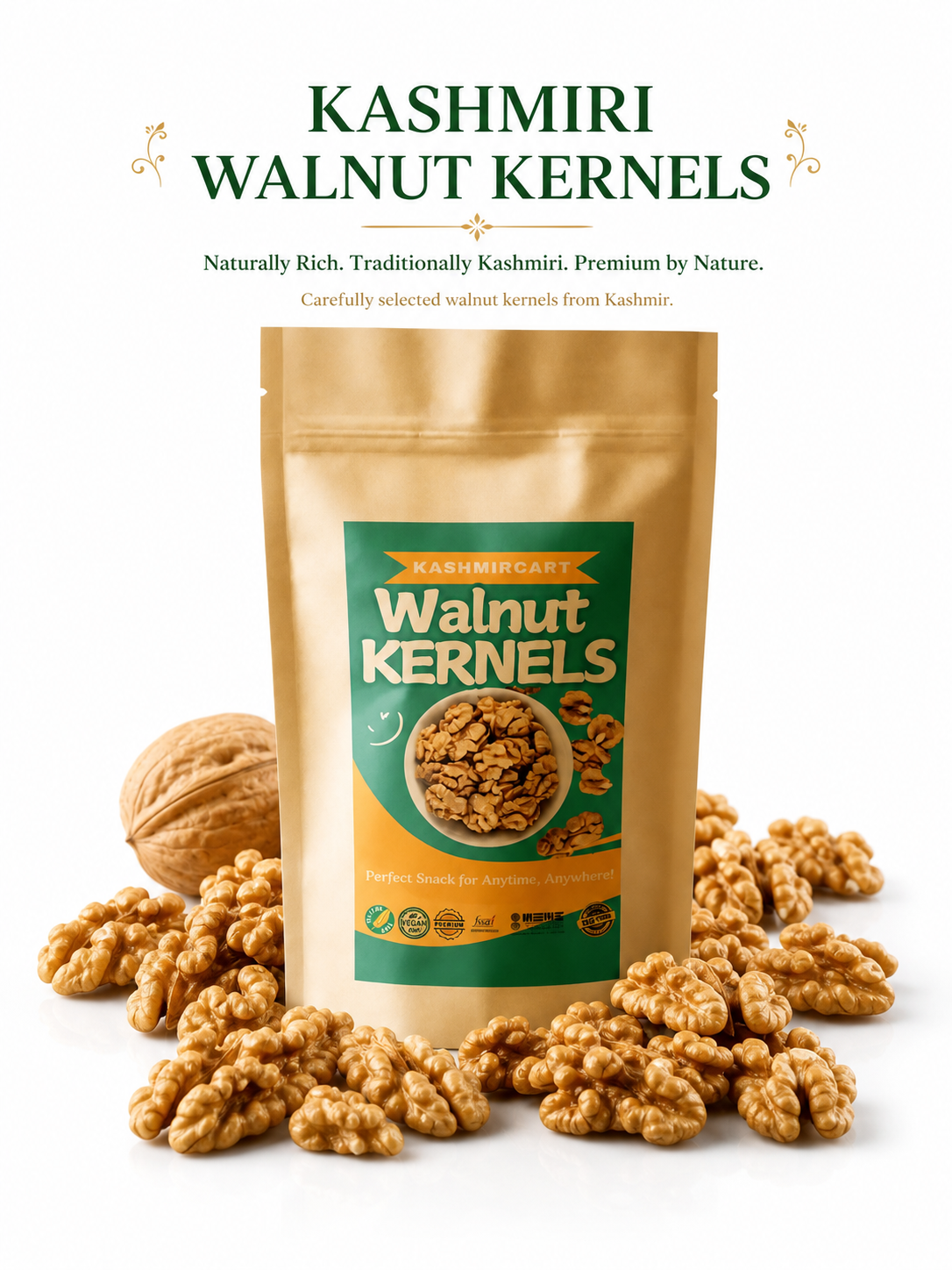
Walnuts are among Kashmir’s best-known orchard products. They are sold whole in shell or as kernels. Whole walnuts offer the protection of the shell until cracking; kernels are convenient for immediate use but need careful packaging because their exposed oils can pick up odours and become stale if stored poorly.
When buying kernels, look for a clean, characteristic nut aroma, a dry texture and packaging that protects them from heat, moisture and strong smells. Colour varies naturally by variety and kernel section, so colour alone cannot prove freshness or grade. Avoid kernels that smell paint-like, rancid, musty or sour.
Explore the KASHMIRCART Kashmiri nuts and dry fruits collection and read our complete walnut-kernel guide before choosing.
2. Almonds and Mamra almonds
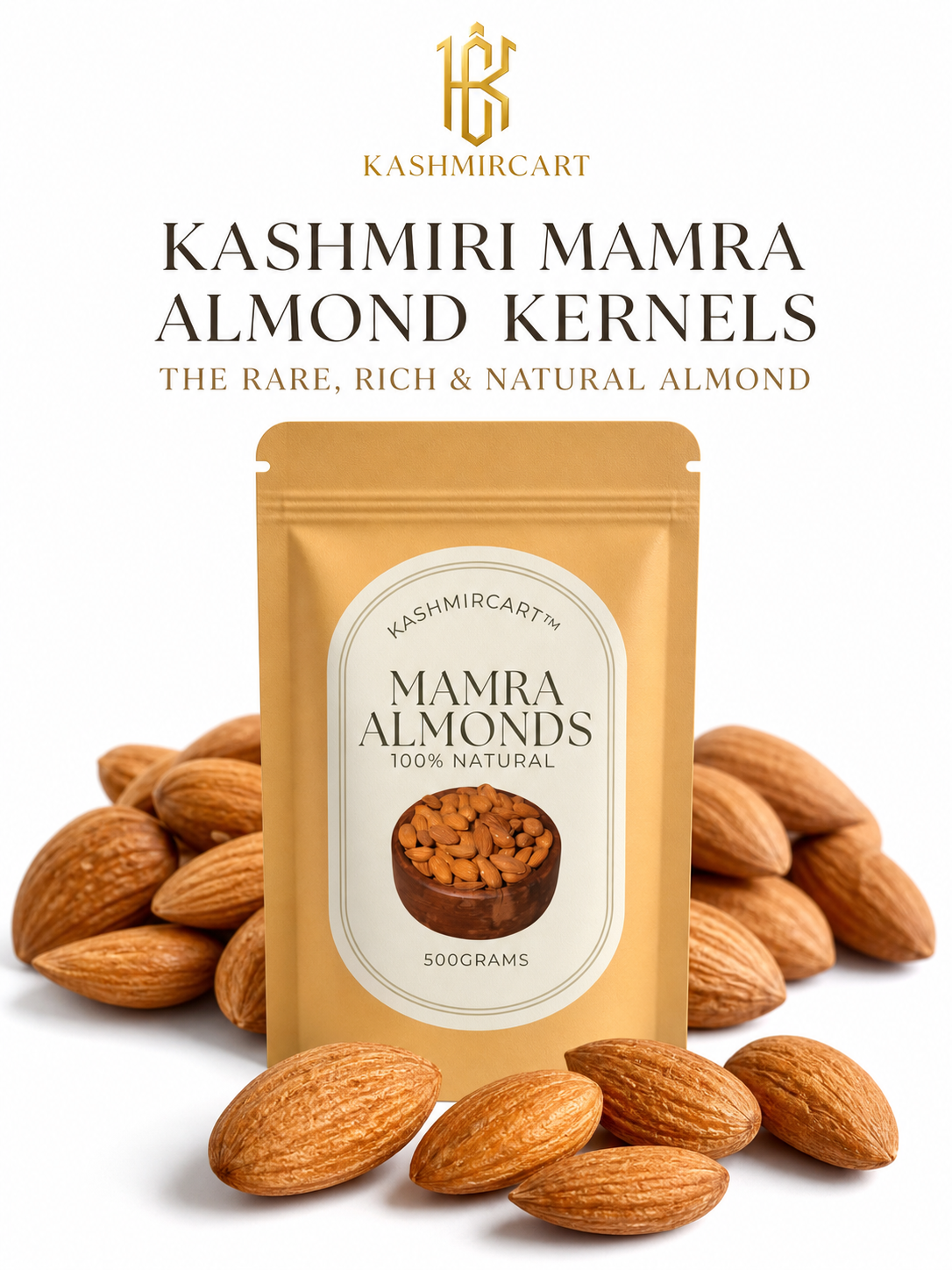
Almonds are used as snacks, in breakfast bowls, desserts and traditional preparations. Mamra is a variety name used in the almond trade; it should not be treated as an automatic guarantee of a particular farm origin, nutritional superiority or grade. Check the seller’s exact variety and origin declaration.
Compare whole kernels for uniformity, dryness, clean smell and intact packaging. If you are comparing Mamra with other almonds, compare like-for-like pack weights, stated origin, grade, harvest or packing information where available, and price per 100 g—not just the headline price.
See our Mamra almond origin and buying guide and the Mamra almond kernels page.
3. Pecans and other speciality nuts
Pecans have a naturally rich, buttery flavour and work well in desserts, salads and snack mixes. They are not a traditional Kashmiri orchard nut in the same way as walnuts. If a product is sold by a Kashmir-based retailer, that does not by itself establish that the pecans were cultivated in Kashmir. Read the product origin carefully.
For speciality nuts, check whether the pack contains whole kernels or pieces, the grade description, the net weight and the storage instructions. Our pecan buying guide explains what to compare.
4. Raisins, apricots and other dried fruits
Dried fruit can be a convenient ingredient for porridge, desserts, trail mixes and cooking. Look at the ingredient list: ideally it should clearly state the fruit and disclose added sugar, oil, preservatives or other ingredients where used. A glossy appearance is not proof of superior quality. Texture and colour vary by fruit, variety and drying method.
5. Gucchi and other speciality Kashmiri foods
Gucchi (morel mushrooms) are a speciality ingredient that requires careful cleaning and thorough cooking. Buy from a traceable seller, follow the pack’s soaking and cooking directions, and never eat wild mushrooms based only on an informal identification. Read our Kashmiri Gucchi guide for more detail.
How to judge quality when buying dry fruits online
- Read the exact product name and variety; broad labels such as “premium” are not a substitute for product details.
- Check the declared country or region of origin. A Kashmir-based seller and a Kashmir-grown product are not interchangeable claims.
- Compare net weight and unit price. Calculate the price per 100 g or per kilogram.
- Review the ingredient list, food-business details, batch or lot information and best-before date where applicable.
- Check whether the package is sealed and suitable for protecting the food from moisture, heat and contamination.
- Look for clear customer-support, shipping, return and contact information before paying.
Storage after delivery
Transfer nuts and kernels to clean, dry, airtight containers if the original pack is not resealable. Keep them away from direct sunlight, heat, moisture and strong-smelling foods. Refrigeration or freezing can help extend quality for some nuts, provided they are sealed well and protected from condensation. Bring only the quantity needed to room temperature while still sealed, then open it to reduce moisture forming on cold food.
Frequently asked questions
Which dry fruits are most associated with Kashmir?
Kashmir is especially associated with walnuts and almonds, alongside a range of locally sourced and regionally traded foods. Confirm the origin on each product rather than assuming every item is Kashmir-grown.
Are all dry fruits sold by a Kashmiri store grown in Kashmir?
No. A retailer may sell both locally grown and sourced products. Check the individual product’s declared origin.
How can I tell if walnut kernels are stale?
A rancid, paint-like, sour or musty smell is a warning sign. Do not rely on colour alone; check aroma, texture, packaging and storage history.
What is the safest way to store dry fruits?
Keep them dry, sealed, cool and away from sunlight and strong odours. Follow the product label and use clean containers.
Why shop with KASHMIRCART?
KASHMIRCART is a family-run Kashmir-based agricultural and e-commerce business with family farming roots dating to 1977, company incorporation in 2013 and an online presence since 2016. We focus on presenting Kashmiri products with clearer product information and a connection to their regional context. For each item, review the individual listing for current availability, pack size, origin and product details.
Browse KASHMIRCART’s online shop, learn about our farms and farming, or read our sourcing philosophy.
Editorial note: This article is general food-buying information. Nutrition and allergen needs differ by person. Nuts are common allergens; check labels and avoid products that may contain an allergen you need to avoid.



Add comment